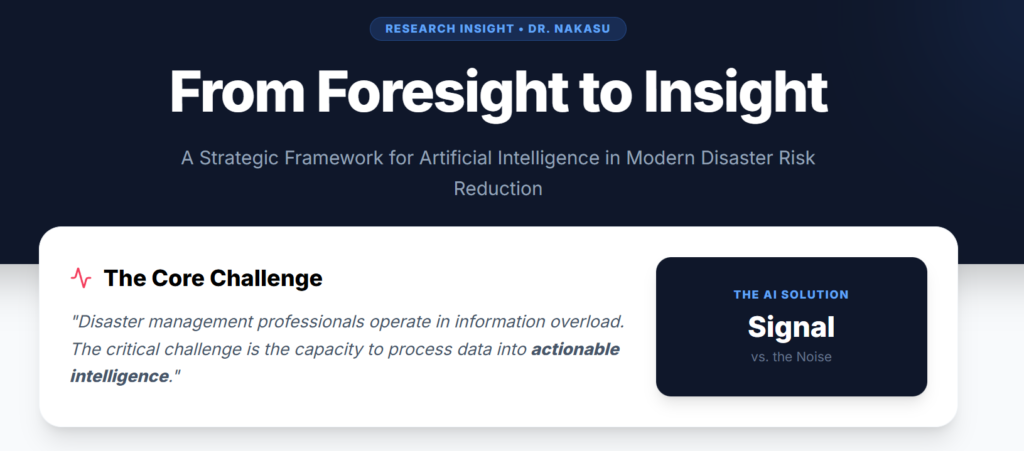
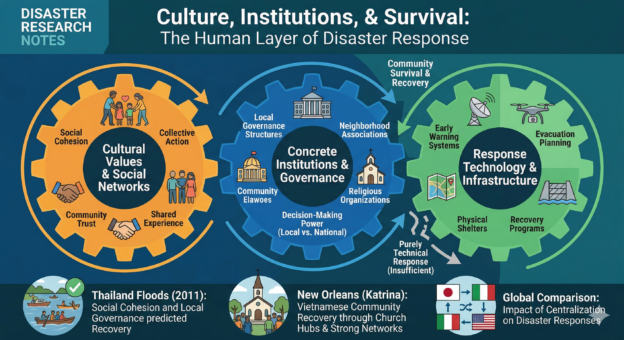
The infographic of the AI-Integrated Disaster Preparedness Platforms is shown as an infographic: AI-Integrated Disaster Preparedness Platforms

The infographic of the AI-Integrated Disaster Preparedness Platforms is shown as an infographic: AI-Integrated Disaster Preparedness Platforms

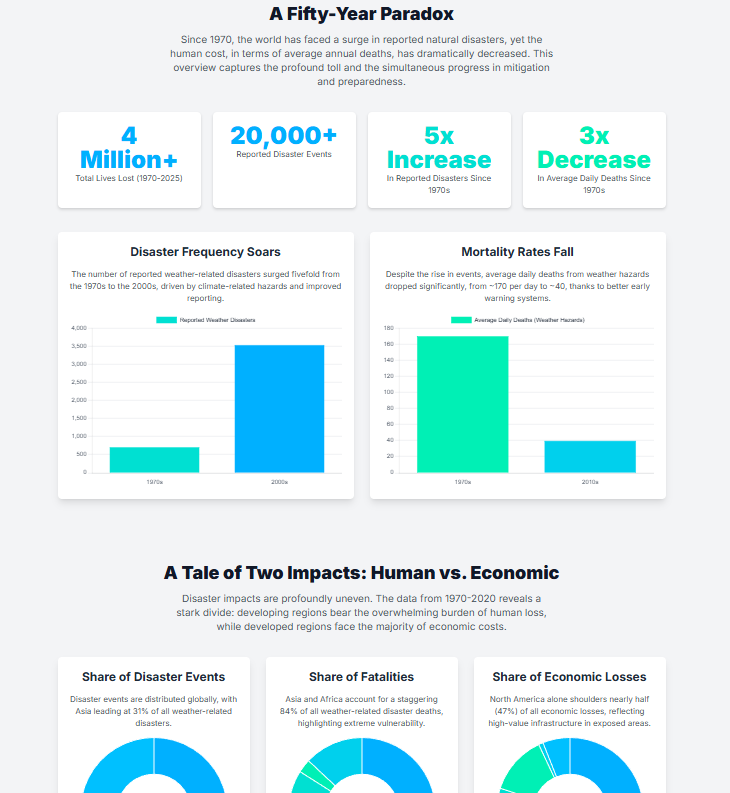
The infographic of the global trends of disasters (1970-2025) is shown as an infographic: https://disasters.weblike.jp/global%20trends.html
From Tragedy to Leadership: The Birth of ADRC
The Asian Disaster Reduction Center (ADRC) was established in 1998 following the devastating Great Hanshin-Awaji Earthquake (commonly known as the Kobe Earthquake) that struck Japan in 1995. This catastrophic event became a catalyst for change, transforming how Japan—and later Asia—approached disaster management and resilience.
Kobe’s Remarkable Recovery Journey
Kobe’s recovery story stands as a powerful testament to resilience and strategic rebuilding. Within just 9 years after the earthquake, Kobe’s population returned to pre-disaster levels—an extraordinary achievement considering the scale of destruction. This recovery wasn’t merely about rebuilding structures but reimagining the city’s future role.
HAT Kobe: A Hub for Disaster Reduction Excellence
Today, Kobe has reinvented itself as a global center for disaster reduction policies and activities. The area known as HAT Kobe hosts numerous disaster-related organizations, including ADRC. The name “HAT” carries dual significance:
This wordplay perfectly captures Kobe’s transformation from a disaster-struck city to a knowledge hub that helps others prepare for and respond to unexpected disasters.
Learning From Kobe: A Model for Disaster Recovery
Kobe’s recovery process offers valuable lessons for communities worldwide facing similar challenges. The city demonstrates how effective post-disaster planning can transform tragedy into opportunity, creating not just infrastructure but institutional knowledge that benefits others.
ADRC’s Mission Across Asia
ADRC plays a vital role in sharing disaster reduction expertise with its member countries throughout Asia. The organization:
Resources for Disaster Management Professionals
ADRC maintains comprehensive resources that disaster management professionals can access:
These resources provide valuable insights into regional disaster management systems, country-specific approaches, and up-to-date information on current disaster situations across Asia.
Building Regional Resilience Together
Through organizations like ADRC and the example set by Kobe, Asian countries are developing stronger collaborative approaches to disaster risk reduction. By learning from past experiences and sharing knowledge, communities across the region are better prepared to face future challenges with resilience and determination.
As highlighted in the Bangkok Post article, “More must be done to fight climate change“, Thailand faces significant challenges from various natural disasters. This analysis presents a national risk assessment mapping to help identify priority areas for disaster management.
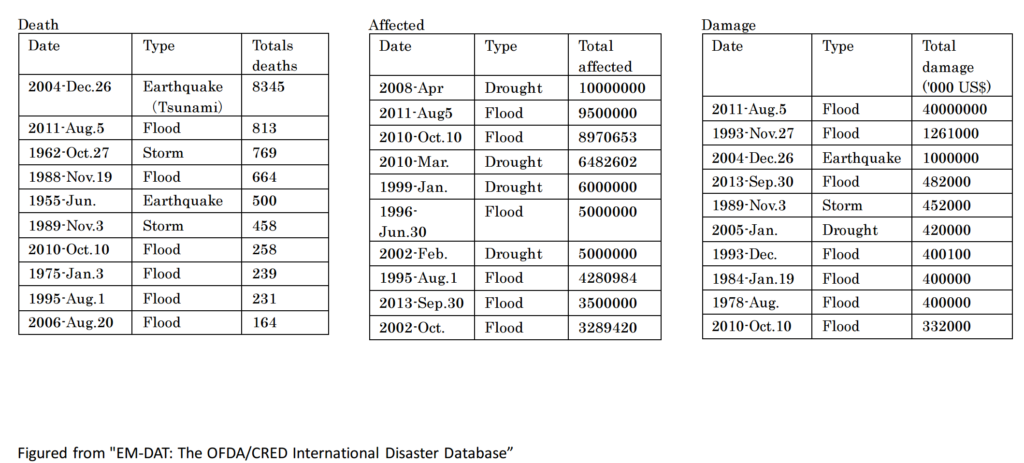
Table 1 Disaster data in Thailand

The EM-DAT database analysis covers disasters from 1900 to 2014. Notably, the most severe impacts—measuring deaths, affected populations, and economic damage—have occurred primarily since the 1970s. Two catastrophic events stand out in Thailand’s disaster history:
These events have dramatically shaped Thailand’s approach to disaster risk management.

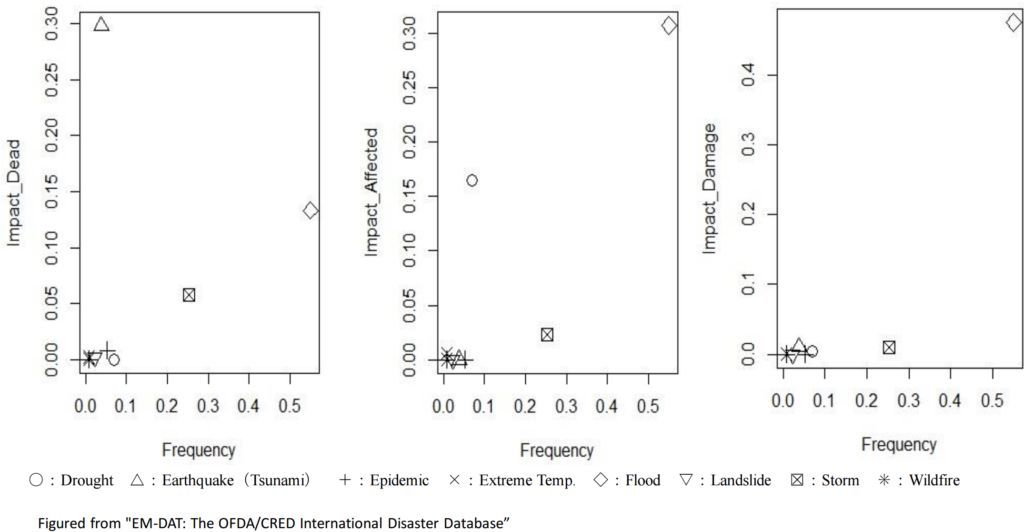
Figure 1 National Risk Assessment Mapping in Thailand
The above visualization presents Thailand’s risk assessment map created using EM-DAT data spanning 1900-2014. This frequency-impact analysis by damage type offers a straightforward yet comprehensive overview of Thailand’s disaster risk landscape.
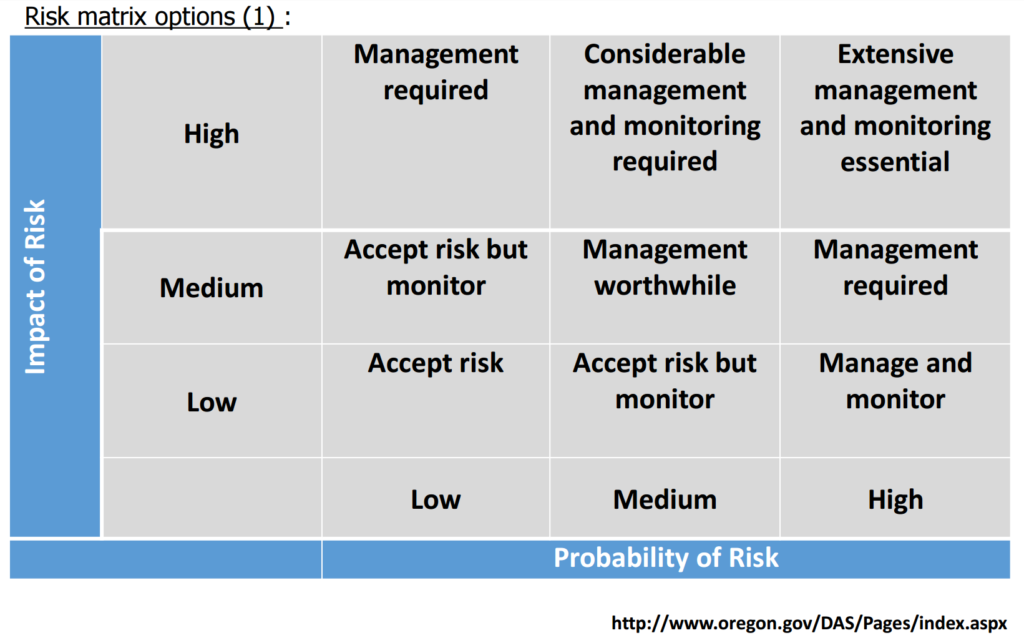
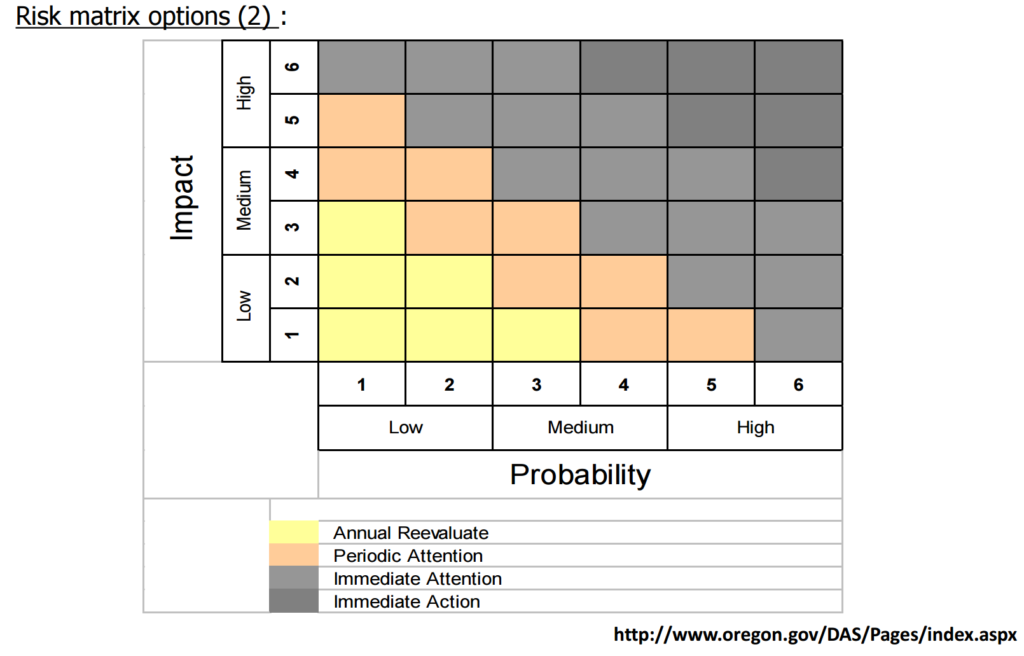
To properly contextualize these risks, we employ two complementary evaluation matrices:

Figure 2 Risk matrix options (1)

Figure 3 Risk matrix options (2)
The risk assessment mapping (Figure 1) clearly identifies flooding as Thailand’s most critical disaster risk requiring immediate attention and resources. According to the evaluation matrices shown in Figures 2 and 3, flood events necessitate:
This preliminary analysis serves as a foundation for more detailed research. A report for the conference (Conference: 13th International Conference on Thai Studies) has published a more comprehensive examination of these findings.
Additional Resources
For more information on disaster risk reduction in Southeast Asia, visit the natural hazards research journal (open access) .
1991 Unzen Fugendake Volcano Eruption Killed 43 people. This disaster has taught a lot of lessons. The key words are media, volunteer firefighters, police officers, and an evacuation area. The people were all dead in the evacuation area. During the volcano eruption, media people tried to get into the area to shoot pictures, videos, and report. They went into the local people’s houses. The residents were worried about their belongings in their houses. So many volunteer firefighters (12) also went into the area to check, and police officer (2) also did that. The taxi drivers (4) bring them into the area. They all died in the area. Katia Krafft and Maurice Krafft, world’s famous French volcanologists were also dead during the disaster.
Wikipedia (Katia and Maurice Krafft)
https://en.wikipedia.org/wiki/Katia_and_Maurice_Krafft
Wikipedia (Unzen Fugendake Pyroclastic flow, Japanese)
https://ja.wikipedia.org/wiki/%E9%9B%B2%E4%BB%99%E5%B2%B3#1991.E5.B9.B46.E6.9C.883.E6.97.A5.E3.81.AE.E7.81.AB.E7.A0.95.E6.B5.81
North America
Mount St.Helens erupted in 1980. Fifty-seven people were dead.
St. Helen’s volcanic eruption was massive. You can see this from the following video.
From environmental and sociological perspectives, the difference between the U.S. and Japan is the people’s and nature’s relationships. This case indicated that somehow. The people are living far from nature, on Mt.Helens. That is why the fatality rate was not so high compared to the enormous eruption. In Japan, people tend to live near and with nature. This is called “Satoyama” in Japanese. Other Asian countries are the same as Japan.
This will be discussed later.
Caribbean
Mount Pelee
St.Pierre City was eradicated in 1902 by Mt. Plee’s eruption.
The population of the city was approx. 28000; almost all were dead, only two survived. One of the only two survivors was in prison. The story can be seen in the following video.
North America
In 1900, Galveston’s death toll was over 6,000
2005 Katrina, the death toll was over 1400, and the cost was $100 billion. UDS
In 1998, Mitch reported that 13,700 people were victimized in Honduras and 3,300 in Nicaragua
Caribbean
Hurricane Jeanne, 2800 were killed in Haiti
Disaster data, such as the death toll, is sourced from the NIED DIL homepage.
ADRC is established in 1998 after the Kobe Earthquake. Kobe city’s population had caught up the same level before the disaster in 9 years. Kobe reinvents itself as a center of disaster reduction policies and activities in the world. There are so many disaster-related organizations in HAT Kobe. The HAT means “Happy and Active” and also “surprised” in Japanese. This is a good example to refer to for the disaster recovery process. We can learn the lessons from Kobe. ADRC contributes to disaster reduction policies and activities for member countries in Asia. We can check member countries disaster management systems, country reports, and others. We can also confirm the updated disasters on the ADRC’s website.
*ADRC member countries information site.
http://www.adrc.asia/disaster/index.php
** Disaster Information
http://www.adrc.asia/latest/index.php
Overviews
The overviews of Natural Disasters in China are the followings:
1) Death numbers

Source: EM-DAT
2) Affected numbers

Source: EM-DAT
3) Damage costs

Source: EM-DAT
Natural disasters in China are very large scales, reflecting country’s population and geographical size. Also, we need to know that China has a rapidly growing economy. We can confirm the normal historical trends of natural disasters, from human sufferings to economic damages, which this note already mentioned (Day 77). For instance, the top 10 deadliest natural disasters in China are all before 1970s. On the contrary, the top 10 costliest natural disasters in China all occurred after 1990s.
Two Earthquakes
Yang Zhang William Drake et al. (2016)* indicate interesting views on two earthquake disaster recoveries: the 1976 Tangshan earthquake and the 2008 Wenchuan earthquake. The point is why the 2008 Wenchuan earthquake recovery was so rapid compared to the 1976 earthquake.
However, the paper could add the total background changes in China, such as the economy and politics. China has changed dramatically since 1976, from historical viewpoints.
A comparison of the two earthquakes will be explained.
Yang Zhang William Drake et al. (2016), Disaster Recovery Planning after Two Catastrophes: The 1976 Tangshan Earthquake and the 2008 Wenchuan Earthquake, International Journal of Mass Emergencies and Disasters, 34(2):174–200.
On the early morning of May 23, 1960, a massive earthquake, the largest ever recorded with a magnitude of 9.5, struck southern Chile. This earthquake unleashed a tsunami that swiftly crossed the Pacific Ocean, reaching the Japanese coast about 22.5 hours later. The tsunami, which surged up to 8 meters high, resulted in 139 deaths and caused the destruction or displacement of 2,830 buildings across Japan. Due to the geographical position of Chile opposite Japan, the tsunami’s impact was more pronounced upon reaching the Japanese shores. These distant tsunamis are particularly challenging to forecast since they occur without the preliminary tremors typically associated with earthquakes. Consequently, regions prone to seismic activity, particularly around the Pacific, including Hawaii, have established early warning systems.
Day_168 : Past Interview Records – PTWC (Pacific Tsunami Warning Center) in Hawaii (1)
In 2004, the Indian Ocean was struck by another significant earthquake, which triggered a devastating tsunami. At that time, the absence of a tsunami warning system in the Indian Ocean contributed to a staggering death toll of 300,000. The effectiveness of tsunami warnings is limited by their ability to reach extensive coastal areas promptly. Therefore, it is crucial for residents to be aware of their local environmental characteristics and rely on personal judgment and preparedness to mitigate the risks posed by tsunamis.
I just used 1980–2008 natural disaster data (ADRC 2009) and calculated the numbers of fatalities divided by the number of disasters to know the vulnerabilities. The regions mean Asia, the Americas, Africa, Europe, and Oceania.
The following is the order. Sorry, just order; however, we can learn something from the order.
The number of fatalities
1. Asia
2. Americas
3. Africa
4. Europe
5. Oceania
The number of fatalities divided by the numbers of disasters
1. Asia
2. Africa
3. Oceania
3. Americas
4. Europe
The above indicates the vulnerabilities of regions. For example, people in Africa tend to die easily by natural disasters; on the contrary, people in America tend not.
You cannot copy content of this page