Balancing Continuity and Survival: Lessons for Overseas Manufacturers from Thailand’s 2001 Flood


The infographic of the 1985 Mexico City Earthquake, mainly focusing on the social factors with earthquake characteristics, is shown as an infographic: http://disasters.weblike.jp/mexico%20infogr.html
The distance impact reminded me of the situation in Bangkok when an earthquake occurred in Myanmar in April 2025.
Step-by-Step Guide for Excel Regression Analysis
1. Prepare Your Dataset in Excel
Dataset Overview:
Create an Excel file (e.g., DisasterData.xlsx) with the following columns and sample data:

Objective:
Use the earthquake magnitude (independent variable) to predict economic loss (dependent variable: MN USD) through simple linear regression.
2. Enable the Analysis ToolPak
Excel’s Data Analysis ToolPak is required for regression analysis. If it’s not already enabled:
3. Visualize the Data
Before running the regression, it’s helpful to visualize the relationship:
This chart helps you see if there’s a linear trend between the two variables.
4. Conduct the Regression Analysis

5. Interpret the Regression Output
Excel will generate a regression output that includes several key pieces of information:

6. Use the Regression Model for Predictions
Once you have the coefficient and intercept from the output, you can create a prediction formula:
Y=(slope)X+(intercept) Y:Economic_Loss X:Earthquake_Magnitude
<Interpretation for beginners>
Multiple R (Correlation Coefficient):
R Square (Coefficient of Determination):
Adjusted R Square:
Standard Error:
Observations:
The ANOVA table helps you see how much of the total variation in Economic_Loss is explained by the regression (model) versus how much is left unexplained (residual).
df (Degrees of Freedom):
SS (Sum of Squares):
MS (Mean Square):
F and Significance F (p-value for the overall model):
This table provides information about the intercept and the slope of your regression line.
Intercept (Coefficient):
Earthquake_Magnitude (Coefficient):
Regression Equation:
Predicted Economic Loss=−152.261+(28.6965×Earthquake Magnitude)
In summary, these regression results show a strong linear relationship between Earthquake_Magnitude and Economic_Loss. The model explains about 93% of the variation in economic losses, and both the intercept and the slope are statistically significant. However, as with any statistical model, interpret the results with caution and consider real-world factors that may affect the outcome beyond just magnitude.
From Tragedy to Leadership: The Birth of ADRC
The Asian Disaster Reduction Center (ADRC) was established in 1998 following the devastating Great Hanshin-Awaji Earthquake (commonly known as the Kobe Earthquake) that struck Japan in 1995. This catastrophic event became a catalyst for change, transforming how Japan—and later Asia—approached disaster management and resilience.
Kobe’s Remarkable Recovery Journey
Kobe’s recovery story stands as a powerful testament to resilience and strategic rebuilding. Within just 9 years after the earthquake, Kobe’s population returned to pre-disaster levels—an extraordinary achievement considering the scale of destruction. This recovery wasn’t merely about rebuilding structures but reimagining the city’s future role.
HAT Kobe: A Hub for Disaster Reduction Excellence
Today, Kobe has reinvented itself as a global center for disaster reduction policies and activities. The area known as HAT Kobe hosts numerous disaster-related organizations, including ADRC. The name “HAT” carries dual significance:
This wordplay perfectly captures Kobe’s transformation from a disaster-struck city to a knowledge hub that helps others prepare for and respond to unexpected disasters.
Learning From Kobe: A Model for Disaster Recovery
Kobe’s recovery process offers valuable lessons for communities worldwide facing similar challenges. The city demonstrates how effective post-disaster planning can transform tragedy into opportunity, creating not just infrastructure but institutional knowledge that benefits others.
ADRC’s Mission Across Asia
ADRC plays a vital role in sharing disaster reduction expertise with its member countries throughout Asia. The organization:
Resources for Disaster Management Professionals
ADRC maintains comprehensive resources that disaster management professionals can access:
These resources provide valuable insights into regional disaster management systems, country-specific approaches, and up-to-date information on current disaster situations across Asia.
Building Regional Resilience Together
Through organizations like ADRC and the example set by Kobe, Asian countries are developing stronger collaborative approaches to disaster risk reduction. By learning from past experiences and sharing knowledge, communities across the region are better prepared to face future challenges with resilience and determination.

The following is a reprint of a column I once wrote:
The Matsushiro Earthquake Center, nestled in the historic town of Matsushiro within Nagano Prefecture, represents a pivotal chapter in Japan’s approach to seismic research and disaster mitigation. Established in February 1967 under the auspices of the Japan Meteorological Agency’s Seismological Observatory, this institution was born out of a critical period marked by intense seismic activity. Between August 3, 1965, and April 17, 1966, the region experienced a staggering 6,780 seismic events, ranging from imperceptible tremors to significant quakes measuring intensity 5 and 4 on the Japanese scale. This unprecedented series of earthquakes not only posed a major societal challenge but also catalyzed the center’s founding.
The initiative to establish the center was strongly influenced by the then-mayor of Matsushiro, Nakamura, who famously prioritized the pursuit of knowledge and research over material wealth. This sentiment laid the groundwork for what would become a crucial site for earthquake prediction and disaster preparedness efforts, situated on the historical grounds of the Imperial Headquarters.
Drawing from my experience at the Natural Disaster Information Office and in collaboration with the Precise Earthquake Observation Office of the Japan Meteorological Agency (now known as the Matsushiro Earthquake Observatory), I have had the unique opportunity to organize and delve into discussions from that era. Despite being born after the seismic events in Matsushiro, I find the archival records fascinating. They not only recount the collective efforts of Matsushiro’s residents to forge a disaster-resilient community in the aftermath of the earthquake but also highlight the comprehensive nature of the research conducted.
The inquiries extended beyond seismic analysis, encompassing a holistic examination of the earthquake’s impact on the community. Noteworthy is the health survey conducted on students from a local school, in collaboration with the Matsushiro Health Center and hospital, to assess the psychological and physical effects of the seismic swarms. Moreover, the scope of investigation included studies on earthquake-induced landslides and the repercussions on water infrastructure, showcasing the multifaceted response from various experts and frontline workers of the time.
This rich tapestry of collective memory and scientific inquiry underscores the enduring spirit of Matsushiro—a community united in its commitment to disaster resilience, informed by the lessons of its past.
Ref.
http://researchmap.jp/read0139271/%E7%A0%94%E7%A9%B6%E3%83%96%E3%83%AD%E3%82%B0/
ADRC is established in 1998 after the Kobe Earthquake. Kobe city’s population had caught up the same level before the disaster in 9 years. Kobe reinvents itself as a center of disaster reduction policies and activities in the world. There are so many disaster-related organizations in HAT Kobe. The HAT means “Happy and Active” and also “surprised” in Japanese. This is a good example to refer to for the disaster recovery process. We can learn the lessons from Kobe. ADRC contributes to disaster reduction policies and activities for member countries in Asia. We can check member countries disaster management systems, country reports, and others. We can also confirm the updated disasters on the ADRC’s website.
*ADRC member countries information site.
http://www.adrc.asia/disaster/index.php
** Disaster Information
http://www.adrc.asia/latest/index.php
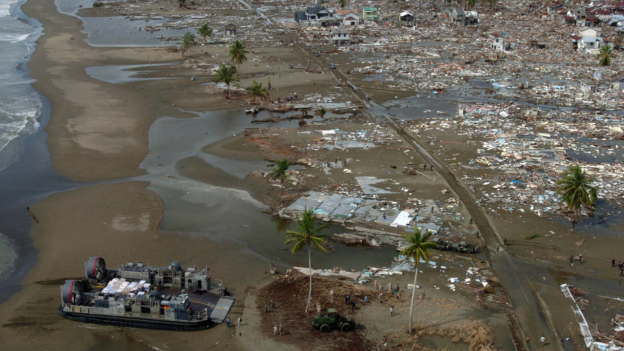
80% ofall tsunamis occurring in the world are concentrated in the Circum-Pacific Belt.The leading countries researching the tsunami are Japan, the U.S., and Russia. The tsunami is originally a Japanese term that means a high tidal wave. The name was used by Japanese immigrants during a tidal wave caused by the 1946 Aleutian Islands earthquake (tsunami) hit in Hiro, Hawaii and it became an international word, especially an academic word, ”Tsunami”. The International Union of Geodesy and Geophysics (IUGG) is in charge of a tsunami session at the start of an international conference about tsunamis. “Tsunami” became public after the 2004 Indian Ocean Tsunami disaster.
*The word “tsunami” is composed of the Japanese words “Tsu” (which means harbor) and “Nami” (which means “wave”)(ITIC)
The 1946 Aleutian Islands earthquake
Hiro, 1964

When an earthquake strikes, fires start simultaneously in many places. The combination of dispersed firefighters’ ability to extinguish fires, broken buildings and unusable roads, broken water supplies and water shortages, and congested roads with many cars makes it very difficult to extinguish fires. For these reasons, large-town fires are more likely to occur during earthquakes. This is especially true in wet areas like Japan, where buildings are mainly made of wood and fires can spread over them as they break down, causing more damage. In dry areas, many houses are made of brick or stone, which are often completely destroyed by earthquakes.
During the Great Kanto Earthquake of 1923, 320,000 houses, or about 62% of the houses in Tokyo, were burned down. There were 136 fires, 76 of which spread widely, burning as much as 44% of the city in three days. Almost all (95%) of the deaths were caused by fire. Almost the same proportion (63%) of houses burned down in Yokohama. History shows that every time there has been a major earthquake, there has also been a major fire. The basic measure against fires caused by earthquakes is to make the house earthquake-proof and prevent it from collapsing.
source:
https://dil.bosai.go.jp/workshop/2006workshop/gakusyukai11.html
Overviews
The overviews of Natural Disasters in China are the followings:
1) Death numbers
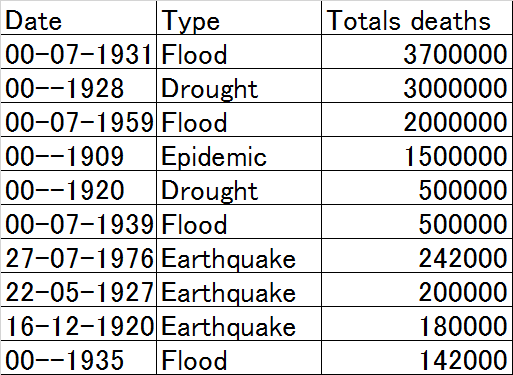
Source: EM-DAT
2) Affected numbers

Source: EM-DAT
3) Damage costs
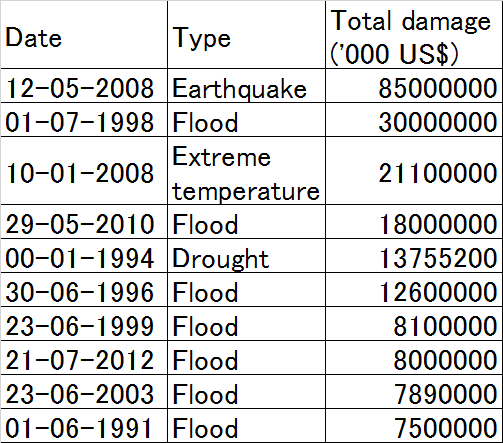
Source: EM-DAT
Natural disasters in China are very large scales, reflecting country’s population and geographical size. Also, we need to know that China has a rapidly growing economy. We can confirm the normal historical trends of natural disasters, from human sufferings to economic damages, which this note already mentioned (Day 77). For instance, the top 10 deadliest natural disasters in China are all before 1970s. On the contrary, the top 10 costliest natural disasters in China all occurred after 1990s.
Two Earthquakes
Yang Zhang William Drake et al. (2016)* indicate interesting views on two earthquake disaster recoveries: the 1976 Tangshan earthquake and the 2008 Wenchuan earthquake. The point is why the 2008 Wenchuan earthquake recovery was so rapid compared to the 1976 earthquake.
However, the paper could add the total background changes in China, such as the economy and politics. China has changed dramatically since 1976, from historical viewpoints.
A comparison of the two earthquakes will be explained.
Yang Zhang William Drake et al. (2016), Disaster Recovery Planning after Two Catastrophes: The 1976 Tangshan Earthquake and the 2008 Wenchuan Earthquake, International Journal of Mass Emergencies and Disasters, 34(2):174–200.
You cannot copy content of this page