Category Archives: Lessons

Day_116 : World Disaster Chronology-1981

Date Place Disaster Type Situations
1981.01- Philippines (Mindanao) Heavy Rain, Flood 200 (DM)
1981.01.19 Indonesia, East (Irian Jaya) Inland Earthquake M6.8, 1,4002,000 (DM)
1981.01- South Africa Heavy Rain, Flood 200 (DM)
1981 India, North Cold Wave 270 (DM)
1981 China, Central Inland Earthquake M unknown, 100 (DM)
1981 Pakistan Inland Earthquake M unknown, 210 (DM)
1981.04.17 India, East Tornado Over 120 (DM)
1981.05.14 Indonesia, SouthJava Volcano 325 (DM)
1981.06- India Cyclone, Flood 500-3,000 (DM)
1981.06.11 Iran, East Inland Earthquake 1981 Golbaf Earthquake*, M6.73,000 (DM)Kerman Province
1981.07.01 Philippines Mudslide 120(DM)
1981.07.12 Sichuan Province** Heavy Rain, Flood (unknown), 1,600 (DM)
1981.07- India/Nepal Heavy Rain, Flood Over 100 (DM)
1981.07.28 Iran, East Inland Earthquake 1981 Sirch earthquake* M7.2, Kerman Province, 1,500-8,000(DM)
1981.08- China, North Heavy Rain, Flood Over 800 (DM), Yellow river
1981.08- Colombia Heavy Rain, Flood 150 (DM)
1981.08- Japan Typhoon, Flood 43 (DM),Injured 170, Destroyed approx.4,400, Inundation over31,000
1981.09- Nepal Heavy Rain, Flood Over 500 (DM)
1981.10.09 Philippines Mindanao Landslide Over 200 (DM)
1981.10- Sichuan Landslide 240 (DM)
1981.11- Philippines Typhoon, Flood 270 (DM)
1981.12- India, North Cold Wave Over 130 (DM)

D : The number of death     DM : Dead and missing number

* Kerman province in Iran has two huge earthquake disasters in this year, the 1981 Golbaf earthquake and the 1981 Sirch earthquake. The 2003 Bam earthquake also hit this province and the Bam earthquake disaster was the worst  earthquake disaster which caused over 26000 casualties in Iran.

** Sichuan Province in China also experienced the 2008 Situan earthquake disaster which made approx.69000 fatalities.

Day_108 : World Disaster Chronology-1978

The chronology will be improved little by little. This is the first draft version. The information source will be shown later. In addition, other some events will be explained.

Date Place Disaster Type Situations
1978.01- US, East Cold wave The dead and missing number is 160
1978.02- US Disease Influenza, the dead number is over 6,000
1978.04.16 India Tornado The dead and missing number is over 600
1978.06.12 Japan, Northeast Submarine Earthquake 1978 Miyagi ken Oki earthquake M7.4, The dead number is 28
1978.07- Bangladesh Heavy rain, Flood The dead and missing number is over 120
1978 Pakistan Heavy rain, Flood The dead and missing number is over100
1978.08- India Heavy rain, Flood The dead and missing number is 900-1,300
1978.09- Africa, East Disease The dead number is over 350
1978.09.16 Iran, Central Inland Earthquake 1978 Tabas earthquake*  M7.2-7.8, The dead and missing number is 18,000-25,000
1978.10- India Disease The dead number is over 480
1978.11- Sri Lanka, and others Typhoon, Flood The dead and missing is 1,500

*1978 Tabas Earthquake

The one of the most earthquake vulnerable countries in Asia is Iran. Iran had 16 times earthquakes in the 1800s  and 18 times earthquakes in the 1900s which caused over 1000 deaths. In particular, the one of the main causes of deaths is a building structure, called adobe.

Adobe is a kind of clay used as a building material, typically in the form of sun-dried bricks (Oxford dictionaries).

In dry climates, adobe structures are extremely durable, and account for some of the oldest existing buildings in the world. Adobe buildings offer significant advantages due to their greater thermal mass, but they are known to be particularly susceptible to earthquake damage if they are not somehow reinforced. Adobe are common throughout the world such as Middle East, West Asia, North Africa, West Africa, South America, southwestern North America, Spain, and Eastern Europe (Wikipedia).

“Adobe and earthquakes are a perverse and tragic combination”
“The people on the street are killed by the walls that fall out, the people inside are killed by the roof that falls in”  says Mr Marcia Blondet (A Peruvian engineer). (BBC).

Day_105 : Relocations or Rebuildings (2)


http://disasters.weblike.jp/disasters/archives/2950

After the 1896 Meiji sanriku tsunami, many communities considered relocating to higher grounds, however, a few communities could proceed the relocations. The main reasons why they could not relocate to higher grounds are the followings (Nakasu et al., 2011):

1) It was very inconvenient for them to settle the areas which were far from the sea because they were mainly fishermen or living their daily lives by the sea.

2) Most of them were doing small size fishing related businesses, had not enough budgets to relocate.

3) There were difficulties to attain the agreements to do relocations among the community members.

4) They, community members, had conflicts with land owners to select and purchase the relocation lands.

5) There were technical limitations to create a land for living on the slope because Japan did not have enough technological level at that time.

They mainly relocated to higher grounds by their own decisions. However, some groups gave pressures on the people who had planned to move and tried to let them give up to do so because they would like to maintain the communities to recover.

A small number of the communities moved to higher grounds, however, some went back to their original places. In addition, their relatives or other village people started to live there. Some families positively accepted the immigrants from outsides to maintain their ownerships.

Finally, almost all communities had chosen to rebuild at the same places, so the risks were retained and this combined with the fact that they were re-affected by the 1933 Showa sanriku tsunami disaster.

Concerning after the 1933 Showa sanriku tsunami, this will be explained later.

Day_104 : Lessons from a Japanese Environmental Movement- The Matsumura Research Group (2)

Mishima Numazu Shimizu (MNS) environmental movement in 1963-1964 is the turning point of a Japanese environmental history. The core of the movement is the science-based issues, especially, The Environmental Impact Assessment conducted by the Government Research Group and the Local Research Group.

https://disasterresearchnotes.site/archives/2981

Proposed the Development Plan

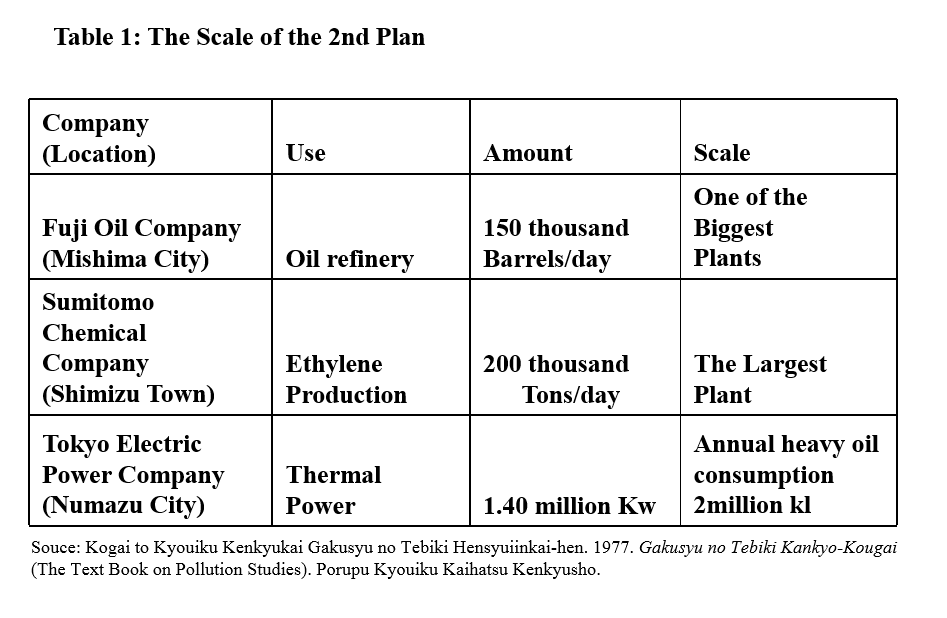
The below Figure 1 and Table 1 indicate the proposed development plan. These are the companies which had planned to come to the area. You can also see the scale of the plan.
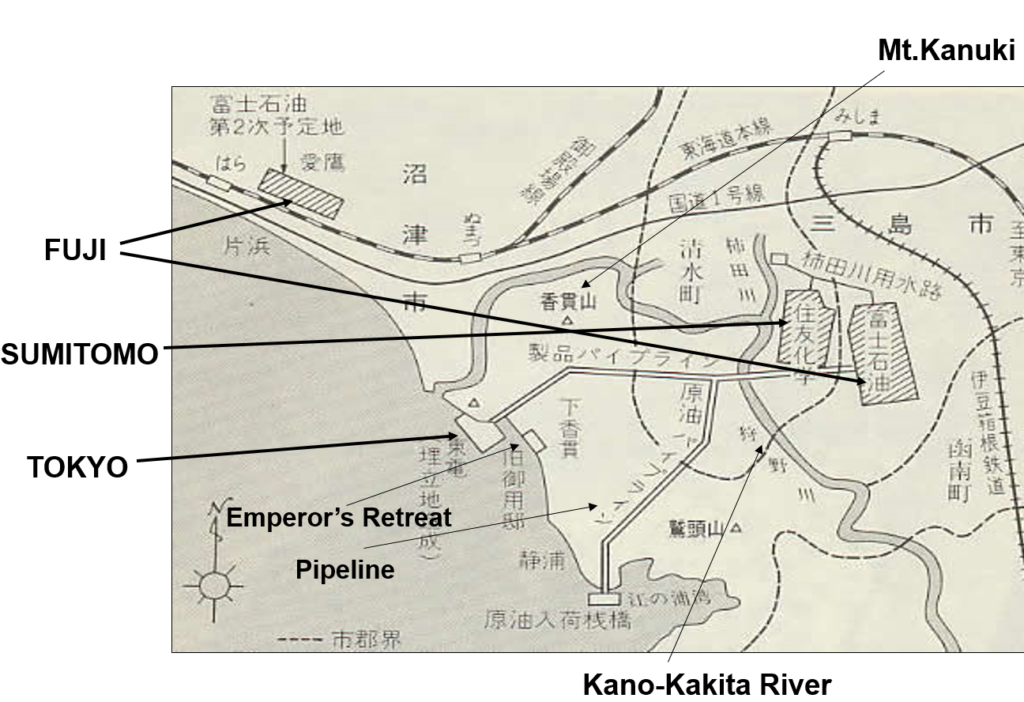
planned project MNS
Figure 1  Proposed an Industrial Complex Plan

Table 1 The Scale of the Plan
The planned MNS

What is the MNS Movement?
The following two factors can be highlighted to explain the MNS movement. The first, the survey carried out by students (KOINOBORI research). The second, a few hundred education programs (mainly for local citizens)

In regard to the student survey, the survey carried out by students of Numazu Technical High School consists of three types by using local materials which were KOINOBORI, empty bottles and thermometers. The KOINOBORI were used in the air current survey that was conducted by about 300 students. The students made some air current maps that showed that the government’s appraisal of wind direction was incorrect. These maps gave decisive data to the Matsumura research group. Empty bottles were used for the water current survey. Thermometers enabled the students to make some maps showing the variation of temperatures.

On the other hand, the results of the survey reported by students of East Numazu High School which were called “Petrochemical Complex Project in Numazu and Mishima Area” was conducted by a Local Research Club. They researched it by using social scientific methods (including the survey in Yokkaichi City). The MNS activists use this report.

With reference to the education programs, many education programs were conducted by Numazu Technical High School teachers. They were held at schools, at the town halls and in the streets. Because of the programs, local citizens (including farmers and fishermen) became eager to learn. Local citizens wanted to know what was going on in their locality.

The Students Participatory Survey

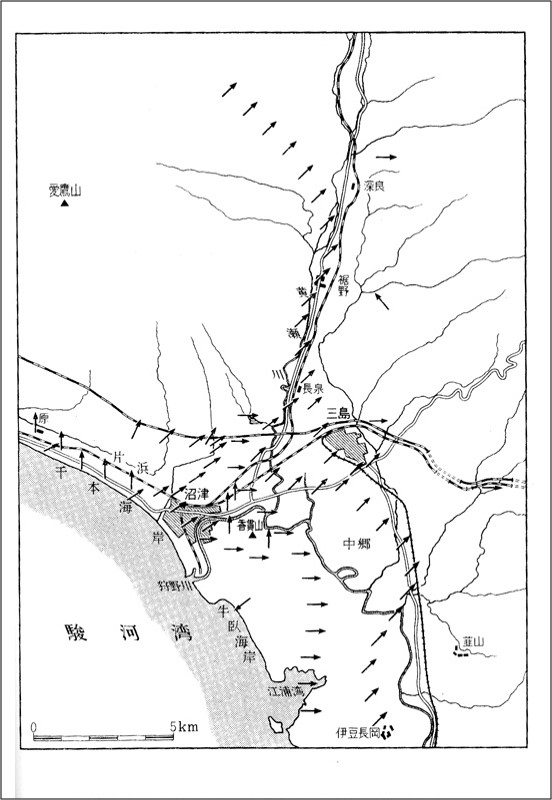
The following Figure 2  shows the wind directions are from the sea to the land. This map was created by the students during the Koinobori time. This means the local people would be influenced by the pollutions from the planned factories. However, the government survey appealed the different ways.
Wind directions student survey
Figure2  Wind directions survey conducted by high school students
(Source :  Mitsuo Taketani, 1967)

The Kurokawa Research Group (Gov. Research group) carried out the first largest ever Environmental Impact Assessment (EIA) by the Japanese government in 1964. The representative was Dr.Masatake Kurokawa and the staff consisted of national academics. The budget was about 20 million yen (about 180,000 USD) at that time. The research was carried out by using helicopters and high-tech machines. The Kurokawa Research Group was nominated by the Minister of International Trade and Industry and the Minister of Public Health.

On the other hand, the Matsumura Research Group carried out the EIA by getting the cooperation of local people, including high school students. The representative was Dr.Seiji Matsumura and the staff consisted of two researchers with international experience and local high school teachers (Table 2). The budget was about 100 thousand yen (about 900 USD) at that time. The research was conducted using readily available materials and low-tech manpower (for example, Koinobori research). It meant that research people, as well as the local people and high school students, used their own ideas. The Matsumura research group was nominated by the Mayor of Mishima city, Mr.Taizo Hasegawa. They use students, local materials, and Japanese culture.

Table 2 Matsumura Research Group

local research group members
* I have life stories about them by interview surveys

The Formation of the Matsumura Research Group

The following is the formation process of the Matsumura Research Group. The National Institute and the Local high school have bonded together. These make ‘Think globally, act locally’.

  1. Education Seminar about Pollution Held by Two High School Teachers and a Professor
  2. Explanation of the Estimated Pollution Levels Given to the NIG (National Institute of Genetics) by Mr.Nagaoka and Mr.Nishioka (Teachers)
  3. Decided by the NIG Members to Refuse the Petrochemical Complex Plan
  4. Advice Given to Mishima City’s Mayor (Hasegawa) from the NIG Members to Establish the Research Committee for EIA
  5. Decision by Hasegawa to Reject the Proposed Petrochemical Complex
  6. Acceptance of Numazu Technical High School and NIG to do EIA in the Area

To be continued.
Day_103 : New Orleans and Hurricane Katrina in 2005

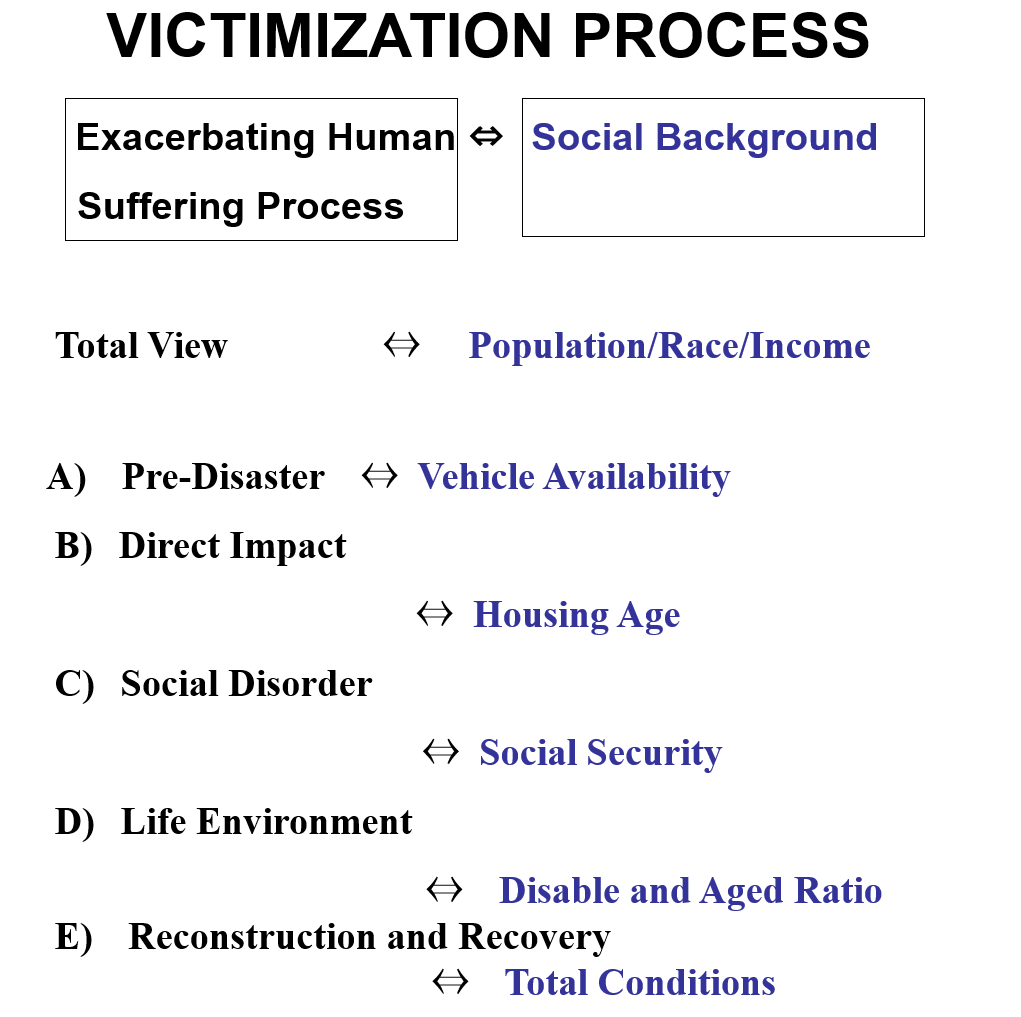
Day_100 indicated a human suffering exacerbation process in New Orleans during the 2005 Hurricane Katrina.

http://disasters.weblike.jp/disasters/archives/2975

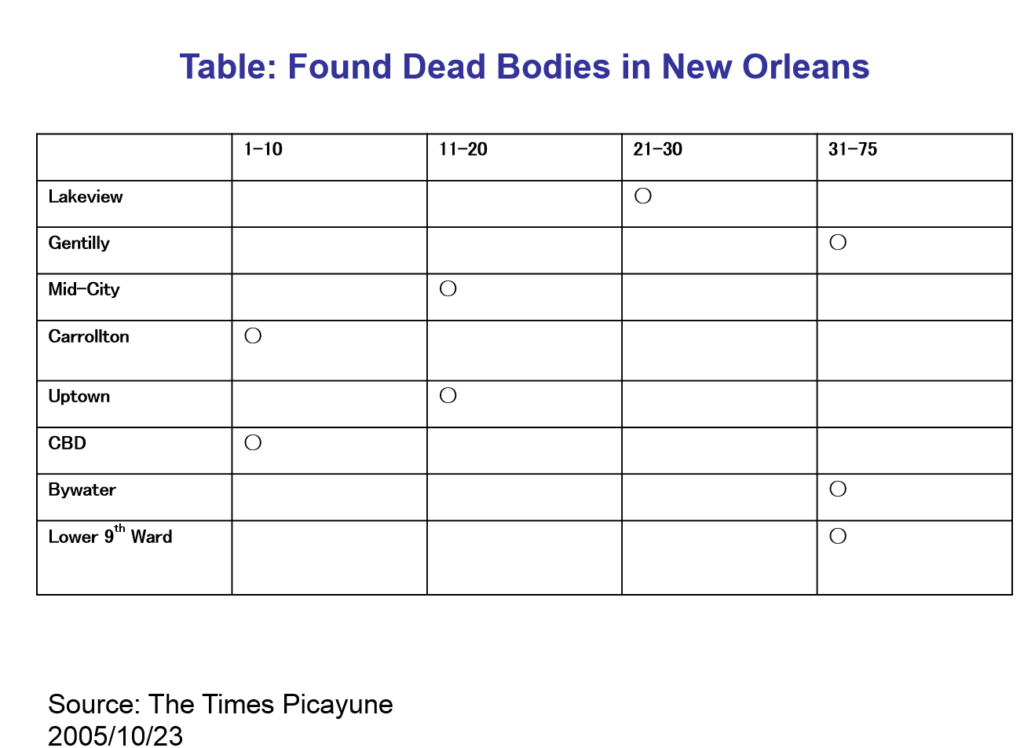
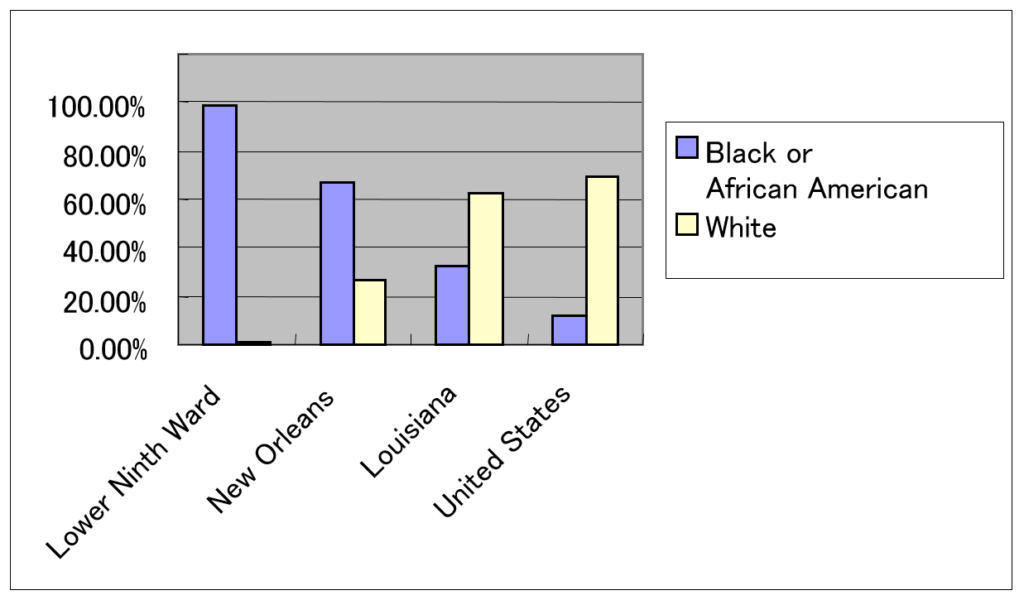
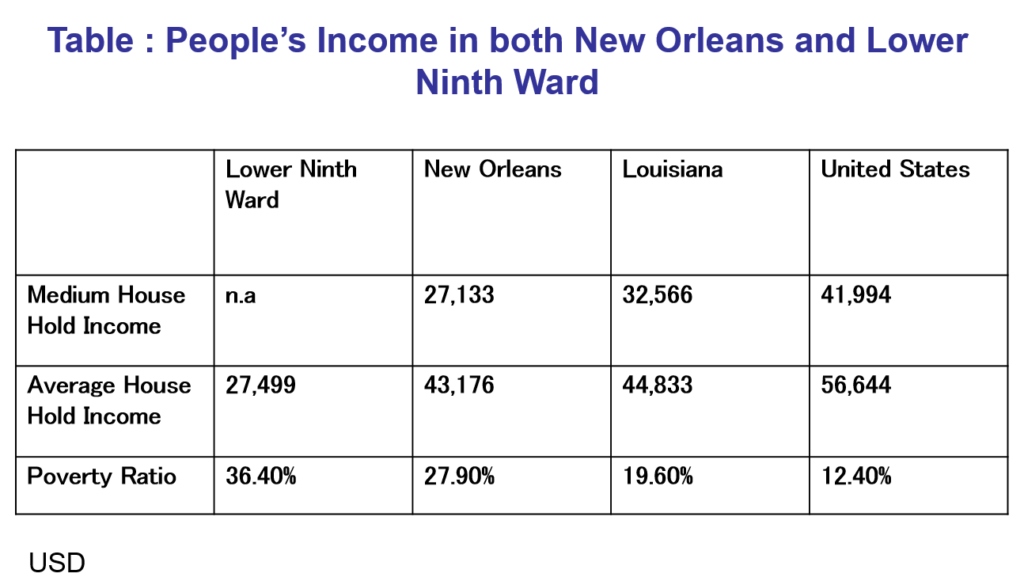
The Figure 1 again shows the relationships between the human suffering exacerbation process and social backgrounds with data. Table 1 also indicates the estimated death numbers in some wards.

exacerbation2
Figure 1 Human Suffering Exacerbation Process and Social Background

Table 1 Found Dead Bodies in New Orleans

dead in neworleans

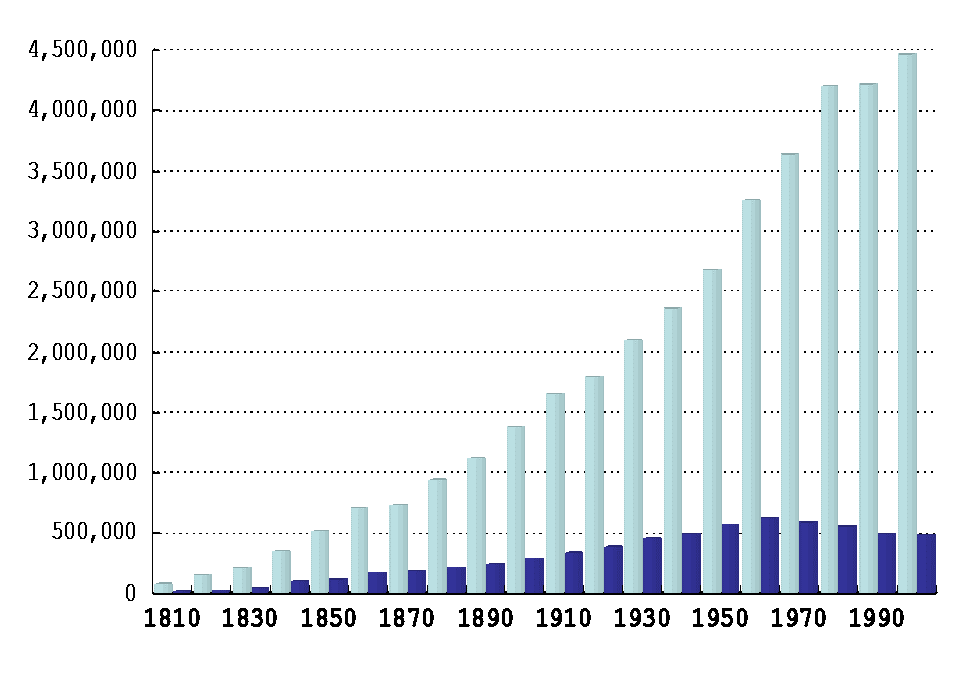
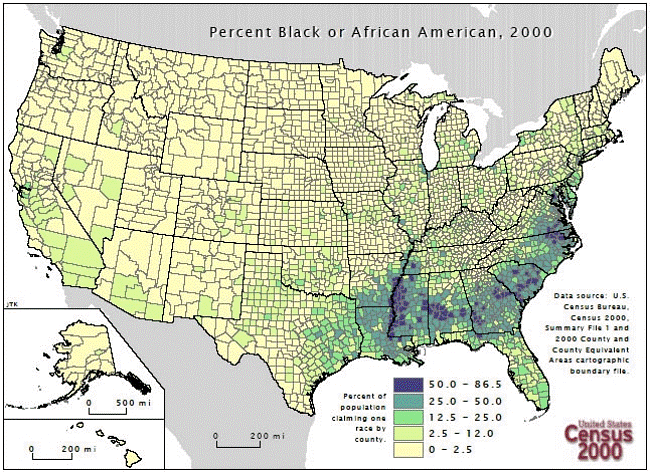
The total views are indicated in the following Figure 2, 3, 4, and Table 2.
Concerning the population change, New Orleans is the one of the decreasing communities in US. For example, rapid urbanization related matters caused environmental degradation before the disaster. Campanella(2004)mentioned New Orleans became not a sustainable, but a survival city. The lower 9th ward, for example, with regard to the ethnicity, we can see the high black and the African American proportion.  With respect to Income, we can also identify the people living in the Lower 9th ward have lower incomes.

NOLApopulation
Figure 2  Population Change Louisiana( Light Blue ) and New Orleans (Dark Blue)


2000census
Figure 3 Percent Black or African American, 2000 (Census, 2000)

pop and ethnicities
Figure 4 Percent Black or African American and White
(Source: Congressional Research Service)

Table 2 People’s Income in both New Orleans and Lower 9th Ward

income katrina

These are referred by an NIED publication.

Day_99 : A Secondary Disaster- 1972 Shigeto Landslide Disaster

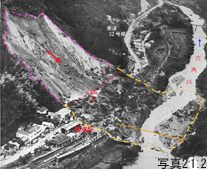
The Shigeto ward, Tosayamada town in Kochi prefecture had a huge landslide disaster on the 5th of July in 1972. We call it Shigeto Landslide.

What we can learn from this landslide is the secondary disaster.

First, a small landslide occurred at 6 am on the day. One volunteer firefighter was buried alive by the landslide. Other volunteer firefighters and local people started to conduct rescue work for him.

Second, a huge landslide happened at 10:55 am during their tasks and killed 59 among them. In addition, the landslide pushed the train stayed at Shigeto station away.

The following Figure 1 shows the landslide (NIED DIL)

shigetoupic
Figure 1 Shigeto Landslide

Day_98 : The Major Tsunami disasters in Sanriku Ria Coast in Japan

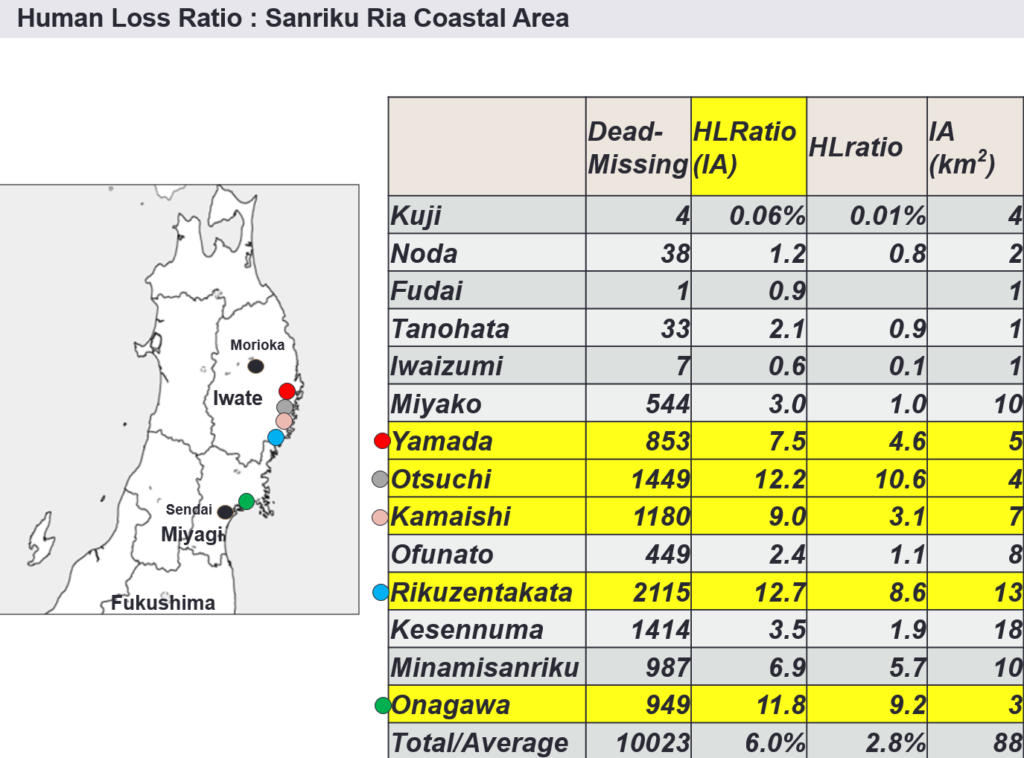
The following slide indicates the Great East Japan Earthquake and Tsunami(GEJET)disaster’s data by each municipality (IRDR conference).You can see the fact that Sanriku ria coast has more severe damage compared to the population of the municipalities.We also need to notice the Sanriku ria coast has a long history of tsunami disasters.But why did they have a sever damage again?

sanriku tsunami history death
Figure 1 Tsunami Disaster Impact in the Sanriku Ria coast (IRDR)

The Sanriku areas have a special geographical condition mentioned as Sanriku ria coast. The coast has mountains close to the sea, so residential areas are limited only in the distributed, narrow and lower zones near to the sea and the areas become very vulnerable against the tsunamis. The bays in the coast are small and the sea inside the bays are very deep. This makes tsunami faster and higher, this is why the Sanriku ria coast makes the one of the highest tsunami risk areas in the world.

Because of these characteristics, the communities in Sanriku ria coast, mainly in Iwate prefecture historically has been severely affected by tsunami disasters such as Meiji Sanriku earthquake tsunami (Meiji (1896)), Sowa Sanriku earthquake tsunami (Sowa (1933)), and Chilean earthquake tsunami (Chilean (1960)) disasters compared to the flat coast mainly in Miyagi prefecture and other areas in Japan.

See the below “Relocation or Rebuilding (1)”

http://disasters.weblike.jp/disasters/archives/2950

The following is the brief explanations of each tsunami disaster. The Figure 2 (Figure 1 of the Day_94 post) does not include the Chilean Tsunami.

sanriku tsunami history
Figure 2
 The Tsunami Disasters in Tohoku (Cabinet office of Japan)

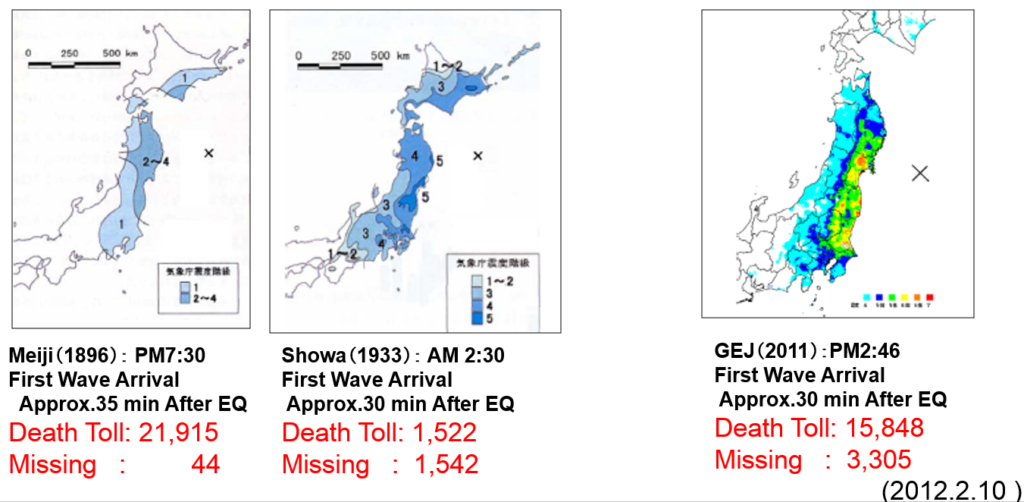
1) Meiji sanriku tsunami disaster(1896), this disaster is so called a surprise attack tsunami disaster happened at approx. 7:30 pm, 15th of June in 1896 mainly in Sanriku ria coast. The dead and missing number has reported over 22,000. The earthquake is not so strong (Japanese earthquake scale indicates Shindo 1-2), however, tsunami is very strong and high (max. height is 38.2m at Ayasato area (present Ofunato city) compared to the earthquake movement scale. The first wave arrival is approx.35m after the earthquake. The Meiji sanriku tsunami disaster (1896) is the worst tsunami disaster ever in Japan.

2) Showa sanriku tsunami disaster(1933), this tsunami disaster can be examined the lessons learned from Meiji (1933) mitigate the impacts. This tsunami attacked mainly the Sanriku ria coast at approx. 2:30 am, 3rd of March in 1933. Even if the midnight, the residents evacuated so quickly because of their memories of the Meiji (1896) with strong earthquake (Japanese scale is Shindo 5.5). The max. tsunami height is 23m at the same place, Ayasato area, with Meiji (1896). The first wave arrival is approx.30 min. after the earthquake.

3) Chilean tsunami disaster(1960), this is caused by the tsunami generated offshore in the long distance. This is coming from Chile in South America. The earthquake occurred in Chile was magnitude 9.5 and this huge earthquake generates tsunami and reach to Japan after 22 hrs and a half. The tsunami come approx. at 3 am, 23rd of March in 1960. The death number is 139 all over the Japan and Sanriku ria coast is the worst such as 63 in Ofunato, 37 in Shizugawa (present Minamisanriku), and 8 in Rikuzentakata.

4) Great East Japan Earthquake and Tsunami(GEJET) disaster(2011), this disaster is the deadliest disaster after the Second World War in Japan. The earthquake happened at 2:46 pm, 11st of March in 2011. The total casualty number is 19,846 based on the EM-DAT.The max.tsunami height is 40m at the Sanriku ria coast. The first wave arrival is approx. 30 min. after the earthquake.

Day_96 : Lessons from a Japanese Environmental Movement- The Matsumura Research Group (1)

Mishima Numazu Shimizu (MNS) environmental movement in 1963-1964 is the turning point of a Japanese environmental history. The core of the movement is the science-based issues, especially, Environmental Impact Assessmentsconducted by the Government Research Group and the Local Research Group.

They fought the results and local people finally assisted the local research group research findings and explanations to choose their future.

Actually, this is the first national EIA (Environmental Impact Assessment) in Japan, which failed and almost all Japanese do not know.

I conducted field research on the local research group for a long time. I stayed local member’s house for over 1 week and collected the documents, for example. Unfortunately, almost all members have passed away now. The followings are the outlines.

Background
In 1963, the national government and local councils proposed the one large industrial complex in Mishima city, Numazu town, and Shimizu town area in Shizuoka prefecture near to the Mt.Fuji.This was one of the largest development projects in Japan at that time. After this announcement, the MNS environmental movement was started with the local people. Local high school teachers and national research institute researchers led this movement with their scientific and local knowledge.

Revolutionary Events in the MNS Movement
– The survey carried out by high school students (KOINOBORI research)
because it happened  in a KOINOBORI time (Japanese culture)
→A high school teacher (The Matsumura Research Group member) led this survey.
→These results were accurate in the local wind direction which was against governmental research findings with explanations. Gov. research group had a huge budget, they used a helicopter to check the wind directions

koinobori
Figure 1 Koinobori   (Source: Wikipedia)

– A few hundred education programs (mainly for local citizens)

The Main Impact of the MNS movement
Former high-ranking officer confessed:
“We (the government) thought we had lost when the Numazu citizens flew those KOINOBORI (carp-shaped streamers) for research purpose. Besides that we also realized that we needed to make laws governing pollution. If we had not done it, we could not have been able to set up any MNS type projects”

The Main Impact of the MNS movement
Prevention Movement against Pollution
Local Government Reform Movement
Legal Action in the Movement
Conducting Independent Research
Implementing Environmental Education Programs

After the movement, Kawasaki City, Tokyo Metropolitan Area,
and Kyoto City became reformist local governments, which
control pollution more seriously than the national government.

Matsumura Research Group
Outcome: “Self Assessment” by the local research group overcome
the “Official Assessment” by the national research group

Mr. Shiramatsu (LDP) criticized during the time in the assembly:
“The Kurokawa Research Group (the national research group) is reliable.
It consists of the country’s most respected specialists in various fields.
They could be called the nation’s best brain. On the other hand, the
Matsumura Research Group (the local research group) is unreliable.
The member are 2 doctorates of Agriculture and 4 high school teachers.
How could they carry out reliable research?
In addition, I heard the budget
of the Matsumura Research Group is about 100 thousand yen. So the research
could be regarded a non-scientific thing”.

To be continued・・・・・

sponsored link

Day_94 : Relocations or Rebuildings (1) (Tentative)

The communities in the Sanriku ria coast have been affected by tsunamis for a long time. After huge tsunami disasters, they have had always faced the difficulty to make a decision, relocations or rebuildings.
The below Figure 1 is the major tsunamis in the Sanriku ria coast.
sanriku tsunami history
Figure 1 Tsunami disasters in Sanriku ria coast (Cabinet office of Japan)
The Meiji sanriku tsunami in 1896 was the worst tsunami disaster ever in Japanese recorded history. The Showa sanriku tsunami in 1933 occurred in the midnight, however, they evacuated well because of the Meiji’s experience. As mentioned before, they always needed to choose relocations or rebuildings with the consideration of their resources after the tsunami disasters.
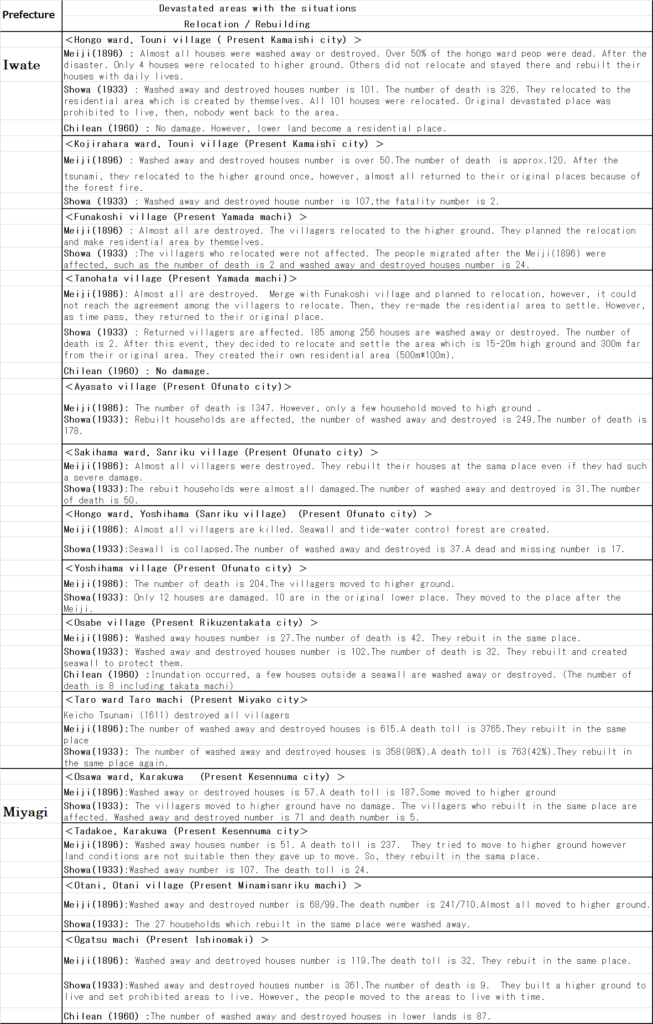
The decisions of each community can be seen in Table 1 (Tentative).
Table 1 Relocations or Rebuilding History of Communities after the Tsunami Disasters(Tentative Table: very rough translation, sorry. Will change soon)
                                                                                                      Ref. ( Nakasu,Tanaka, Miyake, 2011)
relocations2
Some communities relocated to higher grounds after the tsunamis, however, they tended to go back to the original places because of their daily life’s convenience. They are mostly fishermen or making their living by the sea. We can imagine how difficult for them to live in the ground, far from the sea.
To be continued.

Day_84 : Northridge and Kobe

Below is just a comparison between 1994 Northridge and 1995 Kobe earthquakes.

Time
Northridge: :January 17, at 4:30:55 a.m. PST, in 1994 (Mw6.7)
Kobe: January 17, at 05:46:53 JST in 1995 (Mw6.9)

Death toll
Northridge: 57
Kobe: 6,434

Cost
Northridge: Property damage was estimated to be between $13 and $40 billion
Kobe: Around ten trillion yen ($100 billion) in damage, 2.5% of Japan’s GDP at the time.

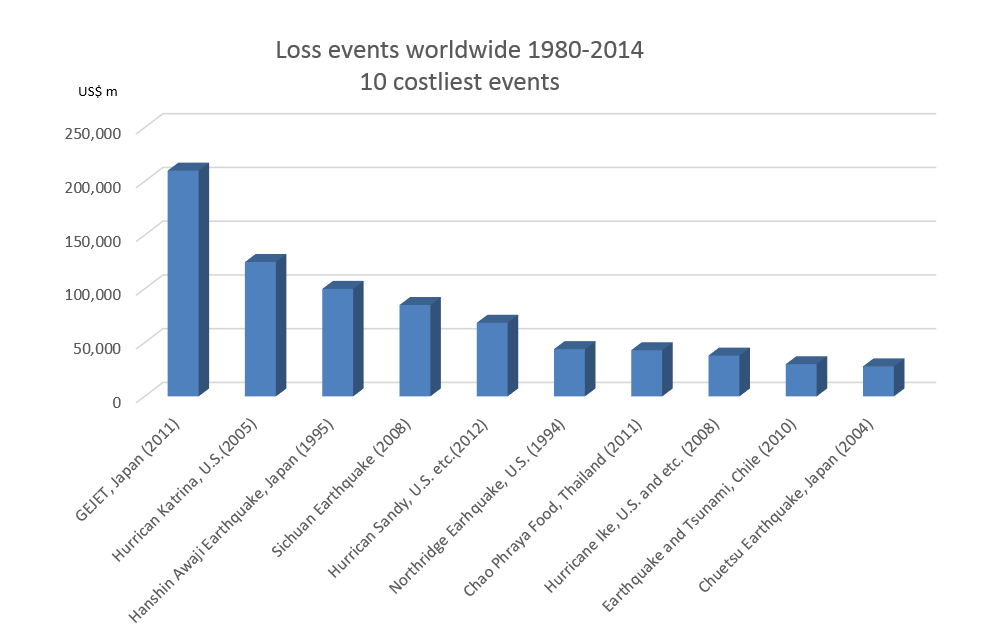
Both earthquakes are in the costliest disasters (Overall losses) in the world (1980–2004), as you can see in the below figure(Munich Re).

costliesdisasters

However, we need to notice the death toll’s huge gap between the two, even if they happened almost at the same time on the same day with almost the same magnitudes. This tells us natural disaster is not “natural”. The earthquake itself does not kill people; it is just a natural phenomenon. We create “natural” disasters.