Category Archives: Disaster Risk Reduction

Day_196 : The Matsushiro Earthquake Center

The following is a reprint of a column I once wrote:

The Matsushiro Earthquake Center, nestled in the historic town of Matsushiro within Nagano Prefecture, represents a pivotal chapter in Japan’s approach to seismic research and disaster mitigation. Established in February 1967 under the auspices of the Japan Meteorological Agency’s Seismological Observatory, this institution was born out of a critical period marked by intense seismic activity. Between August 3, 1965, and April 17, 1966, the region experienced a staggering 6,780 seismic events, ranging from imperceptible tremors to significant quakes measuring intensity 5 and 4 on the Japanese scale. This unprecedented series of earthquakes not only posed a major societal challenge but also catalyzed the center’s founding.

The initiative to establish the center was strongly influenced by the then-mayor of Matsushiro, Nakamura, who famously prioritized the pursuit of knowledge and research over material wealth. This sentiment laid the groundwork for what would become a crucial site for earthquake prediction and disaster preparedness efforts, situated on the historical grounds of the Imperial Headquarters.

Drawing from my experience at the Natural Disaster Information Office and in collaboration with the Precise Earthquake Observation Office of the Japan Meteorological Agency (now known as the Matsushiro Earthquake Observatory), I have had the unique opportunity to organize and delve into discussions from that era. Despite being born after the seismic events in Matsushiro, I find the archival records fascinating. They not only recount the collective efforts of Matsushiro’s residents to forge a disaster-resilient community in the aftermath of the earthquake but also highlight the comprehensive nature of the research conducted.

The inquiries extended beyond seismic analysis, encompassing a holistic examination of the earthquake’s impact on the community. Noteworthy is the health survey conducted on students from a local school, in collaboration with the Matsushiro Health Center and hospital, to assess the psychological and physical effects of the seismic swarms. Moreover, the scope of investigation included studies on earthquake-induced landslides and the repercussions on water infrastructure, showcasing the multifaceted response from various experts and frontline workers of the time.

This rich tapestry of collective memory and scientific inquiry underscores the enduring spirit of Matsushiro—a community united in its commitment to disaster resilience, informed by the lessons of its past.

Ref.

http://researchmap.jp/read0139271/%E7%A0%94%E7%A9%B6%E3%83%96%E3%83%AD%E3%82%B0/

Day_115 : Disaster Technology Websites

I want to introduce you to two disaster technology websites: DRH Asia-Disaster Reduction Hyperbase and Global DRR Technology.

  • The websites below are unavailable today (2024.12.14 confirmed); however, we can still learn the concept and idea as a significant theme.

1) DRH Asia
This site provides qualified information about DRR technology. Its content is easy to grasp, making it possible to transfer DRR technology. The content comes from many Asian countries and has been reviewed by experts. The challenge is the limited number of contents.

The following is an example of the contents.
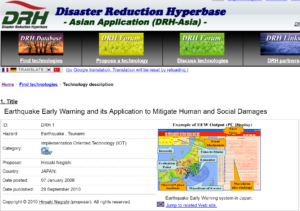
Earthquake Early Warning and its Application to Mitigate Human and Social Damages (Figure 1)

drh
Figure 1

We can understand the quality and availability of the content.

2) Global DRR Technology
This site focuses on an online Community of Practice(CoP) in Disaster Risk Reduction(DRR). Although the content is limited, the site can be easily accessed. The case study site is incredibly visually appealing.

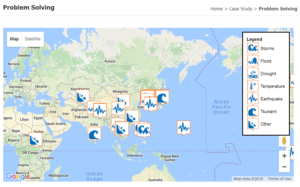
The site below is an example of a case study site. (Figure 2)

global-drr-tech
Figure 2


Day_157: Disaster Warning (1)

I will update a column of the NIED e-mail magazine I wrote long ago because the content does not fade with time. (I will do this step by step in Japanese and English.) I will also add comments to update the situation.

Sorry, I am now revising this post because of the translation difficulties. This post will be revised again. Thank you.

Published May 6, 2010
NIED-DIL e-mail magazine: Disaster Warning (1)

■ Disaster Warning (1) ■

In February 2008, a survey provided an opportunity to visit Hawaii’s Pacific Tsunami Warning Center (PTWC). In a study, I interviewed the director of the PTWC, and the first thing that caught my attention was the role of the media. The director told me that a public tsunami evacuation alert was required three hours before the event, which was too time-sensitive, but the press was an advantage to do this. However, there were various restrictions for the government organization, such as warnings in an international framework. I remembered the Chilean Navy’s disaster response to the damage caused by the earthquake and tsunami in Chile in February this year.

Next, I was interested in science, technology, and data, which are the basis of alarm decisions. I think regular (flood, etc.) warnings will be judged based on current and past data, but especially for tsunami warnings, there were errors in the original earthquake and the tide gauge data. To judge, we should know that 99.99 percent of the errors could be caused by error. The fact that past data is not very useful because the devices to figure out the data are changing daily, making it difficult to rely on it.

From these facts, it was generally noticed that the disaster warning was based on the combination of the progress of science and technology and the competence of the person in charge. The actual warning also relies on the institution belonging to it. For example, variables such as the recipient of the alert, the psychology of the local people, the social situation, and various systems also needed to be added.

Issued May 6, 2010 No. 4

Day_199 : Early Signs of Geological Changes Before Landslides

Before significant landslides occur, various clear natural changes are often observed. Notable incidents include the 1963 Vajont Dam landslide in Italy and the 2006 Leyte Island landslide in the Philippines.

On the evening of October 9, 1963, a massive landslide took place near the Vajont Dam in the Alps of northern Italy. The dam, standing at 262 meters, was completed just three years prior. The landslide dislodged approximately 260 million cubic meters of earth, thrusting up the waters of the dam’s lake. The displaced water surged over the dam, rising more than 100 meters before rushing down into the valley below, resulting in approximately 2,000 fatalities. The geological layers in the area were unstable, compounded by the increased water levels from the dam. A minor landslide had previously occurred in 1960, and the landslide’s progress accelerated to several tens of centimeters per day just before the disaster. Despite ongoing monitoring, the catastrophic damage could not be prevented.

Day_140 : Natural Disasters in Europe (2) Vajont Dam Collapse


On February 17, 2006, a mountain 800 meters tall on the Philippine island of Leyte succumbed to a vast landslide, displacing around 20 million cubic meters of soil and claiming 1,144 lives. Before the collapse, cracks had appeared on the mountain’s ridge, and rainfall had begun to seep into the ground.

Identifying these early signs of geological change is crucial. By monitoring their progression and predicting potential danger zones, we can enhance our preparedness and safeguard our lives against such devastating natural disasters.

Contents (in Japanese)
Source: URL:https://dil.bosai.go.jp/workshop/2006workshop/gakusyukai21.html


What causes a landslide?


Day_138 : Natural Disasters in Europe (1)

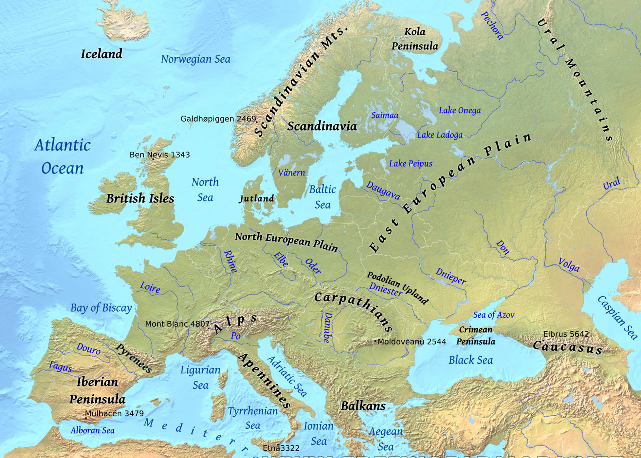
Natural disasters in Europe mainly consist of hydrological, meteorological, climatological, earthquake and volcano eruption disasters.

europe-pic
Figure   The Europe

Earthquake disasters mainly occur in the Aegean Sea, the south-western coast of Balkan Peninsula, and the southern part of Italy. Volcanoes are active in the central and southern parts of Italy, the southern Aegean Sea, and Iceland area.

Concerning hydrological, meteorological, and climatological disasters, heavy rain and storm disasters are caused by low  pressure in the Icelandic area developed in the winter season. A cold atmospheric current coming from Arctic gains a warmer vapor stream from the Gulf Stream and develops a strong atmospheric depression in the area. This causes the strong winds and high tidal waves along the coastal areas of the North Sea.

Netherlands and England can be highlighted. The Netherlands had storm surges in 1530 and 1570. The death tolls were approximately 400,000 (1530) and 70,000 (1570) for each. The 1953 depression took an 1800-person death toll. This disaster also reached England. England’s disasters were the 1703 Thames river flood and the 2003 Heatwave. The temperature was 8–10 over the average year in August 2003.

With regard to earthquake disasters, Italy, Greece, and Portugal are the main countries to be affected.

The following past article explains the recent earthquake cases in Italy.

To be continued…

Day_30 (rev): The two main gaps


There are two main gaps among experts, local disaster managers, and local people. The first is a perspective gap; experts usually have a different point of view on disaster risk reductions based on their specialty. Disaster managers have a management point of view. The local people tend to have a view based on their daily lives. The other gap is the knowledge gap. Each has a different level of knowledge.

These two gaps keep them from conducting the work for effective disaster risk reduction in a local community.

Once I learned the definition of “expert,” as follows:. This definition definitely gives me some insights.

The expert is the persons who knows more and more about less and less


Day_195 : Scientists and Disaster Management Controversy issues with a L’Aquila Earthquake Case

The L’Aquila earthquake, which struck the Abruzzo region of Italy on April 6, 2009, was a significant case study for both scientists and disaster risk management professionals for several reasons. With a magnitude of 6.3, this earthquake caused extensive damage to the medieval city of L’Aquila, resulting in the deaths of more than 300 people, injuring over a thousand, and leaving tens of thousands of people homeless. Beyond the immediate physical damage and tragic loss of life, the L’Aquila earthquake raised important issues related to earthquake prediction, risk communication, and the responsibilities of scientists and authorities in disaster risk management.

Scientific Aspects and Controversies

The occurrence of earthquakes sparked a controversial debate over the ability to predict earthquakes and the communication of seismic risks to the public. Before the earthquake, a series of tremors were felt in the region, leading to heightened public concern. A week before the major earthquake, a meeting of the Major Risks Committee, which included government officials and scientists, was held to assess the situation. The committee concluded that it was not possible to predict whether a stronger earthquake would occur but reassured the public, suggesting a low likelihood of a major event. Unfortunately, the devastating earthquake struck shortly thereafter.

This situation has led to significant controversy, particularly regarding the role and communication strategies of scientists and government officials in disaster risk management. Critics argued that reassurances were misleading and contributed to a false sense of security among the population.

Legal and Ethical Issues

In a highly controversial decision, six Italian scientists and one government official were initially found guilty of manslaughter in 2012 for underestimating the risks and failing to adequately warn the population. This verdict was widely criticized by the international scientific community, which argued that it was unreasonable to expect scientists to accurately predict earthquakes. The verdict was largely overturned in 2014, with the convictions of scientists being annulled and the sentence of the government official being reduced.

Disaster Risk Management Implications

The L’Aquila earthquake underscored the importance of effective disaster-risk management and communication strategies. Key lessons include:

  1. Communication of Uncertainty: It highlighted the need for clear communication of scientific uncertainty to the public. Conveying the inherent uncertainties in earthquake prediction is crucial for helping individuals and communities make informed decisions about risk reduction and preparedness.
  2. Public Education and Preparedness: The tragedy reinforced the need for ongoing public education on disaster preparedness and the importance of building earthquake-resilient communities.
  3. Building Codes and Urban Planning: Ensuring strict adherence to earthquake-resistant building codes and urban planning practices is vital in reducing the vulnerability of buildings and infrastructure.
  4. Multi-disciplinary Approach: The event demonstrated the importance of a multi-disciplinary approach that includes not only seismologists but also engineers, urban planners, emergency management professionals, and policymakers in disaster risk management planning and response.
  5. Ethical Responsibilities: The aftermath raised questions about the ethical responsibilities of scientists and the balance between preventing public panic and ensuring preparedness.

The L’Aquila earthquake remains a case study of the complex interplay among science, policy, ethics, and public communication in the context of natural disaster risk management.

Day_85 : Shingen Embarkment: SAMURAI Disaster Risk Management

Those who can rule the water can also rule the country. This proverb became a reality, especially during the Sengoku period (Warring States Period) in Japan.

Shingen embankment was a flood control system built over 400 years ago to protect the northern part of the Kofu Basin, the rich rice paddy areas of Kai Province, then under the rule of Daimyo (District Lord) Shingen Takeda. The main problem is that the Midai River, a left branch of the Kamanashi River, is the major branch of the Fuji River, Once the Midai River flow increases and broke the bank protecting the Kofu Basin at its confluence with the Kamanashi River, the flood damage to the paddy fields was extensive. Such floods were known even in prehistoric times. Towards AD 1500, Shingen Takeda, the Daimyo (District Lord) of Kai country, directed that flood control works be made to protect the rice paddy area of his country (Takeuchi, 2003*).

Shingen Takeda was one of the strongest Samurai Daimyo (District Lord). He controlled his soldiers well and so did the floods.

shingenFigure: Shingen Embarkment**

*The Basis of Civilization: Water Science? (Proceedings of theUNESCO/IAMS/IWHA symposium held in Rome, December 2003). AI IS I’ubl. 286, 2004

**Brochure (Information about Fuji river Flood Control)

Day_53 : Disaster Information : Desinventar

Even though the countries are limited, UN Desinventar has really detailed disaster information. Let me share an example: Vietnam’s data.
Just click the target country (Vietnam), and you can see the different types of data, such as pie charts (disaster type), polygonal lines (trend), spatial (geographical distribution), and statistical (regional data).

The following are the screen shots:.

VietNam_pie VietNam_plot VietNam_spacial VietNam_stat


* UN Desinventar
http://www.desinventar.net/index_www.html

Day_36 : Disaster Scenario

A Disaster Scenario is one way to improve our disaster management skills. It is a kind of role-playing or simulation. Science can be applied to make the scenario more realistic. Disaster scenarios can be used at the personal or national level. We usually tend to have a normalcy bias; however, well-planned disaster scenarios can break such bias.

* Normalcy bias (Wikipedia)
We tend not to want to accept abnormal situations.