Category Archives: Disaster Preparedness

Day_146 (Rev): A Text Mining : Trends of disaster research on aging

Have just conducted a text mining as follows:

Overviews of the Literature concerning elderly and disasters by text mining.
<Method>
1. Search the keywords in Web of Science (Core Collection)
2. Selected Information (Titles and Abstracts) was gathered into one text file.
3.1st contents analysis has been carried out and omitted the unnecessary words.
4. Cleaning process
5. 2nd contents analysis has been carried out. >>This process was repeated
6. Research findings are examined.
7. Examine the extracted words and phrases by reaching to the original abstracts and original papers.

*To do the text mining, KH Corder was used.

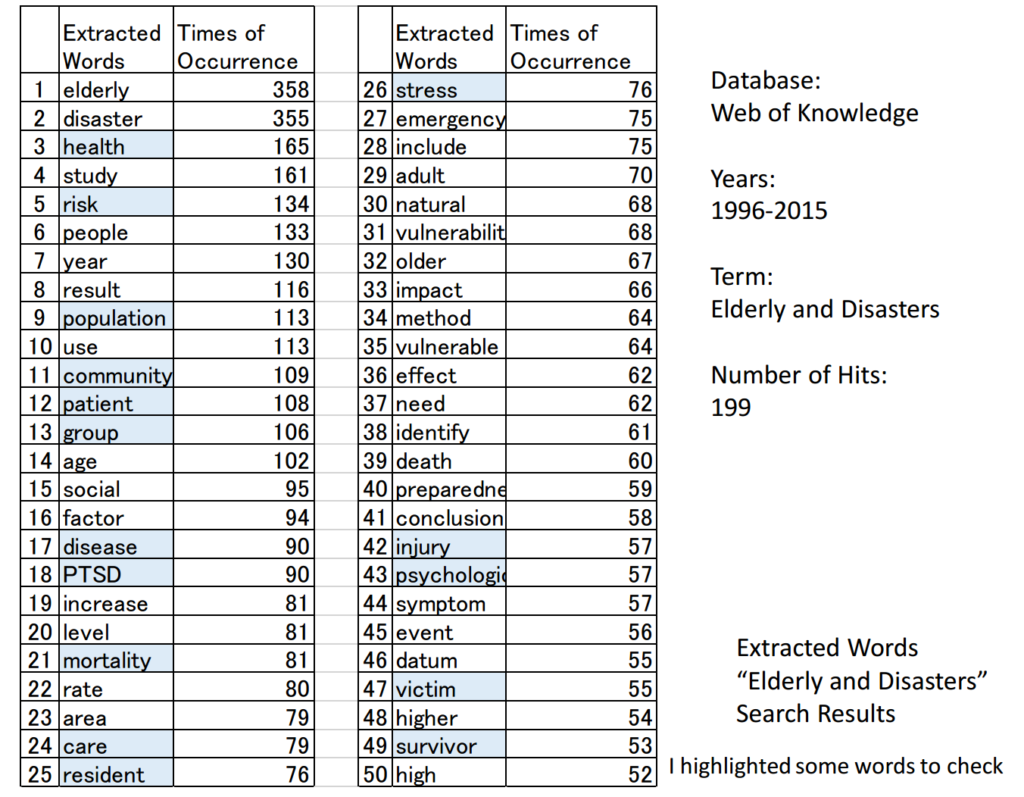
Table 1 Keywords

Keywords_elderly

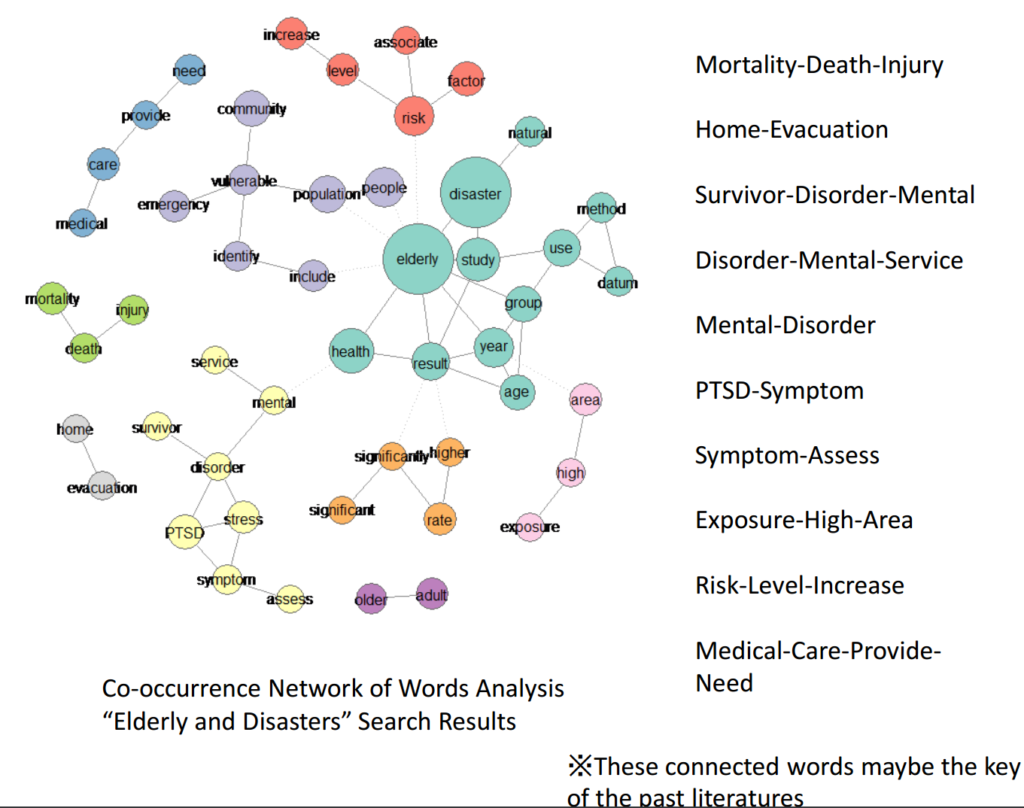
Co-occurrence network_elderly
Figure 1 A co-occurrence network analysis

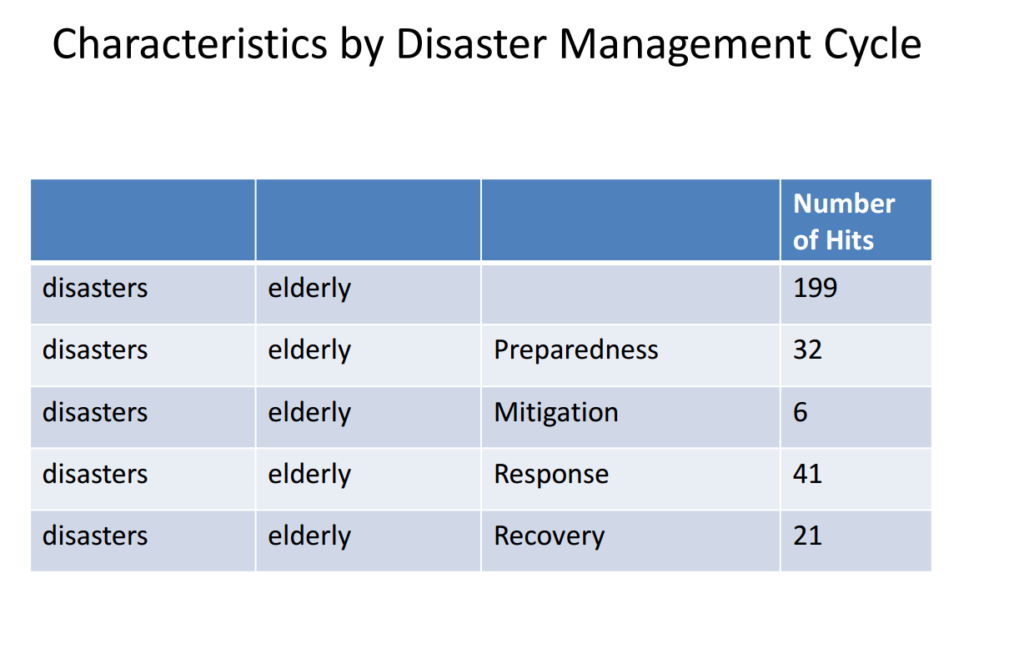
Table 2  The hit numbers with disaster management cycles’ stages

disaster management cycle elderly

Table 2 indicates that elderly issues on disasters are more discussed in relation to “response” and “preparedness” than “recovery” and “mitigation” in the disaster management cycles’ stage.

correspond analysis elderly
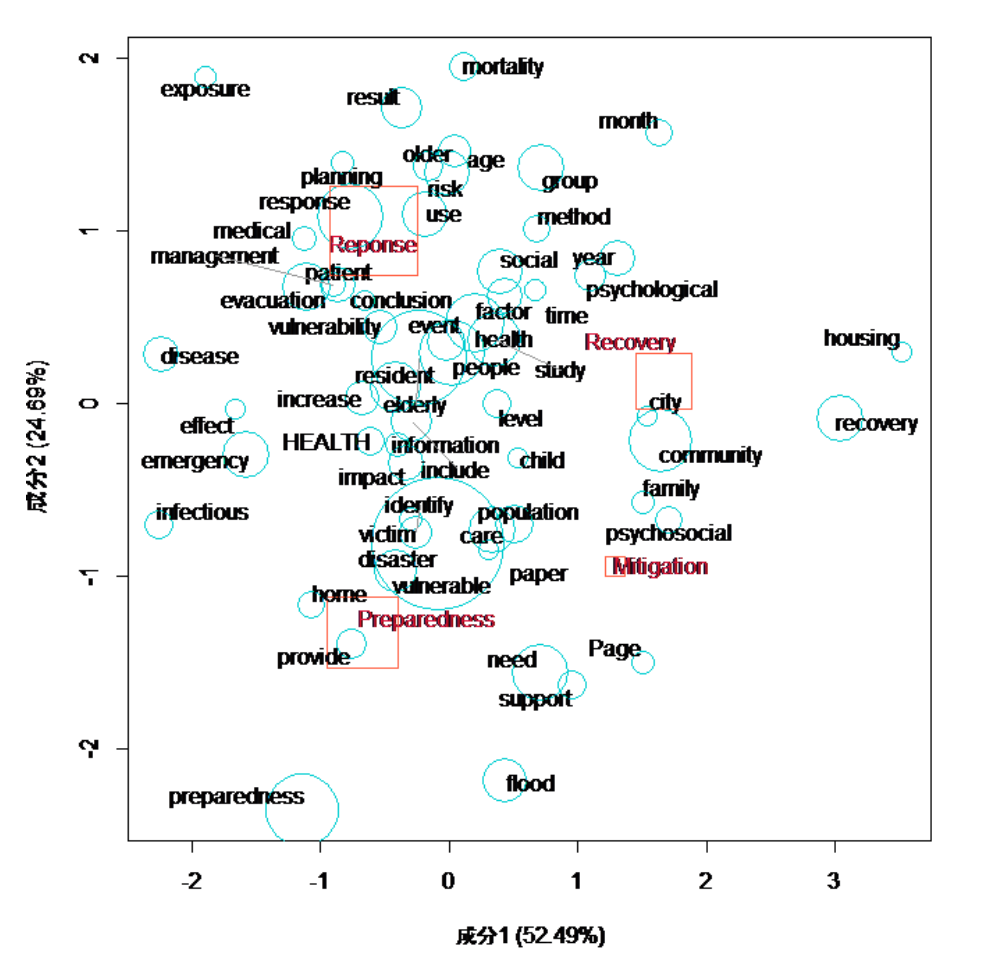
Figure2 Correspond analysis (The related words with disaster management cycles’ stages)

For example, Figure 2 suggests the close relationship between response and related words such as planning, management, medical, evacuation, vulnerability, and patient. This suggests the elderly’s difficulties for evacuation because of their physical conditions.

**This article is a revised version of Day_26(rev)

Reference:

Collection and Analysis of Overseas Disaster Evacuation Related Papers and Documents(in Japanese)

Day_133 : Science, Technology, Population, and Lessons for DRR

Japanese people have tended to trust the government and science & technology so much.
These are one of what we learned from recent disasters. After the second world war, Japanese gov. has built high sea walls along the coastline especially potential risk areas all over Japan. We have also developed warning systems along with rapid economic growth. Not only those, but we have also developed soft countermeasures such as disaster education and training, especially after the 1995 Kobe Earthquake. After the Great East Japan Earthquake and Tsunami (GEJET) disaster, we have realized what has happened because of our over trust to the government and science&technology. This is why Japanese gov. has particularly focused on the community since the disaster, establishing a new frame on the community disaster planning in the disaster countermeasure basic act. The recovery plans on the affected coastal communities tended to change more integrated manners and so did disaster countermeasures than before, looks like turning back to the time when we did not have advanced science and technologies.

We need to know the limitations of the gov. and science&technology’s roles. We also can consider the demographic change to do the job for disaster risk reductions. For example, Japan is facing a severe aging society, so our government resources will be decreasing to cover the situations. We need to have more self-help and mutual help than public help.

Learning from the lessons and past wisdom with those considerations is also very important. “Inamura no Hi” is one of the important lessons we can learn from the past.

http://disasterresearchnotes.site/archives/2720

“Inamura no Hi” is a story of a man who noticed a precursor of a large tsunami at the earliest stage and led village inhabitants to a higher ground by burning harvested rice sheaves. This story was based on a true story at the time of Ansei-Nankai Tsunami (1854), which claimed around 3,000 lives in the coastal areas of Western Japan (ADRC).

Hirokawa Town’s video well explains the background of the story in short and their tsunami disaster education.


Day_125 : Shingen(-Zutsumi) Embarkment (2)

Those who can rule the water can also rule the country. This proverb became a reality, especially during the Sengoku period (Warring States Period) in Japan.

https://disasterresearchnotes.site/archives/2837

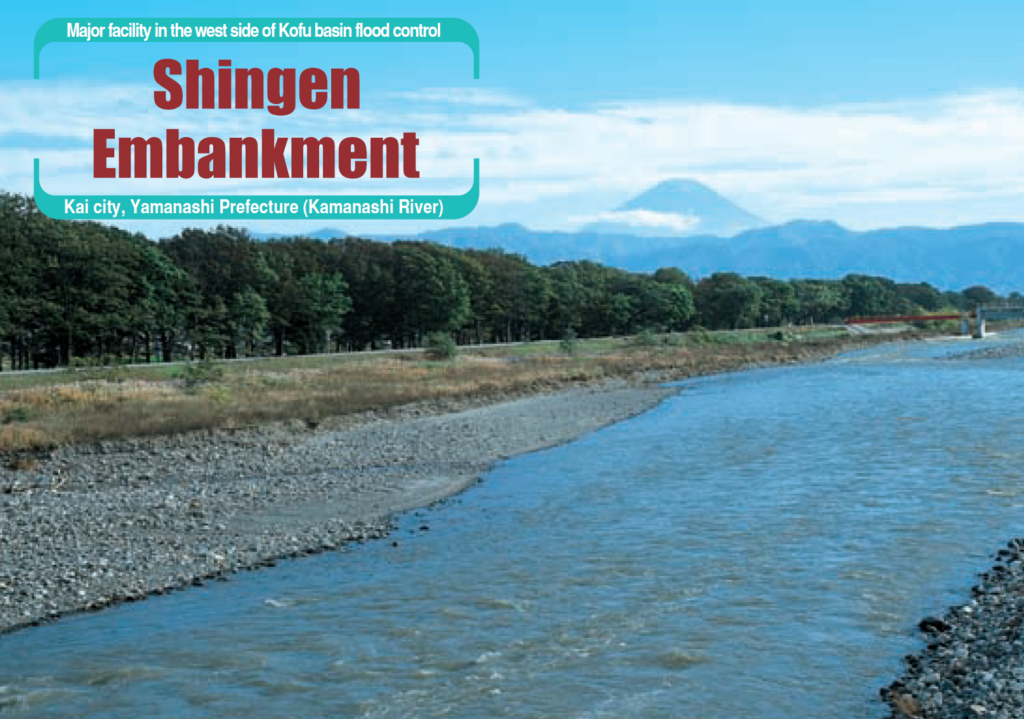
Shingen(-Zutsumi) embankment is a flood control system which was built over 400 years ago to protect the northern part of the Kofu Basin, the rich rice paddy areas of Kai Province. The name comes from the Daimyo (District Lord) Shingen Takeda. Shingen Takeda was one of the strongest Samurai Daimyo during the period. He controlled his soldiers well and so the floods.

shingenFigure: Shingen Embarkment**

In addition to Shingen-Zutsumi Embankment, there are also Bunroku-Zutsumi and Taiko-Zutsumi Embankments established by Shogun (Hideyoshi Toyotomi). The Circle Levee in Nobi Plain is also called that it was built during the time. However, there are still arguments that Samurai Daimyo could built such embankments or not because they required high technologies and a huge amount of human resources during the periods.

To be continued……

**Brochure (Information about Fuji river Flood Control)

Day_124 : Chain Reactions of Economic Damage- 2011 Chao Phraya River Flood in Thailand (3) Horizontal and Vertical Damage Exacerbations

Continue to explain the chain reactions of economic damage caused by Chao Phraya river flood. There were horizontal and vertical damage exacerbations types.

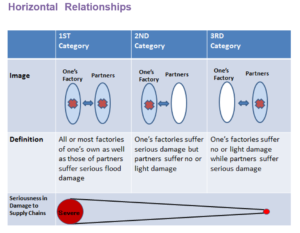
Concerning the horizontal damage exacerbations, we sometimes neglect indirect severe impacts caused by disasters. However, in this global world, economic activities are connected each other and so do the impacts. The following Figure 1 shows the three types of disaster exacerbations for example. The first category is “All or most factories of one’s own as well as those of partners suffer serious flood damage”. This category is the severest. The second category is “One’s factories suffer serious damage, but partners suffer no or light damage”. The third category is “One’s factories suffer no or light damage while partners suffer serious damage”. However, if the one’s factory totally relies on the partners which are affected by the disaster could have a very serious impact.

supply_holizontal
Figure 1  Damage types and severities (Horizontal)

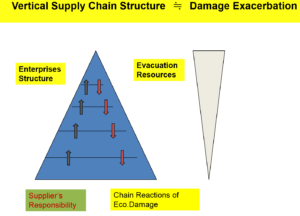
With respect to the vertical damage exacerbation, the key word is the suppliers’ responsibility. For example, a big major car company has the responsibility for customers to supply cars, subcontractors have the responsibility for the car company to supply the parts,  sub-subcontractors have the responsibility for the subcontractors to supply the parts of the parts, sub-sub-subcontractors have the responsibility for the sub-subcontractors to supply the parts of the parts of the parts, and so on. The numbers of the companies become larger along with this vertical pyramidal structure. However, their resources are opposite as mentioned in Figure 2. Industrial estates and parks ordered the evacuation for the companies very slowly at that time of the flood because of some reasons (The reasons will be explained). However, the big companies continued their activities until the time, so sub and sub-sub and sub-sub-sub contractors could not evacuate until the bigger (upstream) companies’ evacuation decision making because of the supplier’s responsibilities. The big companies could evacuate so fast and effectively. They have the resources to do so. However, smaller companies could not evacuate so fast because they needed to wait until the bigger company’s evacuation decision and they tended to have limited resources along with the structure. They, for instance, could not move heavy machines to the upper floors. They did not have enough employees, systems, or plans to do so.

supply_vertical
Figure 2  Damage types and severities (Vertical)

These are the outlines of the disaster damage exacerbation of the supply chains.  These are presented at several meetings in Japan.

Day_100 : A Human Suffering Exacerbation-Data from Greater New Orleans Community Data Center

The Greater New Orleans Community Data Center (GNOCDC) website was found after the field survey on Hurricane Katrina in Louisiana and Mississippi in 2005. I was so amazed. This is the one of the demographers great contributions to disaster research.

The site provides the information of the pre-Katrina situations by parish and also by ward. This is very useful to examine the social backgrounds of the areas in detail.
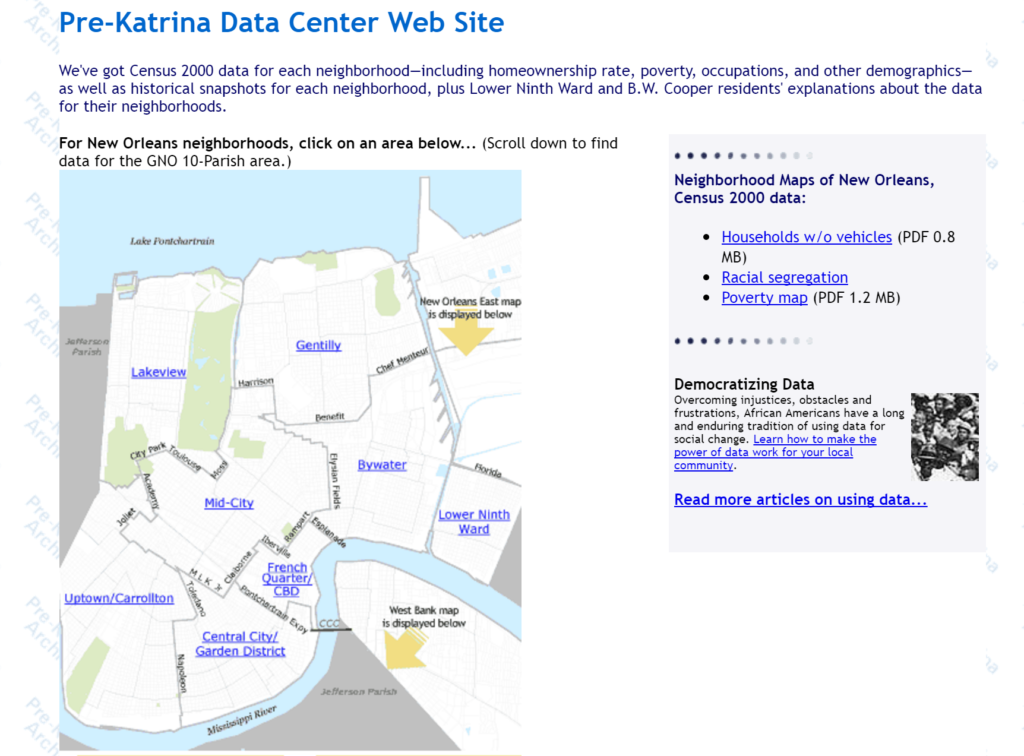
gnocdcPrekatrinaFigure 1 GNOCDC (Pre-Katrina data site)

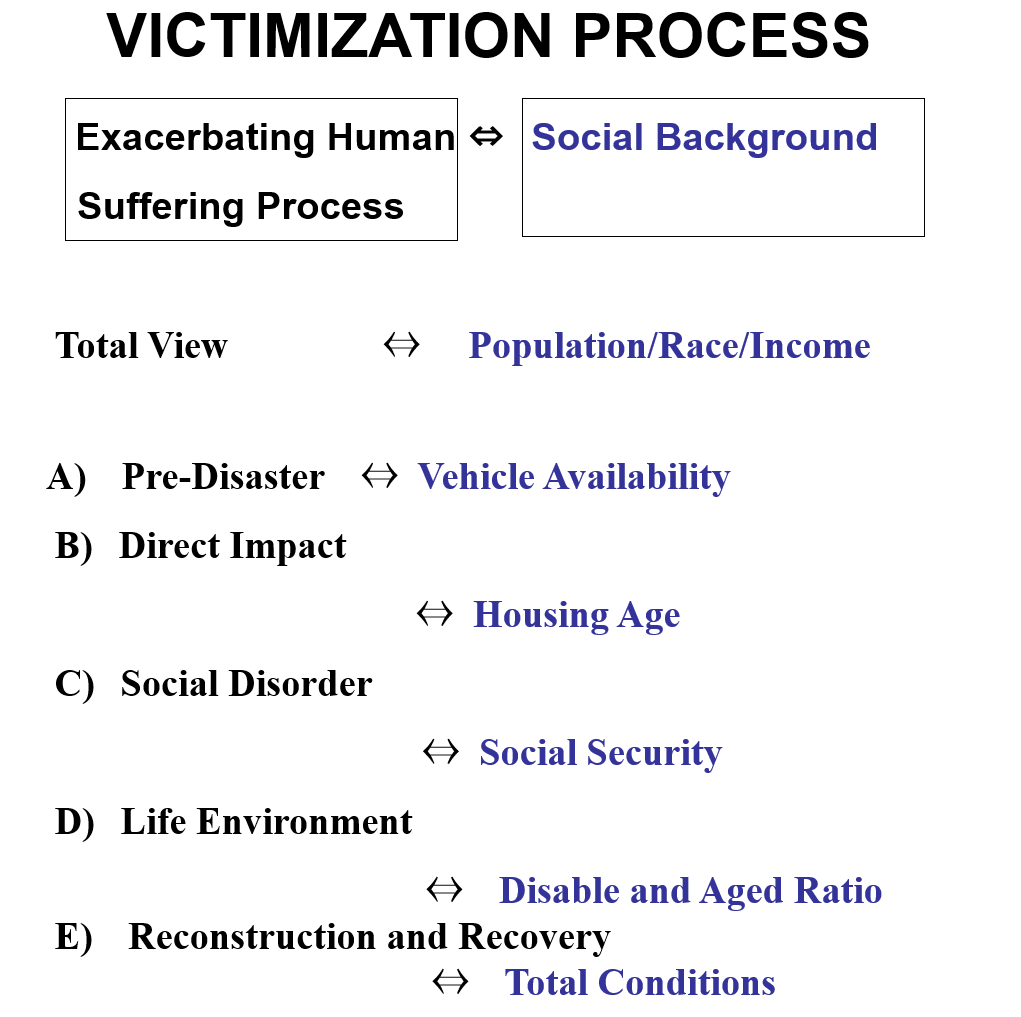
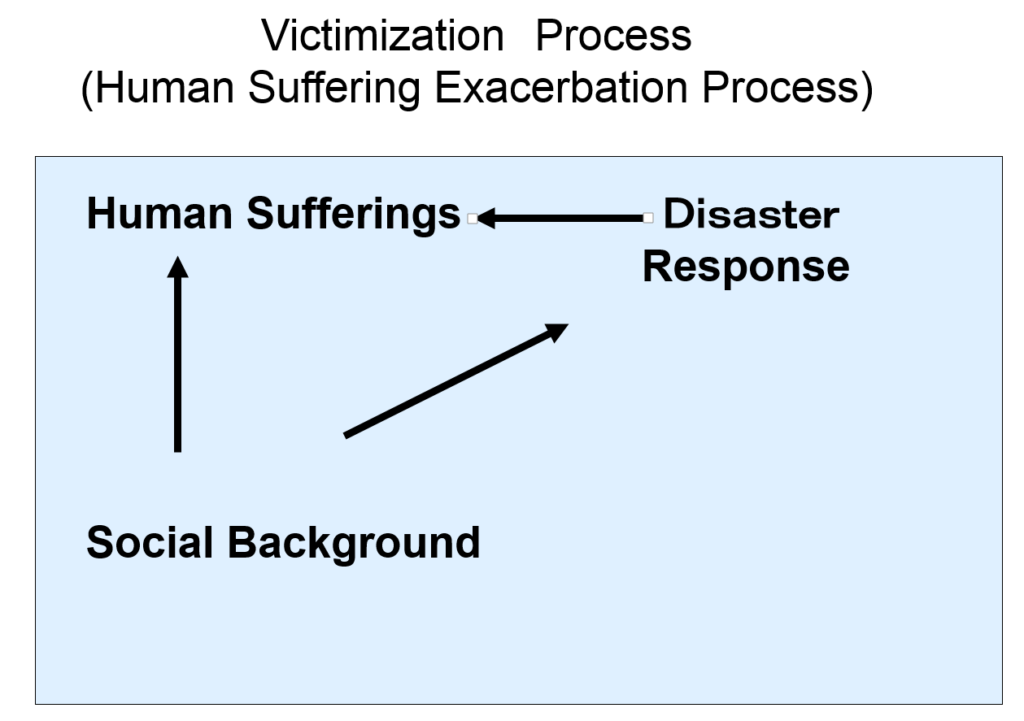
The paper on Karina disaster using these data is to explain how human sufferings were exacerbated by the stage with the social background as shown in Figure 2 (Nakasu, 2006 :Sorry in Japanese, however, summary and figures are in English).
human suffering
Figure 2 Victimization Process

exacerbation2
Figure 3
Victimization Process by Stage

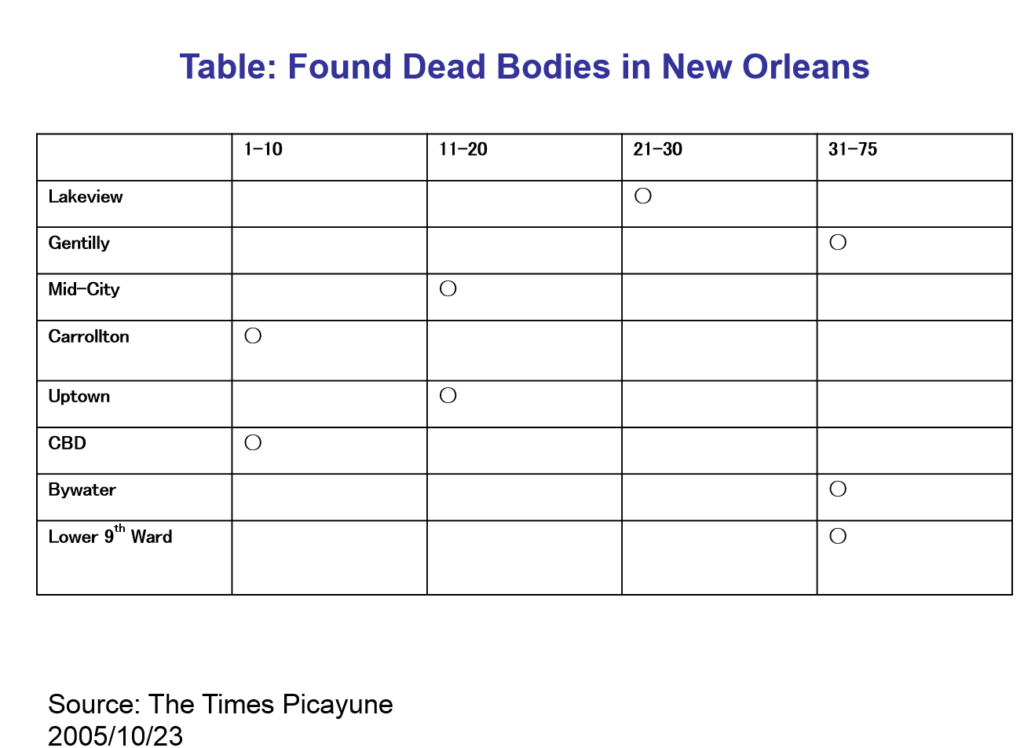
Table 1 Found Dead Bodies in New Orleans  
dead in neworleans

The process can be divided into five stages with time such as A) Pre-disaster B) Direct damage C) Social disorder D) Life environment  E) Reconstruction and recovery. Then, these are examined with the social background data (Figure 3).

For example,  1) Pre-disaster stage, I picked up an evacuation aspect to explain the social background of this stage.

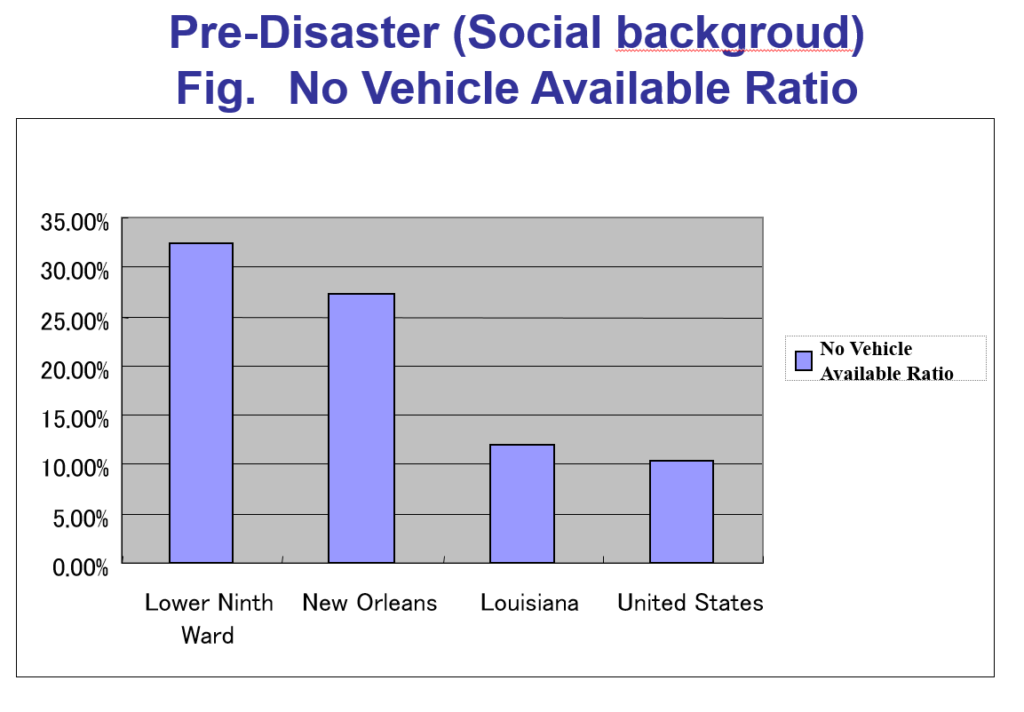
Using the GNOCDC database, I could check the possession ratio of the vehicle in some areas.
novehicle
Figure 4 No Vehicle Available Ratio (GNOCDC)

Table 1 and Figure 4 show the people in Lower 9th ward, one of the most severely affected areas, had a low possession ratio of the vehicle. This can explain so many residents needed to have government help to evacuate and they could not evacuate before the Hurricane hit.

The general social background, such as ethnic groups, household incomes, and others with other stages of examinations will be discussed later.


The Great Deluge: Hurricane Katrina, New Orleans, and the Mississippi Gulf Coast (English Edition)
Day_74 : Population Studies and Disasters

A demographic change is one of the key aspects to examine the future natural disaster risk. The below 2 paragraphs were just picked up from the papers.

“We argue that if we fail to acknowledge and act on the mounting
evidence regarding population composition, migration, inequality,
and disaster vulnerability, we will continue to experience disasters
with greater regularity and intensity” (William and Havidan 2008)

“From a disasters analysis point of view, population growth and patterns of economic development are more important than climate change or cyclical variations in weather.”
(Cred Crunch No.38)

sponsored link

Day_19:POCT 概略 [Japanese]

2015年の仙台会議で防災対策としてPreparedness(事前準備)とbuilding back better(よりよい復興)の重要性が強調されましたが、POCT(臨床現場即時検査)*はまさに今必要とされている災害対応の具体的かつ実践的な処方箋の一つであることは間違いないと思います。

POCTとはいったい何か、どんなメリットがあるかについて、一例をあげると、災害現場では、まずトリアージによって、患者を選別するかと思いますが、医師も人間ですので、瞬時にすべて上手く選別するにも限界があります。これが深刻な問題となっています。2005年の尼崎の列車脱線事故ではその問題が指摘されました。さらにいえば、緊急治療群として適切に赤タグを付けられた場合でさえも、そのグループに多数がいる場合、その中で誰を優先に搬送すればよいかなどの優先順位の問題が生じます。災害時には、医療は緊急性が優先されるために、瞬時の医師の判断が要求されますが、上手く分類するには、それだけの知識と経験が必要ですし、さらに上手く分類できたとしてもそのなかで優先順位をつけなければなりません。POCTは、この問題を解決に大いに貢献します。つまり、迅速に対応できる簡易臨床検査によって、これまでの経験による判断に数値的な裏づけが加わることを可能にします。そしてその事例も多くあります。**個人的には、将来POCTは、人口知能と結びつき、より効果的な医療が行われるのではないかと考えています。

なお私は災害の研究者であって災害医療については、まだ初心者です。もし間違いなどありましたらご指摘くださいませ。連絡先は、とりえず、リンク先のClass紹介サイトに示しています。

災害医療としてのPOCTに関する本を少しづつ紹介してみたいと思います。日本にはまだ適当な本が見当たらないため、以下の本の内容を中心に紹介していきます。

Source Book:
Kost, G. J. (n.d.). Global point of care: Strategies for disasters, emergencies, and public health resilience.

https://www.aacc.org/store/books/9200/global-point-of-care-strategies-for-disasters-emergencies-and-public-health-resilience

災害対応におけるPOCTの世界戦略(案)

<全体像>
本書は、災害対応に関わる世界のPOCT(Point of Care Testing : 臨床現場即時検査)に関する108の事例を55章にて紹介しており、将来の災害、疫病、緊急医療、及び公衆衛生に対するしなやかな対応力(レジリエンス)を高めるロードマップを提供している。ロードマップは、専門家に対してだけではなく、コミュニティにおるすべての人への災害、疫病、緊急事態、さらには、公衆衛生の危機的状況に際してのガイドとなる。それだけではなく、個人の健康戦略の構築にも役立つはずである。本書は、主に次の10項目の内容から構成されている。
第一は、POC (Point of Care)の現状及び将来の方向性
第二は、POCの基本的な概念の紹介
第三は、処方箋と処置を促進する工夫
第四は、命に関わる危機的状況にある患者への迅速な処方箋
第五は、POC検査器具の保守管理
第六は、災害準備体制やレジリエンスを高めるためのPOCの活用
第七は、GIS(地理情報システム)との融合による防災計画に対する貢献
第八は、過去の災害経験のPOCへの貢献
第九は、将来のコミュニティにおける災害準備体制やレジリエンスに関する情報
第十は、POCT(臨床現場即時検査)の戦略、公衆衛生政策、及びガイドラインの紹介

*Point of Care Testing
POCTについては、下記の日本臨床検査自動化学会の定義を参考にしました。
http://www.acute-care.jp/learning/course/immunoassay/poct/16041801.html

** Day_9 Day_11

Day_18 : Natural disasters in Thailand

“More must be done to fight climate change” (Bangkok Post)
http://www.bangkokpost.com/opinion/opinion/1034545/more-must-be-done-to-fight-climate-change

The above article was found on the Bangkok Post. The risk assessment mapping in Thailand* indicates the flood is the first priority to prepare. Disaster data infrastructure is challenging in Thailand to analyze. The culture to establish an excellent disaster management system in Thailand could be facilitated by the research based on the data infrastructure.

* Risk assessment mapping in Thailand (Tentative)

http://disasters.weblike.jp/disasters/archives/2935

The above was already published in JAEE report.