Author Archives: tada

About tada

Dr. Nakasu is a post-doctoral fellow and an adjunct lecturer at College of Population Studies, Chulalongkorn University in Thailand. He had been working at NIED (National Research Institute for Earth Science and Disaster Prevention) as a principal research fellow and ICHARM (International Centre for Water Hazard and Risk Management), PWRI (Public Works Research Institute) as a research specialist in Japan for a decade. He has conducted many disaster field surveys such as Indian Ocean Tsunami (2004), Hurricane Katrina (2005), Typhoon Ondoy and Pepeng (2009), Great East Japan Earthquake and Tsunami (2011), and Chao Phraya River Flood (2011). He also conducted abundant disaster management research around the globe. He had been a project leader of the Working Group of Hydrology, the Typhoon Committee (WMO and UN/ESCAP) for nearly 3 years. He was also a visiting researcher at JICA (Japan International Cooperation Agency) and an adjunct instructor at several universities in Japan. He won a second prize for his poster presentation at the Society for Risk Analysis-Asia Conference in Taipei in 2014. He is a tsunami evacuation research committee member of the Japanese Association for Earthquake Engineering (JAEE). His research interests include the environment and comparative studies. 日本語版: 中須正

Day_153 : Reported Death Numbers

I will update a column of the NIED e-mail magazine which I wrote a long time ago because the content is not faded with time. (I will do this step by step in Japanese and English.) I will also add comments to update the situation.

Published February 4, 2010
NIED-DIL e-mail magazine: Reported fatalities due to disasters

January 12 There was a big earthquake in Haiti. The consequences are still a major social issue, but at an early stage, the President declared that the number of casualties reached 200,000.

At the time of the Hurricane Katrina disaster at the end of August 2005, the first report was 10,000 casualties. But, in the end, there were about 1,300. I felt that nationality, culture, and so on became apparent compared to Japan.

A typical case in Japan is the Great Hanshin-Awaji Earthquake. I was living in Kyoto and worked in Kyoto City at that time. I remember that around 7 a.m., it was reported on TV that there were only a few deaths. As time went by, it increased to hundreds and thousands.

The U.S. tends to have a top-down and strategic approach; on the other hand, Japan seeks bottom-up and accurate process to disclose the number. In the 2004 Indian Ocean tsunami, reported death tolls in affected countries fluctuated, but taking this into account is a way to understand the disasters that reflect the country’s situations, including social backgrounds, cultures, economies, and so on.

Regarding Haiti, the number of reported deaths increases with time. I pray that the number will not be so huge.

P.S.
For example, the following World Vision website considers the current estimated death to be 250,000. In short, the first report ended up gaining some meaning.

https://www.worldvision.org/disaster-relief-news-stories/2010-haiti-earthquake-facts

Day_191 : The Comprehensive Guide to Understanding Droughts

Recent years have seen a substantial impact of both climate change and human activities on droughts, which are complex and multifaceted natural phenomena. Droughts are marked by prolonged periods of precipitation that fall below average, resulting in significant scarcity of water that has far-reaching consequences for economies and ecosystems worldwide. This expanded guide delves deeper into the causes of droughts, their wide-ranging impacts, and the innovative solutions needed to mitigate their effects.

Causes of Droughts

Droughts arise from a blend of natural variability and human-induced factors. Key natural causes include shifts in atmospheric circulation patterns, which can disrupt traditional weather patterns, and the ongoing challenge of global warming, which intensifies evaporation rates, reducing soil moisture and water availability. Human activities, such as deforestation, directly alter land use and local climates, further diminishing rainfall and aggravating drought conditions. Additionally, the unsustainable use of water resources and pollution significantly strain water supplies. A comprehensive understanding of these factors is essential for crafting effective and sustainable drought mitigation strategies.

The Multidimensional Impacts of Droughts

The consequences of droughts extend far beyond the immediate lack of water, affecting environmental, economic, and social spheres. Environmentally, droughts can cause severe soil degradation, loss of plant and animal life, and an increased incidence of wildfires. Economically, they can devastate agricultural productivity, leading to food scarcity, skyrocketing prices, and a decrease in energy production, especially in regions reliant on hydroelectric power. Socially, the effects of droughts can be devastating, causing displacement, heightening conflicts over dwindling resources, and exacerbating health crises due to limited water supplies. The impacts are particularly pronounced in developing nations, where agriculture forms the backbone of the economy.

Historical Context of Droughts

Historically, droughts have posed significant challenges to civilizations, with events like the Dust Bowl of the 1930s in the United States serving as stark reminders of their potential severity. Recent droughts, such as the prolonged one in California, underscore the increasing frequency and intensity of these events in the face of climate change. Studying these historical droughts offers invaluable lessons for current and future drought preparedness and response strategies.

Measuring and Monitoring Droughts

Accurately measuring and monitoring droughts is crucial for early detection and response. The Palmer Drought Severity Index (PDSI) and other metrics like soil moisture and streamflow offer insights into drought severity and progression. Advancements in remote sensing and satellite imagery provide comprehensive data on drought impacts over large areas, facilitating timely and effective mitigation efforts.

Global Drought Conditions and Responses

Droughts today impact vast regions globally, with severe conditions persisting in areas such as the Sahel in Africa, Maharashtra in India, and across Australia. These conditions call for a unified global response, integrating both traditional strategies and innovative technologies to address the multifaceted challenges of droughts.

Forward-Looking Solutions for Drought Mitigation

Sustainable water management practices are foundational to drought mitigation. Techniques like rainwater harvesting, water recycling, and the adoption of efficient irrigation methods can dramatically improve water security. Embracing drought-resistant crops and soil conservation techniques further bolsters agricultural resilience. Innovatively, solutions such as desalination and cloud seeding present promising avenues for augmenting water supplies, while genetically modified crops offer potential for enhanced drought resistance.

A Unified Call to Action

The challenge of droughts is formidable but not insurmountable. With a deep understanding of their causes and impacts, combined with a commitment to sustainable management and innovative solutions, we can confront droughts effectively. It is a collective responsibility, from policymakers to individuals, to foster a resilient and sustainable approach to water management. Together, we can ensure a water-secure future for all, safeguarding our environment, economy, and societies against the enduring challenge of droughts.

Day_190: The Future of Safety: Emphasizing Disaster Risk Reduction Education

The Increasing Importance of Disaster Risk Reduction Education

In an era marked by more frequent and severe natural and man-made disasters, the necessity for communities to be prepared and resilient is paramount. The crux of achieving this resilience lies in disaster risk reduction education. This education covers a broad spectrum of activities designed to inform communities about disaster risks and the steps necessary to mitigate their effects. Beyond understanding the scientific mechanisms of disasters, this education emphasizes the human and social factors contributing to vulnerabilities, adopting a comprehensive approach that encompasses knowledge of disaster types, their causes, and management strategies. By equipping communities with essential knowledge and skills, disaster risk reduction education cultivates a culture of safety and resilience, essential for confronting disasters effectively.

Building Disaster-Resilience Communities through Education

Disaster risk reduction education’s role in fostering prepared communities is invaluable. It equips individuals with the knowledge and skills for proactive disaster risk reduction, promoting a preparedness culture and self-reliance. This education bridges scientific knowledge and local wisdom, enhancing community awareness of risk reduction measures and fostering community cohesion. The solidarity and collective responsibility nurtured through this education are vital for effective disaster response and recovery.

Comprehensive Strategies for Effective Disaster Risk Reduction Education

Effective disaster risk reduction education programs are characterized by their comprehensive nature, inclusivity, and adaptability. Essential components include risk assessment, community engagement, interdisciplinary approaches, and context-specific content, all aimed at addressing the unique needs and vulnerabilities of each community. Schools and community centers play pivotal roles in disseminating this education, serving as hubs for knowledge sharing and skill development.

Technological Advancements Enhancing Education Efforts

Technology offers innovative ways to enhance disaster risk reduction education. E-learning platforms, mobile applications, social media, and immersive technologies like virtual and augmented reality are transforming how communities engage with disaster preparedness. These tools provide accessible, interactive, and engaging learning experiences, broadening the reach and impact of educational efforts.

Global Initiatives and Success Stories

Global initiatives, such as those led by the United Nations Office for Disaster Risk Reduction and frameworks like the Sendai Framework for Disaster Risk Reduction, highlight the international commitment to disaster resilience through education. Success stories from countries like Bangladesh, Japan, Haiti, New Zealand, and Mexico illustrate the transformative impact of comprehensive disaster risk reduction education programs. These examples demonstrate significant reductions in disaster-related fatalities and enhanced community preparedness.

Looking Ahead: Future Directions in Disaster Risk Reduction Education

The future of disaster risk reduction education will be shaped by technological innovation, community-led initiatives, and an increased focus on social and environmental justice. Collaboration and integration into broader development agendas, including the Sustainable Development Goals, are essential for addressing the complex challenges posed by climate change and urbanization.

A Call to Prioritize Disaster Risk Reduction Education

The path to mitigating disaster impacts lies in empowering communities with the knowledge and skills for disaster risk reduction and response. A collective effort from governments, organizations, and individuals worldwide is necessary to prioritize and advance disaster risk reduction education. Together, we can build more resilient and sustainable communities capable of withstanding the challenges of our changing world.

Day_60 : 1988 Landslide disaster in Thailand

1988 The landslide disaster was the turning point in Thai society. The major landslide hit Nakhon Si Thammarat province in the south of Thailand, and the number of casualties was approximately 230. This is assumed to be caused by deforestation. After recognizing the situation, the King talked to the people in Thailand about protecting the environment on December 4, 1989. This became a trigger to facilitate environmental policy and movement in Thailand. In 1992, environment-related agencies, organizations, funds, and others were established. This is the same year as the UN Earth Summit.

Day_123 : 1995 Kobe Earthquake victims (2)- Golden 72 hours

Day_76 gave you the following two inquiries on the 1995 Kobe earthquake:.
1) Why were so many early 20’s victims victimized?
2) Which floor is more dangerous, 1st or 2nd?

Day_76 : 1995 Kobe Earthquake victims


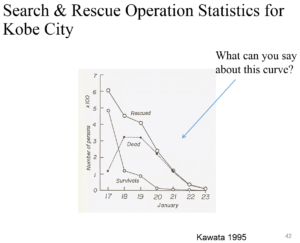
The next question is: what can you say about the following Figure 1?

rescue
Figure 1: Search & Rescue Operation Statistics

You can see the survival rate dramatically dropped after 3 days and 72 hours. The experts say this 72 hours after the disaster, especially earthquake, is golden 72 hours. This is a well-known phrase even before the Kobe earthquake.

Day_75 : Okushiri Island (2)

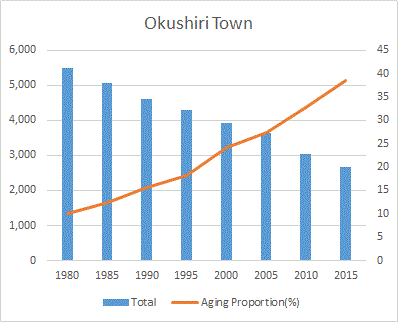
The 1993 southwest-off Hokkaido earthquake hit okushiri island severely. The number of casualties was 165. Okushiri town had faced population-decreasing and aging issues before the disaster. After the disaster, Okushiri town had a lot of aids, especially from inside of Japan. Japan had a very good economy at that time, so the situations enabled them to have such huge aids. Even though the large economic assistance, the town’s demographic tendency before the disaster was facilitated. total population is from 4,604 (1990) to 2,662 (2015), and the aging proportion over 65 is from 15.6% (1990) to 38.6% (2015)*.

Below is the graph, which indicates the demographic changes on the island.
okushiri population

Some disaster recovery theories can be referred to explain this tendency clearly We should learn from this lesson to consider for our common sustainable futures.

*Day_43

https://disasterresearchnotes.site/archives/2510

[ad#ads1]

Day_107 : Italy-Recent earthquake and past earthquake disasters

Below is the outline of the earthquake disaster in Italy from ADRC.
“A magnitude 6.2 quake hit at 03:36 (01:36 GMT) on April 24, 2016, 100km (65 miles) north-east of Rome, in central Italy. More than 70 people were killed in the earthquake.”

However, Reuters mentioned, “The death toll from a devastating earthquake in central Italy climbed to 250 on Thursday as rescue teams scoured mounds of rubble for a second day in towns and villages flattened by the natural disaster.” on Friday, two days after the quake.

In addition, the source also added, “Almost 200 of the victims died in Amatrice, which is famed for a local pasta dish and was full of holiday makers ahead of its 50th annual food festival, set for this weekend.”

Historically speaking, Italy has had a lot of earthquake disasters that have caused huge numbers casualties. Italy has had 44 earthquakes that have caused over 1,000 deaths since 1600. The interval is approximately . 25 years. They happened mostly in the central and southern part of Italy around the Apennine mountains and caused huge casualties. One of the reasons they had a large number of casualties was the stone-built houses.

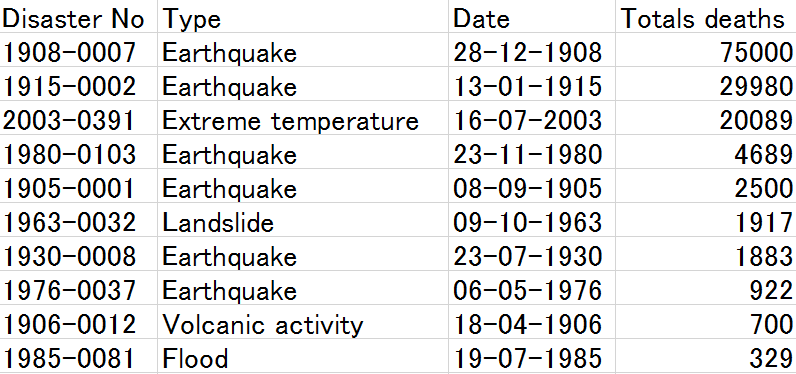
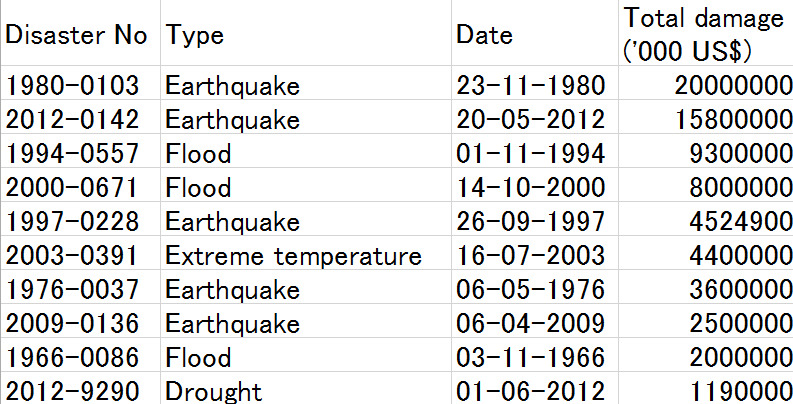
Table 1 and Table 2 show the 1900–2016 top 10 deadliest and costliest disasters in Italy (EM-DAT).

Table 1: Total deaths
Italy deadliest

Table 2: Total damage
Italy costliest disasters

Southern Italy had an earthquake (M6.9) in Campania (1980 Irpinia earthquake), the dead number is approximately . 4700, damage is 20 billion USD. The 2009 L’Aquila earthquake (M6.3) occurred and caused approximately death and 2.5 billion USD damage. This earthquake became controversial because the scientists and government officers were sentenced to six years in prison for their false announcement. The quality of construction also became an issues “Once again, we are faced with a lack of control over the quality of construction.” “In California, an earthquake like this one would not have killed a single person,” Franco Barberi, who heads a committee assessing earthquake risks at Italy’s Civil Protection agency, told reporters in L’Aquila (Reuters AlertNet) after the quake.

1908 Messina earthquake (M7.1) had caused the highest death number (75,000) in Italian history since 1900.

Reuters said still now (26, 2016), “Italy has a poor record of rebuilding after quakes. About 8,300 people who were forced to leave their houses after a deadly earthquake in L’Aquila in 2009 are still living in temporary accommodation.”


Day_188: Developing Flood Disaster Preparedness Indices (FDPI) for Thailand

The methodology involves a comprehensive approach to developing Flood Disaster Preparedness Indices (FDPI) for Thailand, with a focus on the cases of Ubon Ratchathani and Hat Yai. The FDPI was developed as a typhoon committee’s project as well as an ICHARM project. The outcome was polished, altered, and customized, and we are using the Indices as a selp capacity assessment tool.

Methodology

The development of Flood Disaster Preparedness Indices (FDPI) in Thailand was driven by a need for a standardized set of indicators that could assess the flood preparedness of local communities comprehensively. The methodology was designed to address the complexities of flood disaster management, acknowledging the balance between structural and non-structural measures (UNISDR, 2015) and the significance of community-based disaster risk management, especially in developing countries (Maskrey, 2011).

Literature Review and Theoretical Framework

An extensive literature review was conducted to understand the existing frameworks and measures used globally for evaluating disaster preparedness, with a particular emphasis on flood disasters. This review helped in identifying gaps in existing indices and provided a theoretical basis for developing a new set of indices that are universally applicable, considering both structural and non-structural elements of disaster risk management (Twigg, 2004; UNISDR, 2009).

Field Surveys and Data Collection

Field surveys were conducted in Bangkok, Ubon Ratchathani Province, and Hat Yai District, including interviews and questionnaire surveys. The surveys aimed to gather first-hand information on local disaster preparedness levels, community awareness, and existing infrastructure. This approach aligns with participatory methods recommended in disaster preparedness research, emphasizing local knowledge and engagement (Gaillard & Mercer, 2013).

Creation of Indices and Diagrams

Based on the literature review and field survey data, a comprehensive set of indices was created. The indices covered various aspects of disaster preparedness, from infrastructure and planning to community awareness and leadership. The creation of these indices was informed by best practices in disaster management literature, including the importance of comprehensive planning, community involvement, and the integration of local and scientific knowledge (Paton & Johnston, 2001; Cutter et al., 2008).

Analysis

The collected data were analyzed using principal component analysis and cluster analysis to identify key components of flood disaster preparedness and to categorize communities based on their preparedness levels. This analytical approach is consistent with methodologies used in similar studies, facilitating the identification of patterns and trends across diverse datasets (Jolliffe & Cadima, 2016).

Validation and Iteration

The FDPI was subjected to several rounds of validation, including expert reviews and community feedback sessions. This iterative process ensured the reliability and applicability of the indices across different communities, addressing the need for flexible and adaptable disaster preparedness tools (Few, 2007).

Source Papers

References:
1. Cutter, S. L., Boruff, B. J., & Shirley, W. L. (2008). Social vulnerability to environmental hazards. Social Science Quarterly, 84(2), 242-261.
2. Few, R. (2007). Health and climatic hazards: Framing social research on vulnerability, response, and adaptation. Global Environmental Change, 17(2), 281-295.
3. Gaillard, J. C., & Mercer, J. (2013). From knowledge to action: Bridging gaps in disaster risk reduction. Progress in Human Geography, 37(1), 93–114.
4. Jolliffe, I. T., & Cadima, J. (2016). Principal component analysis: A review and recent developments. Philosophical Transactions of the Royal Society A: Mathematical, Physical, and Engineering Sciences, 374 (2065), 20150202.
5. Maskrey, A. (2011). Revisiting Community-Based Disaster Risk Management. Environmental Hazards, 10(1), 42–52.
6. Paton, D., & Johnston, D. (2001). Disasters and communities: vulnerability, resilience, and preparedness. Disaster Prevention and Management: An International Journal, 10(4), 270–277.
7. Twigg, J. (2004). Disaster risk reduction: mitigation and preparedness in development and emergency programming. Humanitarian Practice Network.
8. UNISDR (2009). Terminology on Disaster Risk Reduction. United Nations International Strategy for Disaster Reduction.
9. UNISDR (2015). Sendai Framework for Disaster Risk Reduction 2015–2030. United Nations International Strategy for Disaster Reduction.This methodology reflects a comprehensive approach to developing a set of indices that can assess and enhance flood disaster preparedness at the community level. Through a blend of theoretical understanding, field research, and community engagement, the FDPI aims to contribute significantly to disaster risk reduction efforts in Thailand and potentially other similar contexts globally.

Day_187: Disaster Definitions


Day_23 : The Definitions


Disasters are indeed categorized based on their origin and the factors that contribute to their occurrence. This categorization into natural, technological, and human-made disasters is critical for understanding the varying dynamics of disaster risk, management, and mitigation strategies. Here’s a brief overview of each category, along with references that provide in-depth insights:

1. Natural disasters: These include earthquakes, hurricanes, floods, wildfires, and volcanic eruptions as examples of natural processes and phenomena. Even though human activity can exacerbate their effects, natural disasters are frequently beyond human control.

Reference: Cutter, S. L. (2005). The Geography of Social Vulnerability: Race, Class, and Catastrophe. Social Science Quarterly, 84(2), 242-261. This work explores the social dimensions of vulnerability to natural disasters, highlighting the intersection of social factors with natural phenomena.

2. Technological Disasters: Also known as anthropogenic or man-made disasters, these occur as a result of technological or industrial accidents, infrastructure failures, or specific human activities that lead to catastrophic events. Examples include chemical spills, nuclear accidents, and industrial explosions.

Reference: Perrow, C. (1984). Normal Accidents: Living with High-Risk Technologies. Princeton University Press. Perrow analyzes the inherent risks of complex technological systems and the inevitability of failures that lead to disasters.

3. Human-Made Disasters: This category includes events that are a direct result of human actions but are not necessarily related to technological failures. These can include acts of terrorism, armed conflicts, and widespread violence. Human-made disasters are characterized by their intentional nature and the purposeful infliction of harm on communities or the environment.

Reference: Wisner, B., Blaikie, P., Cannon, T., & Davis, I. (2004). *At Risk: Natural Hazards, People’s Vulnerability, and Disasters*. Routledge. Although primarily focused on natural hazards, this book provides a comprehensive framework for understanding vulnerability and resilience in the context of various disaster types, including human-made events.

Each of these categories underscores the need for tailored approaches to disaster risk reduction, preparedness, response, and recovery. Understanding the specific characteristics, causes, and impacts of each type of disaster is crucial for developing effective management and mitigation strategies.

Day_186: Timeline for Hurricane Sandy

Moving forward, it is crucial that we continue to prioritize disaster management and invesin mitigation measures to minimize the impact of future disasters. This includes implementing resilient infrastructureconducting regular risk assessments, and engaging with communities to ensure their activparticipation in preparednesand recovery efforts. Additionally, we must continue to improve our communication strategies, utilizing various channels to disseminate timely and accurate information to the public. By learning from the lessons of Hurricane Sandy, we can strengthen our disaster management plans and better protect our communities in the face ofuture challenges.

Hurricane Sandy, which struck the East Coast of the United States in October 2012, is often cited as a case where disaster management and the use of a disaster management timeline played a crucial role in mitigating impacts and facilitating recovery. The response to Hurricane Sandy involved extensive pre-event planning and post-event recovery efforts that spanned the four phases of disaster management: mitigation, preparedness, response, and recovery.

1. Mitigation
Prior to Hurricane Sandy, New York had already invested in some mitigation measures based on lessons learned from previous storms, though the scale of Sandy’s impact highlighted the need for more extensive measures.

How New York Used Mitigation:
The city had begun to implement its PlaNYC initiative, aimed at preparing the city’s infrastructure for the impacts of climate change, including rising sea levels and more frequent severe weather events.

2. Preparedness
As Hurricane Sandy approached, New York’s state and city officials took several steps to prepare for the impending storm.

How New York Used Preparedness:
Evacuation Orders: Mandatory evacuation orders were issued for residents in low-lying areas, known as Zone A, affecting approximately 375,000 people.
Public Information: Information was disseminated through multiple channels, including social media, to keep the public informed about the storm’s progress and safety measures.
Transit Shutdown: The Metropolitan Transportation Authority (MTA) shut down subway, bus, and commuter rail services in anticipation of the storm to protect the system and its users.

3. Response
Once Hurricane Sandy made landfall, the response phase was immediate, with efforts focused on life-saving measures and ensuring the safety of the affected population.

How New York Used Response:
Emergency Services: First responders and emergency services worked tirelessly to rescue those stranded by the floodwaters and to provide immediate aid.
Power Restoration: Efforts were quickly organized to restore power to the millions of residents left in the dark.
Supply Distribution: Critical supplies, including food and water, were distributed to residents, especially in the hardest-hit areas.

4. Recovery
The recovery from Hurricane Sandy has been long-term, with efforts ongoing in some areas years after the storm.

How New York Used Recovery:
Rebuilding Infrastructure: Significant investments were made to rebuild and strengthen the city’s infrastructure, including electrical grids, transportation systems, and coastal defenses.
Resilience Planning: The storm’s impacts led to a heightened focus on resilience and the development of more robust plans to protect against future disasters, such as the “Rebuild by Design” competition that sought innovative solutions for coastal protection.
Community Support and Rebuilding: Efforts were made to support affected communities through the rebuilding process, including financial assistance for homeowners and businesses.

Lessons Learned and Implementation
The response to Hurricane Sandy highlighted the importance of preparedness and the need for robust mitigation and recovery planning. New York’s experience with Sandy has informed subsequent disaster management efforts, emphasizing the need for resilient infrastructure, comprehensive planning, and community involvement in disaster preparedness and recovery strategies.

The use of a disaster management timeline in the context of Hurricane Sandy demonstrated how proactive and reactive measures can mitigate the impact of such events and aid in the recovery process. It also showed the importance of continuous improvement in disaster management plans, incorporating lessons learned to enhance future preparedness and response efforts.

References:

Rosen, Y., & Yakubov, N. (2013). Hurricane Sandy: Lessons Learned from the Severely Damaged Coney Island Hospital, Prehospital and Disaster Medicine, 28(6), 643. https://doi.org/10.1017/S1049023X13008807

Barthel, E. R., Pierce, J. R., Speer, A. L., Levin, D. E., Goodhue, C. J., Ford, H. R., Grikscheit, T. C., & Upperman, J. S. (2013). Delayed family reunification of pediatric disaster survivors increases mortality and inpatient hospital costs: A simulation study. *Journal of Surgical Research*, 184(1), 430. https://doi.org/10.1016/j.jss.2013.05.040

Deitchman, S. (2013). Enhancing Crisis Leadership in Public Health Emergencies. Disaster Medicine and Public Health Preparedness, 7(5), 534. https://doi.org/10.1017/dmp.2013.88

Schmeltz, M. T., González, S. K., Fuentes, L., Kwan, A., Ortega-Williams, A., & Cowan, L. P. (2013). Lessons from Hurricane Sandy: A Community Response in Brooklyn, New York. *Journal of Urban Health*, 90(5), 799. https://doi.org/10.1007/s11524-013-9818-9

Freund, A., Zuckerman, N., Luo, H., Hsu, H.-H., & Lucchini, R. (2014). Diesel and Silica Monitoring at Two Sites Following Hurricane Sandy. *Journal of Occupational and Environmental Hygiene*, 11(9), D131. https://doi.org/10.1080/15459624.2014.916809

Solecki, W., & Rosenzweig, C. (2014). Climate Change, Extreme Events, and Hurricane Sandy: From Non-Stationary Climate to Non-Stationary Policy. *Journal of Extreme Events*, 01(01), 1450008. https://doi.org/10.1142/S2345737614500084

Johnson, D. A. (2023). Exploring the Effectiveness of 311 Data in Disaster Recovery and Response: A Case Study of Hurricane Sandy in New York City. *Academic Commons*. Columbia University. https://academiccommons.columbia.edu/doi/10.7916/p6h0-vp31

Petkova, E. P., Beedasy, J., Oh, E. J., Sury, J., Sehnert, E. M., Tsai, W.-Y., & Reilly, M. J. (2017). Long-term Recovery From Hurricane Sandy: Evidence From a Survey in New York City. (Disaster Medicine and Public Health Preparedness). https://doi.org/10.1017/dmp.2017.57

Federal Emergency Management Agency. (n.d.). Remembering Sandy Five Years Later. Retrieved from https://www.fema.gov

These references cover a range of topics related to the impact of Hurricane Sandy, including healthcare challenges, family reunification, crisis leadership, community responses, monitoring of environmental hazards, policy changes due to climate change, the effectiveness of using public data for disaster recovery, and long-term recovery challenges faced by residents.