Dr. Nakasu is a post-doctoral fellow and an adjunct lecturer at College of Population Studies, Chulalongkorn University in Thailand. He had been working at NIED (National Research Institute for Earth Science and Disaster Prevention) as a principal research fellow and ICHARM (International Centre for Water Hazard and Risk Management), PWRI (Public Works Research Institute) as a research specialist in Japan for a decade. He has conducted many disaster field surveys such as Indian Ocean Tsunami (2004), Hurricane Katrina (2005), Typhoon Ondoy and Pepeng (2009), Great East Japan Earthquake and Tsunami (2011), and Chao Phraya River Flood (2011). He also conducted abundant disaster management research around the globe. He had been a project leader of the Working Group of Hydrology, the Typhoon Committee (WMO and UN/ESCAP) for nearly 3 years. He was also a visiting researcher at JICA (Japan International Cooperation Agency) and an adjunct instructor at several universities in Japan. He won a second prize for his poster presentation at the Society for Risk Analysis-Asia Conference in Taipei in 2014. He is a tsunami evacuation research committee member of the Japanese Association for Earthquake Engineering (JAEE). His research interests include the environment and comparative studies.
日本語版:
中須正
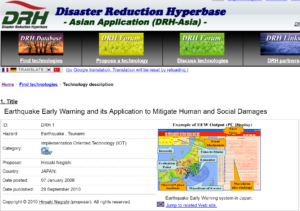
I want to introduce you to two disaster technology websites: DRH Asia-Disaster Reduction Hyperbase and Global DRR Technology.
The websites below are unavailable today (2024.12.14 confirmed); however, we can still learn the concept and idea as a significant theme.
1) DRH Asia
This site provides qualified information about DRR technology. Its content is easy to grasp, making it possible to transfer DRR technology. The content comes from many Asian countries and has been reviewed by experts. The challenge is the limited number of contents.
We can understand the quality and availability of the content.
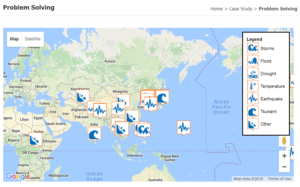
2) Global DRR Technology This site focuses on an online Community of Practice(CoP) in Disaster Risk Reduction(DRR). Although the content is limited, the site can be easily accessed. The case study site is incredibly visually appealing.
The site below is an example of a case study site. (Figure 2)
ADRC is established in 1998 after the Kobe Earthquake. Kobe city’s population had caught up the same level before the disaster in 9 years. Kobe reinvents itself as a center of disaster reduction policies and activities in the world. There are so many disaster-related organizations in HAT Kobe. The HAT means “Happy and Active” and also “surprised” in Japanese. This is a good example to refer to for the disaster recovery process. We can learn the lessons from Kobe. ADRC contributes to disaster reduction policies and activities for member countries in Asia. We can check member countries disaster management systems, country reports, and others. We can also confirm the updated disasters on the ADRC’s website.
I will update a column of the NIED e-mail magazine I wrote long ago because the content does not fade with time. (I will do this step by step in Japanese and English.) I will also add comments to update the situation.
Sorry, I am now revising this post because of the translation difficulties. This post will be revised again. Thank you.
Published May 6, 2010 NIED-DIL e-mail magazine: Disaster Warning (1)
■ Disaster Warning (1) ■
In February 2008, a survey provided an opportunity to visit Hawaii’s Pacific Tsunami Warning Center (PTWC). In a study, I interviewed the director of the PTWC, and the first thing that caught my attention was the role of the media. The director told me that a public tsunami evacuation alert was required three hours before the event, which was too time-sensitive, but the press was an advantage to do this. However, there were various restrictions for the government organization, such as warnings in an international framework. I remembered the Chilean Navy’s disaster response to the damage caused by the earthquake and tsunami in Chile in February this year.
Next, I was interested in science, technology, and data, which are the basis of alarm decisions. I think regular (flood, etc.) warnings will be judged based on current and past data, but especially for tsunami warnings, there were errors in the original earthquake and the tide gauge data. To judge, we should know that 99.99 percent of the errors could be caused by error. The fact that past data is not very useful because the devices to figure out the data are changing daily, making it difficult to rely on it.
From these facts, it was generally noticed that the disaster warning was based on the combination of the progress of science and technology and the competence of the person in charge. The actual warning also relies on the institution belonging to it. For example, variables such as the recipient of the alert, the psychology of the local people, the social situation, and various systems also needed to be added.
On that day… “A big typhoon is coming,” my father declared, returning home early from work. “If it takes the worst possible path, we’ll be on the right side of the typhoon, so it’s going to be bad,” he said as he nailed wood to reinforce the window glass, preparing for the typhoon as we always did.
By just after 8 PM (?), we had finished dinner and were getting ready for the typhoon. “The wind is getting incredibly strong. The house might collapse,” he worried more than usual about the house falling apart and started to prepare. He stacked futons about a meter high in a U-shape in front of the dresser to create a bunker-like structure, and all five of us got inside.
My brother and I had packed our clothes in plastic bags and were wearing our backpacks. My father, preparing for the house to collapse, had a hammer hanging from his waist. My mother had a flashlight at her waist. The wind grew stronger, and when my father went around the house to check, he called me to help hold the windows.
“For the first time, I understood the ‘breath’ of a typhoon. As the typhoon ‘exhaled’—’Whooosh’—the window glass bulged outward, looking like it might shatter at any moment. Rather than holding it down, it felt more like we were pulling on the window muntins to prevent them from flying away, which was extremely difficult due to the ferocious wind.
“It’s no use. The house is going to collapse. Get under the futons,” he said, and I quickly returned to where my grandmother and brother were. Right after that, “What’s that noise?”… “It’s water!” my father exclaimed. At the front door, water began trickling in through the threshold, dribbling onto the earthen floor.
“We can’t stay in the house with the water. Let’s escape to Akiba Shrine at the back,” he decided.
As he lifted my bent-backed grandmother onto the top tier of the closet, my mother carried my first-grade brother on her back, and my father led me by the hand to the front door. When he opened the sliding door, the murky water reached up to his chest in an instant. “Oh!” was all he could say as he grabbed the post of the sliding door to support himself. The current swept me to the right; only my fingertips managed to cling to either his collar or shoulder blade. At that moment, I saw my mother and brother on the tatami at the front of the house, but I don’t remember anything from then until we got on the roof of the kitchen.
During this time, my mother and brother heard my repeated cries of “My hands are slipping! Help!” And at that same moment, the wooden fence outside the house washed past between my father and the post he was holding, and the muddy water rushed into the house. My father thought he had lost me when my hands slipped from his neck.
My father and I were likely pushed inside by the current. I’m not sure… From then on, my mother and brother only remember fragments. Unable to escape outside, we took refuge in the attic. As the water rose, the tatami mats began to float, and I saw the TV sinking into the water as we fled. The fear of that moment is unforgettable, my mother says. “Even though it was dark due to the power outage, something was still bright,” my father and I said as we clung to the pillars and crossbeams in the courtyard, trying not to float on the rising tatami. The kitchen wall was there, so the water reached the eaves of the roof, which were quite deep, but the force seemed a bit diminished. My father managed to get onto the roof first, holding onto the gutter and then pulling me up onto the roof.
When we crossed the roof, my foot slipped. It was a tin roof. “Don’t slip! Don’t fall! The sea is to the right,” my father’s loud voice I remember well. The stormy weather was intense; looking to the right, the water was a vast expanse, moving incredibly fast and shining brilliantly. I can’t forget the depth of the water and its swift flow.
My mother, carrying my brother, was also swept by the water while clinging to a post between the veranda and the courtyard. My brother recalled, “At that time, I was really uncomfortable squeezed between Kamo-san and our mother’s shoulders.” After seeing me on the roof, my mother managed to get there, clinging to something until my father pulled her up. My father told her to get on the roof too, but she said, “It’s okay. I’m fine here. I can’t go on.” I thought I heard my mother say she was going to die from that moment
on, and I kept screaming, “Help! Help!” but I don’t remember anything after that. Later, my father also pulled her onto the roof.
My father was breaking the tiles on the main roof with a hammer to create an opening to the attic. I don’t remember how I got there, but I found myself near my father on the tin roof, and he was tossing the broken tiles aside and digging into the dirt beneath them. Suddenly, the wind and rain stopped. Looking up, the sky was full of stars. I clearly remember that. Later, I learned that we had been in the eye of the typhoon. Eventually, our family of four entered the attic through this opening in the roof about the size of four tiles. When we got into the attic, I noticed my fingertips were muddy and slightly bleeding.
My father warned my brother, “Be careful with the thin ceiling boards. If you step through, there’s the sea below.” My brother and I sat on a thick beam in the attic and changed into dry underwear and clothes from our backpacks. We didn’t know how high the water would rise, and since the roof might float if the water reached the eaves, we were tied to the beam and utterly exhausted.
Our parents were worried about our grandmother, who was in the closet with the water up to her legs, and considered bringing her into the attic. At that moment, my grandmother reported, “It seems like the water has stopped!” In the middle of the night, the fire brigade came around to check on us. At that time, my parents couldn’t help but shout, “We’re okay. We’re in the attic!”
As dawn broke and the voices outside exclaimed, “The water has receded!” we also came down from the closet.
I am a fourth-grader. My brother is a first-grader.
This time, due to a curious fate, I had the chance to talk about the Isewan Typhoon for the first time in 50 years, remembering “that time” with my mother and brother. Our memories are all fragmented. The fear started “when the water trickled in,” and we can’t be sure about the passage of time or even how deep the water was—maybe about two meters. But it’s certain that all five of us survived.
“Carried by the water, pushed by the water, floating in the water, it was just good luck moment by moment.”
“It’s good that the kitchen roof didn’t get carried away. The four of us were saved because of this roof.”
These are the real feelings of my mother, brother, and me. I am grateful for this opportunity to share.
Acknowledgement: We are deeply grateful to the anonymous interviewee for sharing her harrowing experience. We strive to honor her precious time and valuable contribution.
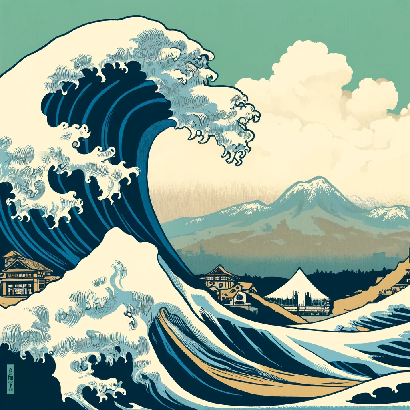
80% ofall tsunamis occurring in the world are concentrated in the Circum-Pacific Belt.The leading countries researching the tsunami are Japan, the U.S., and Russia. The tsunami is originally a Japanese term that means a high tidal wave. The name was used by Japanese immigrants during a tidal wave caused by the 1946 Aleutian Islands earthquake (tsunami) hit in Hiro, Hawaii and it became an international word, especially an academic word, ”Tsunami”. The International Union of Geodesy and Geophysics (IUGG) is in charge of a tsunami session at the start of an international conference about tsunamis. “Tsunami” became public after the 2004 Indian Ocean Tsunami disaster.
*The word “tsunami” is composed of the Japanese words “Tsu” (which means harbor) and “Nami” (which means “wave”)(ITIC)
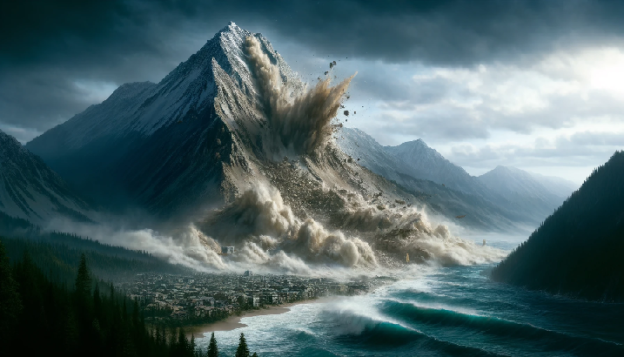
In 1970, a major earthquake (magnitude 7.7) in Peru caused a massive collapse of the summit of Mount Huascaran in the Andes. The large amount of rock and ice (about 100 million cubic metres) that fell from the mountain flowed down for about 14.5 kilometres at more than 300 kilometres per hour. This flow over a 230-meter-high ridge covered the town of Yungai, with a population of 25,000, in a 5-meter-thick layer, killing around 15,000 people.
Meanwhile, in Japan, a 6.8-magnitude earthquake in 1984 in western Nagano Prefecture caused the collapse of some 36 million cubic metres of earth and rock at Kiso-Ontake; in 1792, Mount Unzen-Mayuma probably collapsed in an earthquake, causing some 340 million cubic metres of rock to collapse and flow into the Ariake Sea, causing a tsunami of up to 23 metres.
In an ordinary landslide, the coefficient of friction that indicates the distance and speed at which rocks and soil move is around 0.5, but in a particularly large debris avalanche, this can drop to 0.1 and move much further and faster. Large volcanoes are more prone to such large landslides because of the instability of their internal structure.
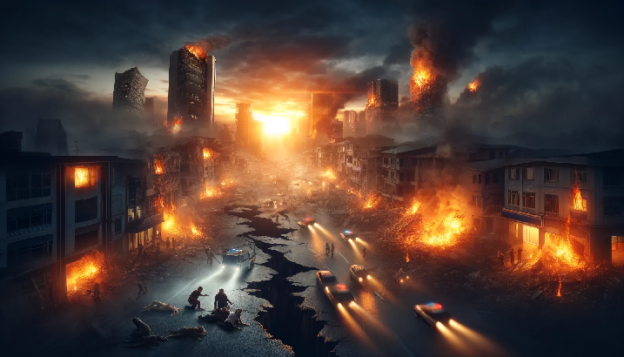
When an earthquake strikes, fires start simultaneously in many places. The combination of dispersed firefighters’ ability to extinguish fires, broken buildings and unusable roads, broken water supplies and water shortages, and congested roads with many cars makes it very difficult to extinguish fires. For these reasons, large-town fires are more likely to occur during earthquakes. This is especially true in wet areas like Japan, where buildings are mainly made of wood and fires can spread over them as they break down, causing more damage. In dry areas, many houses are made of brick or stone, which are often completely destroyed by earthquakes.
During the Great Kanto Earthquake of 1923, 320,000 houses, or about 62% of the houses in Tokyo, were burned down. There were 136 fires, 76 of which spread widely, burning as much as 44% of the city in three days. Almost all (95%) of the deaths were caused by fire. Almost the same proportion (63%) of houses burned down in Yokohama. History shows that every time there has been a major earthquake, there has also been a major fire. The basic measure against fires caused by earthquakes is to make the house earthquake-proof and prevent it from collapsing.
Japan was vulnerable after the Second World War, so we had many natural disasters, especially Typhoon disasters, from 1945 to 1959. Some call this 15 years a great flood and storm era. The first hit was Typhoon Makurazaki on September 15, 1945*. The typhoon hit Hiroshima city. There were 1229 casualties in the city. This fact reminds us of what happened in Hiroshima in the same year. The atomic bomb hit Hiroshima city this August. We had no weather forecast system during the war because of military reasons. The people in Hiroshima were living in vulnerable houses because the bomb hardly hit them. They did not have enough information about the typhoon’s coming, either. Therefore, this typhoon disaster is a complex disaster consisting of natural, technological, and human-made disasters.
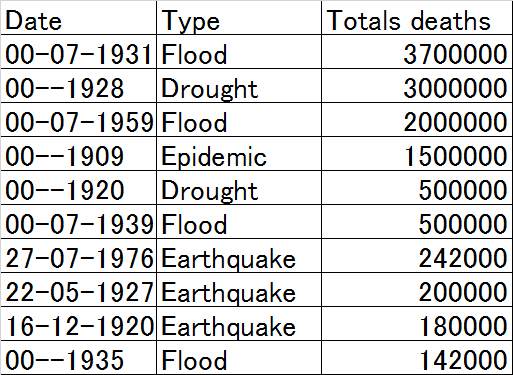
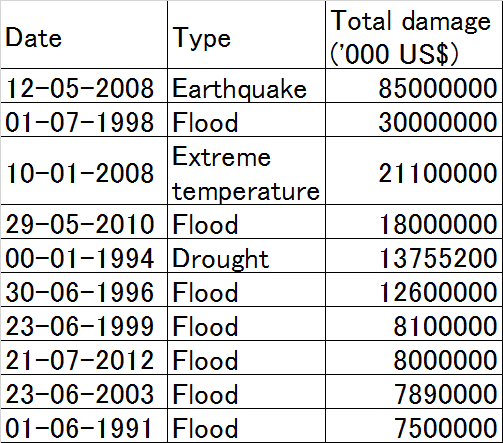
The overviews of Natural Disasters in China are the followings:
1) Death numbers Source: EM-DAT
2) Affected numbers Source: EM-DAT
3) Damage costs Source: EM-DAT
Natural disasters in China are very large scales, reflecting country’s population and geographical size. Also, we need to know that China has a rapidly growing economy. We can confirm the normal historical trends of natural disasters, from human sufferings to economic damages, which this note already mentioned (Day 77). For instance, the top 10 deadliest natural disasters in China are all before 1970s. On the contrary, the top 10 costliest natural disasters in China all occurred after 1990s.
Two Earthquakes Yang Zhang William Drake et al. (2016)* indicate interesting views on two earthquake disaster recoveries: the 1976 Tangshan earthquake and the 2008 Wenchuan earthquake. The point is why the 2008 Wenchuan earthquake recovery was so rapid compared to the 1976 earthquake.
However, the paper could add the total background changes in China, such as the economy and politics. China has changed dramatically since 1976, from historical viewpoints.
A comparison of the two earthquakes will be explained.
Yang Zhang William Drake et al. (2016), Disaster Recovery Planning after Two Catastrophes: The 1976 Tangshan Earthquake and the 2008 Wenchuan Earthquake, International Journal of Mass Emergencies and Disasters, 34(2):174–200.
On the early morning of May 23, 1960, a massive earthquake, the largest ever recorded with a magnitude of 9.5, struck southern Chile. This earthquake unleashed a tsunami that swiftly crossed the Pacific Ocean, reaching the Japanese coast about 22.5 hours later. The tsunami, which surged up to 8 meters high, resulted in 139 deaths and caused the destruction or displacement of 2,830 buildings across Japan. Due to the geographical position of Chile opposite Japan, the tsunami’s impact was more pronounced upon reaching the Japanese shores. These distant tsunamis are particularly challenging to forecast since they occur without the preliminary tremors typically associated with earthquakes. Consequently, regions prone to seismic activity, particularly around the Pacific, including Hawaii, have established early warning systems.
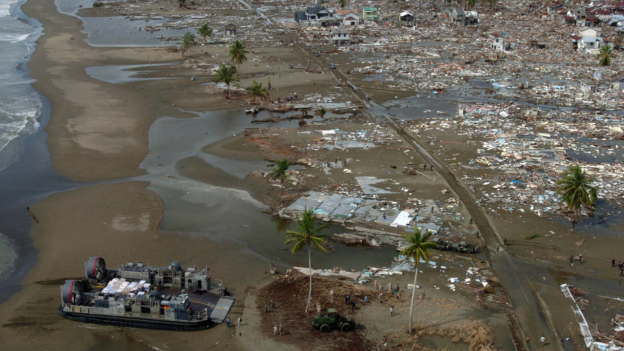
In 2004, the Indian Ocean was struck by another significant earthquake, which triggered a devastating tsunami. At that time, the absence of a tsunami warning system in the Indian Ocean contributed to a staggering death toll of 300,000. The effectiveness of tsunami warnings is limited by their ability to reach extensive coastal areas promptly. Therefore, it is crucial for residents to be aware of their local environmental characteristics and rely on personal judgment and preparedness to mitigate the risks posed by tsunamis.