Category Archives: Lessons

Day_140 : Natural Disasters in Europe (2) Vajont Dam Collapse


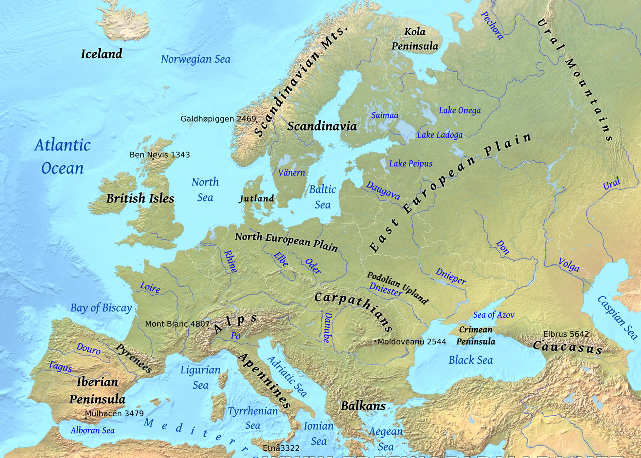
europe-pic
Figure   The Europe

Concerning hydrological, meteorological, and climatological disasters, heavy rain and storm disasters are caused by low  pressure in the Icelandic area developed in the winter season. A cold atmospheric current coming from Arctic gains a warmer vapor stream from the Gulf Stream and develops a strong atmospheric depression in the area. This causes the strong winds and high tidal waves along the coastal areas of the North Sea. Netherlands and England can be highlighted. The Netherlands had storm surges in 1530 and 1570. The death tolls were approximately 400,000 (1530) and 70,000 (1570) for each. The 1953 depression took 1800 deaths. This disaster also reached England. England’s disasters were the 1703 Thames river flood and the 2003 Heatwave. The temperature was 8–10 over an average year in August 2003 (Day 38).

Danube, Elbe, Rhine, and Seine rivers are on a gentle slope, causing slow inundations caused by heavy rains. On August 2, 2002, Central Europe had heavy rain, which caused the Danube and Elbe rivers to overflow in Germany, Czech Republic, Austria, and Hungary. The death toll is approximately 100; the number of people affected is over 100,000. Historical buildings in the city, such as Prague,Dresden, and so on, along the rivers, were also inundated.

The Alps  have had landslides, debris flows, slope failures, and so on. The particular example is the landslide in the Dolomites, North Italy, in 1963. Overflows from Vajont dam caused by a large-scale landslide attacked the village in downstream areas. The death toll is approximately 2600.

A brief explanation


An interview-based explanation

On August 2003, West Europe had 8–10 degrees celsius higher than the average. This heat wave killed 15000 in France, 7000 in Germany, 4000 in Spain, 4000 in Italy, and so on, for a total of 35000.

In summer 2010, Russia had a heat wave and this makes wildfire. The wildfire was spread out and it took over 1.5 months to extinguish.Many villages were destroyed by the fire. Moscow was covered by harmful smoke. Over 55,000 people were killed by the heat wave and the smoke in Russia.

To be continued…
Day_139(Rev) : A Disaster Recovery in an Aging Society : An Okushiri Town’s Case


Based on the disaster recovery theories as mentioned before in Day_92, A Okushiri town’s disaster recovery could be predicted, however, the town still has a lot of difficulties in the disaster recovery process. This was shown in Day_75.

https://disasterresearchnotes.site/archives/2921


https://disasterresearchnotes.site/archives/2753


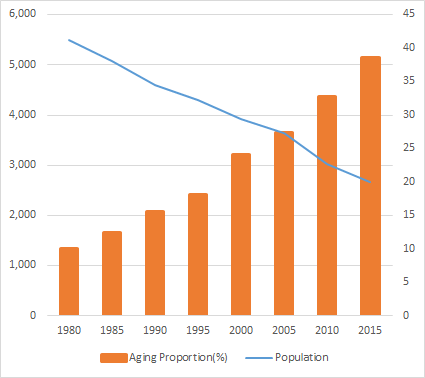
okushiri-recov

Figure 1 Demographic Changes in Okushiri Town

The 1993 southwest-off Hokkaido earthquake hit Okushiri Island severely. Casualties are 198 (including the missing number)and the economic damage indicator mentioned in the above is 0.03(Day_92). This means human suffering is relatively high however economic damage is not so high to the country. However, aid volume from outside is 14.4 percent, as the indicator, and this is so outrageously huge compared to disasters in Day_92. This can be said in the reflection of the Japanese economic situation during the time.

Okushiri town had faced population decreasing and aging issues before the disaster. After the disaster, Okushiri town had a lot of aids, especially from the inside of Japan. Japan had a very good economy at that time, so the situation enabled them to have such huge aids. Even though the large economic assistance, the town’s demographic tendency before the disaster was facilitated and faces a severe recovery process.

The population was dropped to the 2nd worst in Japanese municipalities between 2005 and 2010 after the disaster. Okushiri’s population was decreasing before and after the disaster, for example, 27.4 percent decreasing from 1990 to 2009. In addition, the population of the island had a declining tendency before the disaster and this was facilitated by the disaster. The decreasing population before the disaster can be confirmed as 5,490 in 1980 and 4,604 in 1990, this means 16 percent decrease.

The aging proportion increased two times from 1990(15.6) to 2010(32.7). The aging proportion (over 65) before the disaster was increased from 10.0 percent in 1980 to 15.6 percent in 1990. The Japanese economy was expanding at the time and a huge amount of aid was coming to the town from outside and installed, however, this Okushiri town’s case supports the recovery theory(Figure 1).

Over 20 years after the disaster, Okushiri town gives us a lot of lessons. The followings are the points that we can learn from the lessons to build a resilient society in demographic challenges.

1. Financial aids allocations: balancing soft and hard countermeasures
2. A Long perspective on the disaster recovery process

Concerning the Financial aids allocations, a huge amount of financial assistance rushed to the town, however, the assistance went to the infrastructures, building houses, purchasing fishermen’s ships, and so on to help the people’s lives in the town after the disaster. This shows more emphasis on the reconstruction than the recovery.

With respect to the recovery process, they tend to miss a long perspective. The people in the town could rebuild their houses and purchase new fishermen’s ships. Infrastructures are also rebuilt after the disaster. However, they have had not so attractive industries which the younger generation would like to work and remain in the town to live their lives. The Okushiri becomes high resistance against the disasters town, however, the population is decreasing and aging is facilitating dramatically. This means not so high resilient town. In addition, the cost of infrastructure maintenance will be a burden for the town in the long run.

To be continued……

# This post will be partly published as a paper.

Day_136 : Disaster-Related Death (1)

Kobe Earthquake : 919 (22Dec.2015)
Great East Japan Earthquake and Tsunami : 3,472 (31Mar.2016)

What are the numbers?

The above numbers are the numbers of disaster-related deaths. The disaster-related death means the death which is not directly caused by hazards such as sickness, disease, and committing suicide. Especially , the disaster-related death number of GEJET is still increasing even 5 years after the disaster. This reflects aging society. The elderly people tends to have sickness and losing hope without family members. Local governments have been working hard to prevent such tragedies. They are visiting and watching the victims individually.

Day_131 : Italy-Recent earthquake and past earthquake disasters (2)

CNN: (October 30)A powerful 6.6-magnitude earthquake rocked central Italy on Sunday morning, injuring at least 20 people, in the strongest tremor to hit the country in more than three decades. The earthquake follows tremors last week and comes on the heels of a devastating quake in August, which killed nearly 300 people and flattened entire villages.

Asian Disaster Reduction Center (ADRC) still does not list this earthquake situation.This earthquake is severer than this August Earthquake(Day_107). Earthquakes in Italy happened mostly central and southern part of Italy around the

http://disasters.weblike.jp/disasters/archives/3081

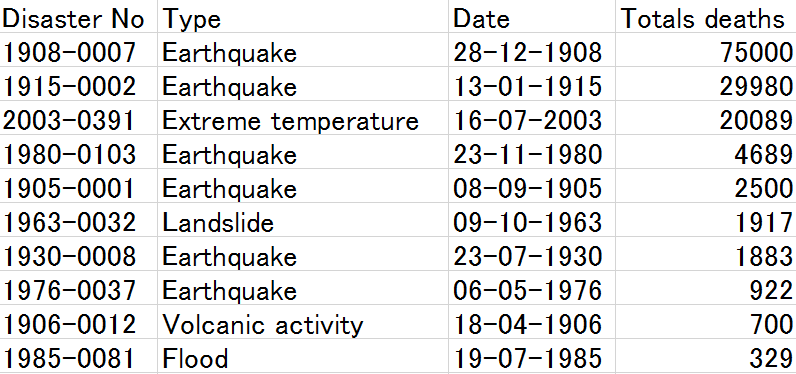
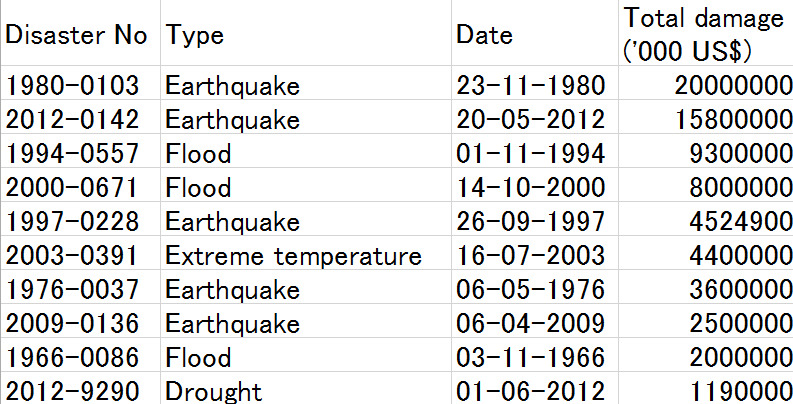
Natural disaster trends are usually from human sufferings to economic damage. In Italy, main natural disaster is the earthquake and follow the trends as you can confirm below.
However, recent earthquake disasters in Italy are so severe.  With this August earthquake, the number of casualties would be over 550. The disaster recovery is also the issue. As mentioned in Day_107, “Italy has a poor record of rebuilding after quakes. About 8,300 people who were forced to leave their houses after a deadly earthquake in L’Aquila in 2009 are still living in temporary accommodation(Reuters).”

Table 1 and Table 2 show the 1900-2016 top 10 deadliest and costliest disasters in Italy (EM-DAT).

Table 1  Totals deaths
Italy deadliest

Table 2  Total damage
Italy costliest disasters

Day_127 : World Disaster Chronology-1990-91

Date Place Disaster Type Situations
1990.01- Indonesia Heavy Rain, Flood Over 130(DM)
1990.03- Bangladesh Heavy Rain, Flood 170(DM)
1990.04- Africa, East Heavy Rain, Flood Over 140(DM)
1990.04.26 China, Qinghai Inland Earthquake M6.5, Over 120(DM) Landslide
1990.05- India Cyclone, Flood Over 3,000(DM)
1990.05.29 Peru, Central Inland Earthquake M6.5,130-200 (DM),Landslide
1990.06- Japan, Kyushu Heavy Rain, Flood 27(DM),Injured 80, Destroyed approx.500, Inundated over 42,000
1990.06.21 Iran, North Inland Earthquake 1990 Manjil–Rudbar earthquake*1),M7.3-7.7, 30,000-50,000(DM), destroyed several towns 
1990.07.16 The Philippines, Luzon Inland Earthquake 1990 Luzon earthquake*2), (M7.8),
1,700-2,400 (DM)
1990.08- China Heavy Rain, Flood Over 300(DM)
1990.08- The Philippines Typhoon, Flood 230(DM)
1990.09- Korea Heavy Rain, Flood Over 130(DM)
1990.09- Japan, Northeast Typhoon, Flood 40(DM), Injured 130, Destroyed approx.16,000, Inundation Over18,000
1990.10- Bangladesh Cyclone, Flood Over 3,000(DM)
1990.11- Tha Philippines Typhoon, Flood Over 350(DM)
1991.02.01 Afganistan Inland Earthquake M6.4,200-700(DM)
1991.04.22 Costa Rica Inland Earthquake M7.6, 70(D) with Panama
1991.04.29 USSR(Georgia) Inland Earthquake M7.0, Over100(DM)
1991.04- Bangladesh Cyclone, Flood 1991 Bangladesh cyclone*3), Over 139,000(DM). This disaster was among the deadliest tropical cyclones on record. 
1991.06- Japan, Kyushu Volcanic eruption Mt.Unzen Volcanic eruption*4),Pyroclastic flow,Over 40(D)
1991.06- The Philippines, Luzon Volcanic eruption Mt. Pinatubo Volcano eruption*5), 700-1000(DM)
1991.06- Pakistan Heat wave Over 300(DM)
1991.06- China Heavy rain, Flood Over 400(DM)
1991.07- India Heavy rain, Flood Over 900(DM)
1991.07- China Typhoon,Flood 200(DM)
1991.08- Korea Typhoon,Flood 100(DM)
1991.09- China Landslide Over 270(DM)
1991.09- Japan, all areas Typhoon,Flood 1991 Typhoon No.19, 62(DM)*6), Injured1,500, Destroyed approx.170,000, Inundation over 22,000
1991.10.20 India, North Inland Earthquake M6.8-7.0, 7702,000(DM)
1991.11- The Philippines, Central Typhoon, Flood Over 6,300(DM)*7)
1992.01- Bangladesh Cold Wave Over130(DM)

DM: The number of dead and missing.

1) Iran is one of the most vulnerable country on earthquake disasters.
The below Day_81 can be checked.
2) Buguio city was severely hit by this earthquake. The city is also vulnerable to landslide disasters. 2009 Typhoon Pepeng hit the Buguio city. There were some issues in this city. Urbanization is the one of the causes.
NIED natural disaster research report
3) Some past posts can be referred. The below Day_117 can be checked.
4) Some past posts can be referred.The below Day_65 can be checked.
5) A huge cloud of volcanic ash and gas rises above Mount Pinatubo, Philippines, on June 12, 1991. Three days later, the volcano exploded in the second-largest volcanic eruption on Earth in this century.Following this Mount Pinatubo’s cataclysmic June 15, 1991, eruption, thousands of roofs collapsed under the weight of ash made wet by heavy rains (see example in photo above). Ash deposits from the eruption have also been remobilized by monsoon and typhoon rains to form giant mudflows of volcanic materials (lahars), which have caused more destruction than the eruption itself(http://pubs.usgs.gov/fs/1997/fs113-97/).
6) Itsukushima Shrine, its complex is listed as a UNESCO World Heritage Site, was damaged.
7) The Ormoc region was inundated by Tropical Storm Uring.The city government recorded 4,922 deaths, 3,000 missing persons, 14,000 destroyed houses. We call this disaster “Ormoc Tragedy”

http://disasterresearchnotes.site/archives/2801

http://disasterresearchnotes.site/archives/3224


https://disasterresearchnotes.site/archives/2679


Day_124 : Chain Reactions of Economic Damage- 2011 Chao Phraya River Flood in Thailand (3) Horizontal and Vertical Damage Exacerbations

Continue to explain the chain reactions of economic damage caused by Chao Phraya river flood. There were horizontal and vertical damage exacerbations types.

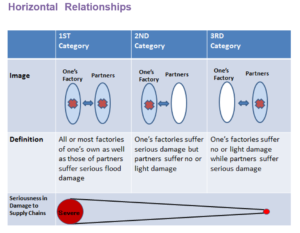
Concerning the horizontal damage exacerbations, we sometimes neglect indirect severe impacts caused by disasters. However, in this global world, economic activities are connected each other and so do the impacts. The following Figure 1 shows the three types of disaster exacerbations for example. The first category is “All or most factories of one’s own as well as those of partners suffer serious flood damage”. This category is the severest. The second category is “One’s factories suffer serious damage, but partners suffer no or light damage”. The third category is “One’s factories suffer no or light damage while partners suffer serious damage”. However, if the one’s factory totally relies on the partners which are affected by the disaster could have a very serious impact.

supply_holizontal
Figure 1  Damage types and severities (Horizontal)

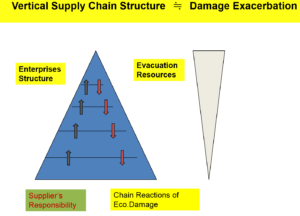
With respect to the vertical damage exacerbation, the key word is the suppliers’ responsibility. For example, a big major car company has the responsibility for customers to supply cars, subcontractors have the responsibility for the car company to supply the parts,  sub-subcontractors have the responsibility for the subcontractors to supply the parts of the parts, sub-sub-subcontractors have the responsibility for the sub-subcontractors to supply the parts of the parts of the parts, and so on. The numbers of the companies become larger along with this vertical pyramidal structure. However, their resources are opposite as mentioned in Figure 2. Industrial estates and parks ordered the evacuation for the companies very slowly at that time of the flood because of some reasons (The reasons will be explained). However, the big companies continued their activities until the time, so sub and sub-sub and sub-sub-sub contractors could not evacuate until the bigger (upstream) companies’ evacuation decision making because of the supplier’s responsibilities. The big companies could evacuate so fast and effectively. They have the resources to do so. However, smaller companies could not evacuate so fast because they needed to wait until the bigger company’s evacuation decision and they tended to have limited resources along with the structure. They, for instance, could not move heavy machines to the upper floors. They did not have enough employees, systems, or plans to do so.

supply_vertical
Figure 2  Damage types and severities (Vertical)

These are the outlines of the disaster damage exacerbation of the supply chains.  These are presented at several meetings in Japan.

Day_122 : Japanese Disaster History after the Second World War (2)

Japanese disaster history has three turning points. The first is the Typhoon Isewan (Vera) in 1959. The second is the Kobe earthquake disaster in 1995, the third is the Great East Japan Earthquake and Tsunami (GEJET) disaster in 2011(Day_33).

https://disasterresearchnotes.site/archives/2439

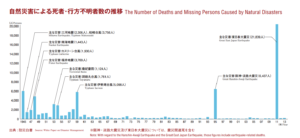
You can see the following figure 1 which displays the dead and missing numbers caused by natural disasters in Japan.

deathtollafterww2
Figure 1 The dead and missing numbers caused by natural disasters in Japan

After the second world war, Japan was vulnerable, so we had a lot of natural disasters, especially Typhoon disasters from 1945 to 1959. We call this 15 years a great flood and storm era. The first hit was Typhoon Makurazaki on Sep. 1945.The typhoon disrupted Hiroshima city. There were 1229 casualties in the city. This fact reminds us what happened in Hiroshima in the same year (Day_34(Re)).

https://disasterresearchnotes.site/archives/2866

The Isewan Typhoon has the following aspects: 1) Physical damages were tremendous 2) Lack of consideration of disaster prevention 3) Inadequate flood defense system 4) Inadequate warning and evacuation system ( The details will be explained later) After the Typhoon Isewan, disaster countermeasures basic act was enacted in 1961. The act combined many disasters related laws into one. After the Isewan Typhoon, we Japanese had thought we were successfully mitigating natural disasters.  You can see the dead and missing numbers were dropped right after the Isewan Typhoon by Figure 1.  This is mainly because of infrastructures and the development of science and technologies such as warning systems along with Japanese rapid economic growth. In addition, we had, fortunately, no huge natural hazards until the Kobe earthquake in 1995.

After the period of1960-1994, we have faced the Kobe Earthquake in 1995. Then, we realized that we could not prevent natural disasters, however, we could mitigate natural disasters after the earthquake. We also learned the importance of soft countermeasures as well as hard countermeasures. The Japanese Government had changed the policies again. The Kobe earthquake facilitated volunteer activities. Many social scientists started to investigate disasters. Before the disaster, natural scientists and engineers are the main players to do disaster-related research along with Japanese infrastructure centered policies. After that, we had confidence again and we thought we could be a model for other countries. The World Conference on Disaster Reduction was held in Kobe in 2005. Kobe city tried to be a center of world disaster-related organizations. (This Kobe earthquake disaster will be explained later)

However, we faced the Great East Japan Earthquake and Tsunami (GEJET) disaster in 2011. The GEJET disaster became the worst ever disaster in Japan after the second world war. The GEJET broke the Japanese confidence again and reconsider our strategies.

To be continued

*Disaster countermeasures basic act:
http://www.preventionweb.net/english/policies/v.php?id=30940&cid=87

sponsored link

Day_121 : Chain Reactions of Economic Damage- 2011 Chao Phraya River Flood in Thailand (2)

Continue the last topic.

http://disasters.weblike.jp/disasters/archives/3257

There were three inquiries to ponder as follows:
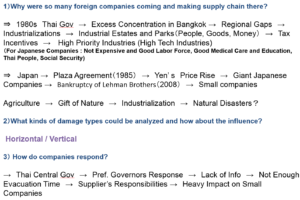
1) Why were so many foreign companies coming and making supply chains?
2) What kinds of damage types could be analyzed and how about the influences?
3) How did companies respond?

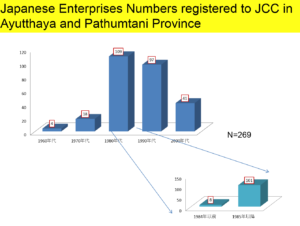
Concerning the 1) Why were so many foreign companies, especially Japanese companies coming and making supply chains? There are reasons from Thailand and Japan sides. The first, Thai national government tried to de-centralize to narrow the gaps between Bangkok and other regions because so many things concentrated in Bangkok. To do this, establishing industrial estates and parks is the one of the effective ways to mobilize the people, things, and investments from Bangkok to the regions. The national government also had set some tax incentives to motivate foreign companies to come. Thailand is the very nice place for Japanese to stay because of the education systems, medical services, abundant labor force, people’s character, safety, and so on. The second, Japan had faced the problems of the rising yen after the Plaza agreement in 1985. Big companies, especially manufacturers, which had international businesses decided to move to Thailand to produce their products. After the bankruptcy of Lehman Brothers in 2008, the world economic climate became worse and the yen’s price was getting higher and higher again. Small companies, this time, could not endure the situations and moved to Thailand to deal with the big companies which already transferred in Thailand. Again, the attached graph (Figure 4) indicates so many Japanese companies came these areas after 1985, the year of the Plaza Agreement.  A number of  the JCC (The Japanese Chamber of Commerce) BKK member reflects the situations.

japanese-companies
Figure 4  Japanese enterprises coming to Thailand

To be continued…………..

Day_120 : Chain Reactions of Economic Damage- 2011 Chao Phraya River Flood in Thailand (1)

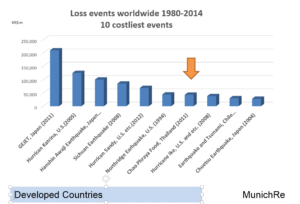
2011 Chao Praya river flood gives us a lot of lessons. The disaster is the 7th costliest disaster worldwide since 1980 to 2014 (Figure 1).

deadliest
Figure 1  10 Costliest events

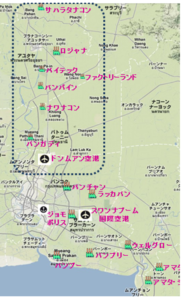
From economic damage points of views, the below is the industrial estates and parks which were affected. 7 estates and parks were inundated. 804 companies were affected and among those, 449 were Japanese related companies in these estates and parks(Figure 2).

pic_industrial-estates-and-parks
Figure 2 7 Inundated industrial estates and parks

Can show you a brief outlines of the chain reactions of economic damage caused by 2011 Chao Phraya river flood. There are three main inquiries to ponder (Figure 3) : 1) Why were so many foreign companies coming and making supply chain? 2) What kinds of damage types could be analyzed and how about the influence? 3) How did companies respond?

3questions
Figure 3  3 Research Questions (rough skech)

These will be explained later. The attached graph (Figure 4) indicates so many Japanese companies came these areas after 1985, the year of the Plaza Agreement.

japanese-companies
Figure 4  Japanese enterprises coming to Thailand

Horizontal and vertical damage exacerbations types can be shown in the following figures.

supply_holizontal
Figure 5  Damage types and severities (Horizontal)

supply_vertical
Figure 5  Damage types and severities (Vertical)

To be continued…………..

Day_118 : World Disaster Chronology-1982-1988


Date Place Disaster Type Situations
1982.01- US and Europe Cold Wave Over 350(DM)
1982.01- Columbia Heavy Rain, Flood 90(DM)
1982.01- Peru Heavy Rain, Flood Over 3,000(DM)
1982.03- Philippines Typhoon Over 90(DM)
1982.03- Mexico, South Volcano  Mt. El Chichon Volcano Eruption, Over 150(DM)
1982.04- Peru Heavy Rain, Flood Over 200(DM)
1982.05- China Heavy Rain, Flood Over 430(DM)
1982 Nicaragua and others Heavy Rain, Flood 180(DM)
1982.06- Indonesia, WestSmatra Heavy Rain, Flood Over200(DM)
1982.06- India, Southeastern Heavy Rain, Flood 200-1,000(DM) Orissa
1982.07- Japan, Kyusyu Heavy Rain, Flood 1982 Nagasaki Heavy Rain Disaster,345(DM), Injured 660, Destroyed approx.850, Inundation over 52,000
1982.08- South Korea Typhoon, Flood Over 60(DM)
1982.08- Japan, Central Typhoon, Flood 95(DM), Injured170, Destroyed approx.5,300, Inundation over 113,000
1982.09- Japan, Central Typhoon, Flood 38(DM),Injured 170, Destroyed approx.600, Inundation over136,000
1982 Guatemala and others Heavy Rain, Flood Over 1,500(DM)
1982.10.06 Liberia  Landslide Over 200(DM)
1982.11- India Typhoon, Flood Over 270(DM)
1982.12.13 Yemen Inland Earthquake 1982 North Yemen earthquake, M5.8, 2,800-5,000(DM)
1983 Turkey, East Inland Earthquake Over 1,000(DM)
1983.02- Australia, Southeastern Forest Fire 75(DM)
1983.05.26- Japan, Northeastern Submarine Earthquake 1983 Sea of Japan Earthquake*,M7.7 104(DM), Injured160, Half Destroyed or more, over3,000
1983.07- Japan, Central Heavy Rain, Flood 1983 Heavy Rain,117(DM), Injured 160, Destroyed approx. 3,600, Inundation over 17,000, Damaged over 1.3mil yen
1983.09- Japan, Central Typhoon 44(DM), Injured 120, Destroyed approx. 600, Inundation over 56,000
1983.12- Japan Heavy Snow 96(DM), Destroyed approx. 900
1984.03.28 US Tornado The 1984 Carolinas tornado outbreak, 57(D)
1984.06.09 USSR Tornado The 1984 Soviet Union tornado outbreak. Over 400(D)
1985.03.03 Chile, Central Submarine Earthquake M7.8-7.9, 180(DM)
1985.08.23 China, Xinjiang autonomous region Inland Earthquake M7.3, Over 80(DM)
1985.09.19 Mexico, Southwestern sea (Mexico city) Submarine Earthquake 1985 Mexico city earthquake, M8.1,9,500-35,000(DM)
1986.08- Japan, Kyusyu and others Typhoon, Flood 21(DM), Injured100, Destroyed approx.2,600, Inundation over 105,000
1986 El Salvador Inland Earthquake 1986 San Salvador earthquake M5.5-5.8, Over1,000(DM)
1986.10.20 Kermadec Islands Submarine Earthquake M7.7-8.2
1987.03.06 Ecuador, South Inland Earthquake Ecuador Earthquake (M6.7-7.1) 1,000~5,000 (DM)
1987.10- Japan, West Typhoon, Flood 9(DM), Destroyed approx.200, Inundation over 24,000
1987.12.17 Japan, East Submarine Earthquake Chiba Ken Toho Oki Earthquake,M6.7,2(D), Injured 160
1988.02- Mozambique Cyclone, Flood Cyclone Filao, approx.100(D)
1988.07- Japan, Kyusyu and others Heavy Rain, Flood 27 (DM), Injured 60, Destroyed approx.600, Inuncation over 10,000
1988.08.21 Nepal   1988 Nepal earthquake M6.9,  killing at least 709 persons and injuring thousands.
1988.11- Bangladesh Cyclone, Flood 6240(D) One of the worst tropical cyclones in Bangladeshi history. 
1988.09- Mexico, and others Hurricane Hurricane Gilbert, 318(D)
1988.10- Caribbean and Central America Hurricane Hurricane Joan–Miriam, 216-334(D)
1988.10- Guam, Marianas Islands, Philippines, China Typhoon Typhoon Ruby, Over 300(D)
1988.11.06 China and Myanmar Inland Earthquake M7.0-7.3, Over 700(DM)
1988.11.28 US, North Carolina and  Virginia  Tornado 1988 Raleigh tornado outbreak, 4(D),Injured 154
1988.12.07 USSR, South (Armenia) Inland Earthquake 1988 Armenian earthquake,M6.7-6.9, 25,000-45,000(DM)
Economic damage is 140 million dollar , worst earthquake disaster in USSR history

D: The number of Death M: Missing number DM: The dead and missing number

1983 Sea of Japan Earthquake*

https://disasterresearchnotes.site/archives/2722