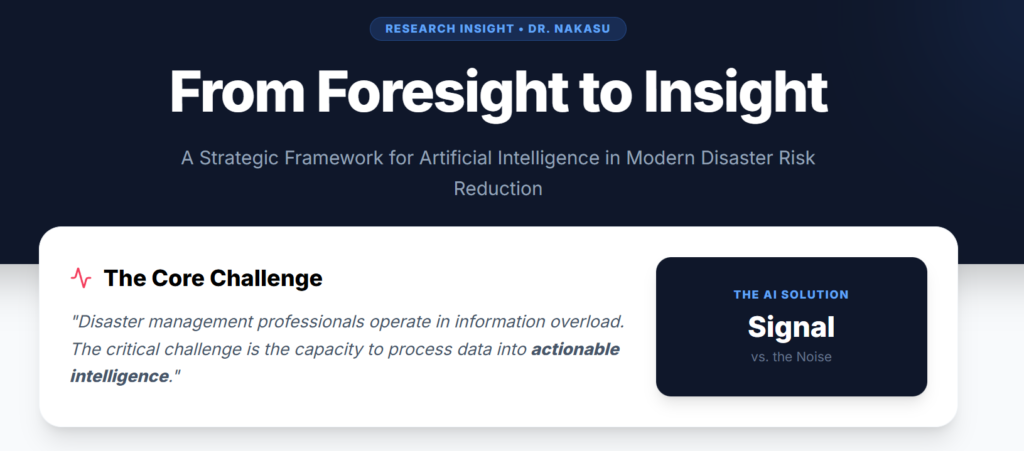
The infographic of the AI-Integrated Disaster Preparedness Platforms is shown as an infographic: AI-Integrated Disaster Preparedness Platforms

The infographic of the AI-Integrated Disaster Preparedness Platforms is shown as an infographic: AI-Integrated Disaster Preparedness Platforms

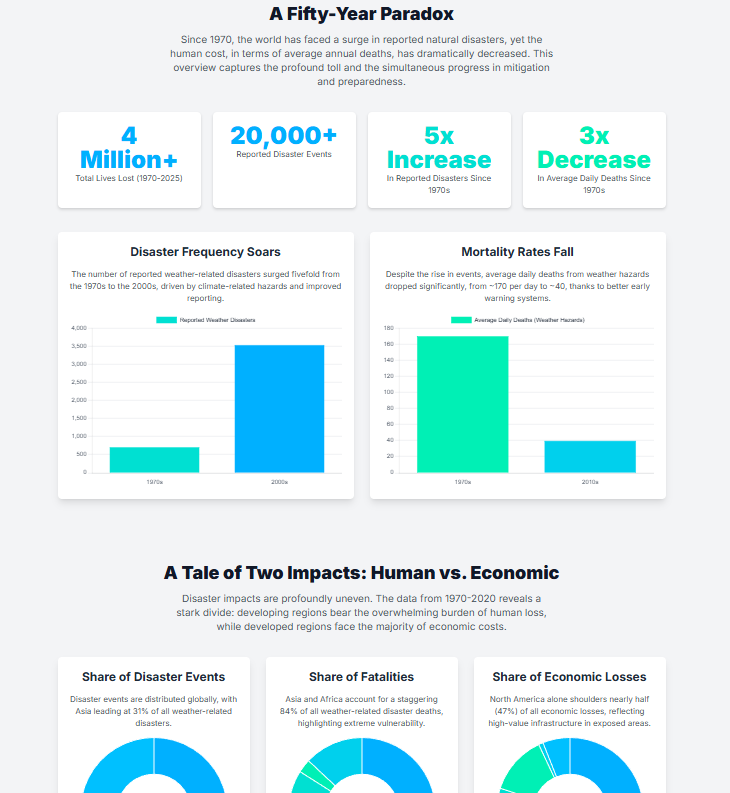
The infographic of the global trends of disasters (1970-2025) is shown as an infographic: https://disasters.weblike.jp/global%20trends.html
The website of the logistic regression analysis in the demography and public policy seminar. Created one of the simplest and easiest-to-understand websites.

website:https://disasters.weblike.jp/logistic%20regression%20overview.html

The infographic of the demography and public policy seminar, one example slide, is shown as an infographic: https://disasters.weblike.jp/IVDV_Relationship%20v1.html

An infographic, “Thailand’s Demographic Transformation,” was created.https://disasters.weblike.jp/Thai%20demographic%20change.html

An infographic, “Japan’s Demographic Transformation,” was created.https://disasters.weblike.jp/Jap%20population%20v2.html
First, the theoretical examination’s concept is explained and two disaster recovery theories are introduced. Second, the first theory is explained and studied. Third, the second theory is explained and examined.
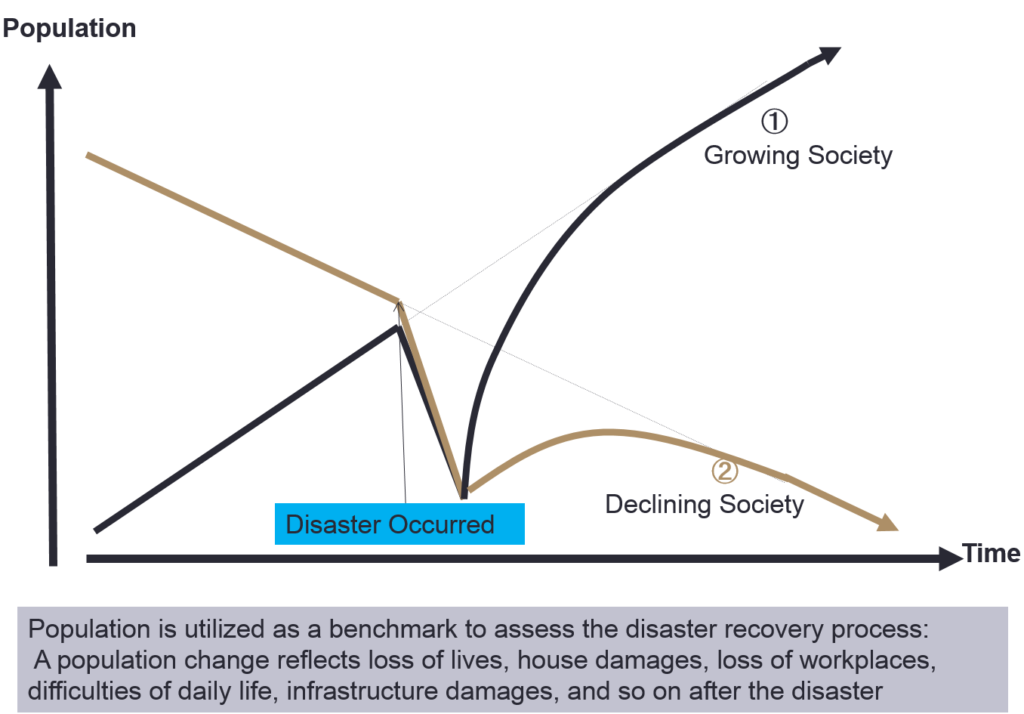
The concept is explained as follows:

Figure1 1: Disaster Recovery Concept
The following are the two disaster recovery theories used for this study.
Theoretical framework 1
Disasters contribute to change, they do so primarily by accelerating trends that are already underway prior to impact (Bates et al., 1963; Bates, 1982; Bates and Peacock, 1993; Haas et al., 1977).
2) Theoretical framework 2
The disaster Process is influenced by
① Devoted aid volume from outside society
② Disaster scale
Community Strength (Social System Strength) (Hirose, 1982)
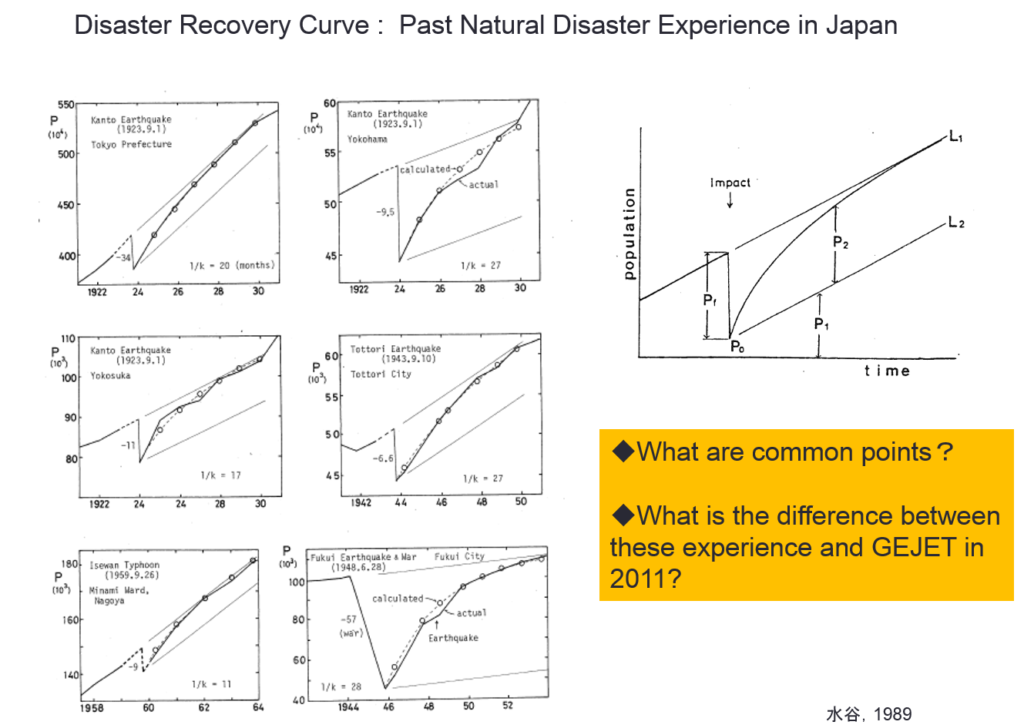
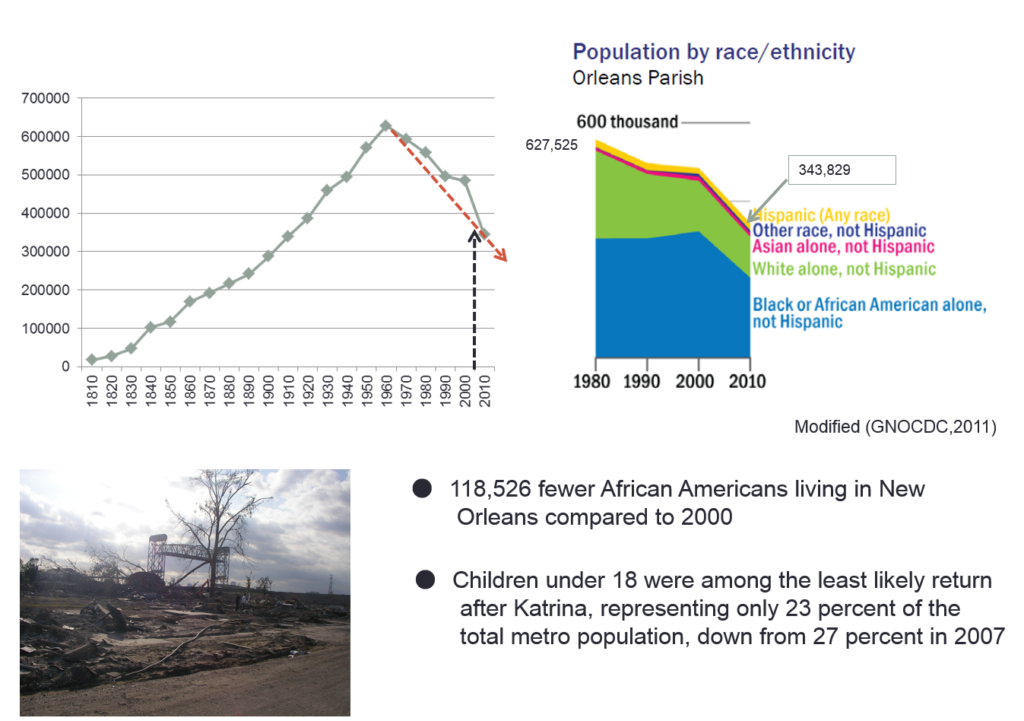
The first theory is confirmed by some cases. You can see the following figures: the Kanto earthquake, Fukui earthquake, Typhoon Isewan in Japan, and Hurricane Katrina in US.

Figure 2: Disaster Recoveries in Japan

Figure 3: The Disaster Recovery from Hurricane Katrina in US.
To be continued…
This is the presentation summary. The presentation was made in 2011, after the tsunami in Japan.
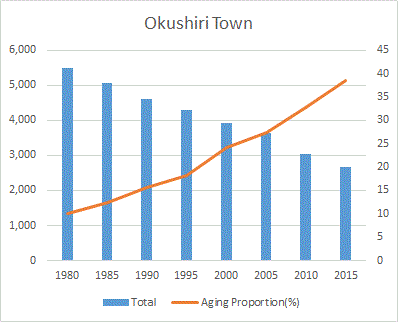
The 1993 southwest-off Hokkaido earthquake hit okushiri island severely. The number of casualties was 165. Okushiri town had faced population-decreasing and aging issues before the disaster. After the disaster, Okushiri town had a lot of aids, especially from inside of Japan. Japan had a very good economy at that time, so the situations enabled them to have such huge aids. Even though the large economic assistance, the town’s demographic tendency before the disaster was facilitated. total population is from 4,604 (1990) to 2,662 (2015), and the aging proportion over 65 is from 15.6% (1990) to 38.6% (2015)*.
Below is the graph, which indicates the demographic changes on the island.

Some disaster recovery theories can be referred to explain this tendency clearly We should learn from this lesson to consider for our common sustainable futures.
*Day_43
https://disasterresearchnotes.site/archives/2510
[ad#ads1]
NIED-DIL mail magazine: 6
Imagine from disaster damage statistics
Contribution day and time: 2013/08/19
There is an index called the World Risk Index. The world risk report ranks Bangladesh as one of the high-risk countries in the world in 2019.
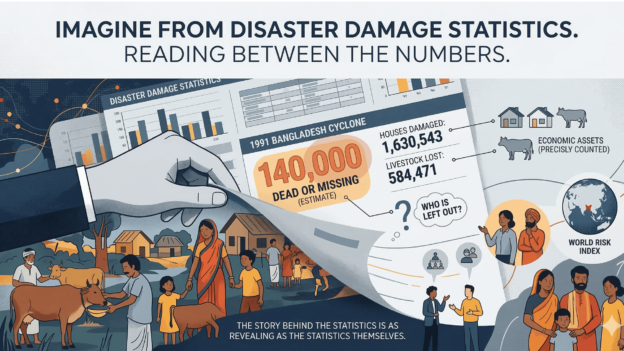
Indonesia and Haiti were easy to imagine, linked to the damages caused by recent earthquakes. Previously, there was an opportunity to learn from a land environment perspective about the past major disasters that struck Bangladesh, especially the large-scale cyclone disasters in 1970 and 1991. During a study session at the institution, I leaned the reported number of the casualties caused by the disasters was 500,000 and 140,000 people each. I was surprised to see the large numbers, but I was wondering why these numbers are so rough. When I looked at the table showing the breakdown numbers, I felt, “Oh!”
Building damage, human suffering, and livestock damage are listed. For example, the cyclone disaster in 1991 resulted in 1,630,543 house damage, 140,000 human suffering (dead or missing), and 584,471 livestock damage.
Yes, human suffering seemed to be a rough figure, while house damage and livestock damage were written down to one digit. And when we looked at what kind of country Bangladesh was like such as caste, religion, and livestock.
The background of the numbers, such as meaning, etc., has come into view. Regarding the number of dead and missing people in 1970, there are no accurate figures, and reports from 200,000 to 550,000 people have been reported in various fields.
https://disasterresearchnotes.site/archives/3224
When there is a disaster, numbers about the damage come out, but I thought it was a very important viewpoint to think about where the numbers came out and what you can imagine from those numbers.
By the way, the web site is
https://reliefweb.int/sites/reliefweb.int/files/resources/WorldRiskReport-2019_Online_english.pdf
Issued July 5, 2010 No. 6
Related Books and Info. for Further Understanding
sponsored link
I will update a column of the NIED e-mail magazine which I wrote a long time ago because the content is not faded with time. (I will do this step by step in Japanese and English.) I will also add comments to update the situation.
Published March 5, 2010
NIED-DIL e-mail magazine: Recoveries from Disasters
■ Disaster Recoveries ■
Global attention is being focused on how recovery will take place after the Haiti earthquake. I have studied a lot about disaster recovery. Still, as a valid theory of thinking, a researcher named Haas says, “A rapidly growing city will recover quickly after the disaster but will remain unchanged, and stagnant or downhill cities will recover very slowly after the disaster or will quickly decline “(1977). When considering what kind of area or growing city it is in this case, the population before the disaster could be examined as an indicator. I’ve researched a lot and predict that no matter how massive the distraction, an area with a growing population may be easier to recover. For example, in the city of Nagoya, due to the Typhoon Ise Bay disaster, the scale of economic and social damages was plentiful, and the amount of aid was small, but it was said that it was revived in less than a year. In comparison, the scale of economic and social disasters in New Orleans due to the Hurricane Katrina disaster was not so large, relative to statistics, but the amount of aid was enormous. Nevertheless, it may be useful to say that five years have passed and that recovery has not yet been good. New Orleans was even expressed as a surviving city, even before the disaster. Regarding the recovery of the stricken area of the Indian Ocean tsunami, it is not clear here, but there were many similar trends.
Let’s return to the example of Haiti. Examination of the population growth rate in Haiti (Port-au-Prince) showed that it was overgrowing until the disaster occurred. Haiti’s revival should be relatively quick, given the population index alone. However, it is also possible that Haiti has an entirely different social situation that cannot be applied to the above example. You may have to think that Haiti’s revival will be heavily influenced by the very elusive variables of political steering and social conditions. There is an article in the magazine “ Economist ” that fears that similar problems may occur in Haiti, such as the problem of contributions and aid in the Indian Ocean cases where oversupply was unevenly distributed and the damage was widened.
What do you think of Haiti’s recovery?
P.S.
The data below indicates a lot about the theory.
Haiti Population Data
https://www.worldometers.info/world-population/haiti-population/
Port-au-Prince Population Data
https://populationstat.com/haiti/port-au-prince
You cannot copy content of this page