Category Archives: Recovery

Day_156: Matsushiro Earthquake Center_NIED-DIL e-mail magazine

I will update a column of the NIED e-mail magazine that I wrote long ago because its content has not faded with time. (I will do this step by step in Japanese and English.) I will also add comments to update the situation.

Published April 5, 2010
NIED-DIL e-mail magazine: Matsushiro Earthquake Center

■ Matsushiro Earthquake Center ■

There is an organization called Matsushiro Earthquake Center in Matsushiro, Nagano Prefecture, Japan. The Center was established in February 1967 at the Japan Meteorological Agency in Matsushiro Town, Nagano Prefecture (now Nagano City), based on the Matsushiro Seismological Observatory, which was established in 1947. The background of this establishment is that between August 3, 1965, and April 17, 1966, insensitive earthquakes with seismic intensities 5 and 4 were observed three times each and a total of 6,780 earthquakes were detected in the Matsushiro town area. This severe earthquake activity has become a major social problem.

It is famous that Mayor Nakamura at that time said that he wanted to learn and research more than things and money, and that was the starting point of the Center. The Center is also well known as the location where the imperial general headquarters was planned to be built at the end of the Second World War. Besides, the experience gained from the observation of the earthquake has dramatically influenced the progress of earthquake prediction and disaster countermeasures today.

The author is organizing the records of the discourse at the time with the cooperation of the Japan Meteorological Agency’s Earthquake Observatory (Matsushiro Seismological Observatory) as the Disaster Information Office. I am surprised at the fascinating records. The fact that Matsushiro city was working to build a disaster-resilient town in the wake of an earthquake throughout the city is well communicated. For example, there was not only research on the earthquake itself but also research on the health status of students, including psychological aspects from nearby schools caused by a swarm. This was due to the cooperation of Matsushiro health centers and hospitals. It does not stop there. Members were active in the front lines of various fields at the time, such as landslide surveys caused by earthquakes and the impact on water supply facilities during earthquakes, reports from various perspectives.

I am sorry that the format, etc. is still insufficient, but I am starting to release these records on the HP in hopes that you can see it in a provisional form. Please see if you have time.

URL: http://dil.bosai.go.jp/library/matsushiro/MRecord.html

Now you can not access it, but you can ask NIED DIL for information.

Published on April 5, 2010

Matsushiro Seismological Observatory
https://www.data.jma.go.jp/svd/eqev/data/matsushiro/en/index.html

Day_155: Recoveries from Disasters

I will update a column of the NIED e-mail magazine which I wrote a long time ago because the content is not faded with time. (I will do this step by step in Japanese and English.) I will also add comments to update the situation.

Published March 5, 2010
NIED-DIL e-mail magazine: Recoveries from Disasters

■ Disaster Recoveries ■
Global attention is being focused on how recovery will take place after the Haiti earthquake. I have studied a lot about disaster recovery. Still, as a valid theory of thinking, a researcher named Haas says, “A rapidly growing city will recover quickly after the disaster but will remain unchanged, and stagnant or downhill cities will recover very slowly after the disaster or will quickly decline “(1977). When considering what kind of area or growing city it is in this case, the population before the disaster could be examined as an indicator. I’ve researched a lot and predict that no matter how massive the distraction, an area with a growing population may be easier to recover. For example, in the city of Nagoya, due to the Typhoon Ise Bay disaster, the scale of economic and social damages was plentiful, and the amount of aid was small, but it was said that it was revived in less than a year. In comparison, the scale of economic and social disasters in New Orleans due to the Hurricane Katrina disaster was not so large, relative to statistics, but the amount of aid was enormous. Nevertheless, it may be useful to say that five years have passed and that recovery has not yet been good. New Orleans was even expressed as a surviving city, even before the disaster. Regarding the recovery of the stricken area of ​​the Indian Ocean tsunami, it is not clear here, but there were many similar trends.
Let’s return to the example of Haiti. Examination of the population growth rate in Haiti (Port-au-Prince) showed that it was overgrowing until the disaster occurred. Haiti’s revival should be relatively quick, given the population index alone. However, it is also possible that Haiti has an entirely different social situation that cannot be applied to the above example. You may have to think that Haiti’s revival will be heavily influenced by the very elusive variables of political steering and social conditions. There is an article in the magazine “ Economist ” that fears that similar problems may occur in Haiti, such as the problem of contributions and aid in the Indian Ocean cases where oversupply was unevenly distributed and the damage was widened.
What do you think of Haiti’s recovery?

P.S.
The data below indicates a lot about the theory.

Haiti Population Data
https://www.worldometers.info/world-population/haiti-population/

Port-au-Prince Population Data
https://populationstat.com/haiti/port-au-prince

Day_154 : (In Japanese) 災害からの復興

かなり前に書いたメールマガジンのコラムですが、内容は、色あせていないので、復習を兼ねて、これから数回にわたり掲載致します。(同様に英語版も順番に掲載していきます。)

2010年3月5日発行
再掲NIED-DILメールマガジン:2回】災害からの復興
□■災害からの復興■□
ハイチの大地震で復興はどのようになるのか、世界の注目は集まっています。
これまで復興についていろいろと調べましたが、考える指針の有効な理論とし
てハースという研究者らの「急速に成長しつつある都市は、被災後急速に復興
するであろうが、変化せず停滞し、あるいは下り坂にある都市は、被災後きわ
めて緩慢に復旧するか、あるいは急激に衰えていくであろう」(1977)があり
ます。この場合の成長する都市とはどういう地域かを考えた際、災害前の人口
の増加が結構指標として使えるのではないかと考えられます。実際、いろいろ
と調べたのですが、災害がどれだけ大きなものであっても、人口が増加傾向に
あった地域は、復興しやすいのではないかという予測です。例えば、伊勢湾台
風災害による名古屋市では、経済・社会的な災害の規模が大きく援助量が少な
かったのですが、一年とたたないぐらいあっという間に復興したといえる状況
になりました。比べて、ハリケーン・カトリーナ災害によるニューオリンズで
は、経済・社会的な災害規模としては、実はそれほど大きくなかったのですが、
援助量は膨大でした。にもかかわらず5年たとうとしているのに、復興はまだ
ままならないといってよい状態かもしれません。ニューオリンズは災害前から
人口の減少が著しく、サバイバルな都市とさえ言われていました。インド洋大
津波の被災地の復興についても、ここでははっきりといえませんが、同様な傾
向が多く見うけられます。
さて、ハイチの例に戻って考えてみます。ハイチ(ポルトープランス)の人
口増加率を調べてみると、災害前まで急速に増えていたことがわかりました。
人口という指標だけで考えるとハイチの復興は比較的早く成し遂げられるはず
ということになります。しかしながらハイチには上記の例では当てはめて考え
ることができない全く異なる社会状況が存在するとも考えられます。そのため
ハイチの復興は、政治の舵取りや社会状況という非常にわかり難い変数に大き
く左右されると考えなければならないのかもしれません。雑誌「エコノミス
ト」には、インド洋で起こった義援金や援助の問題、偏ったところに過剰に供
給され被害が拡大した事例など、と同様な問題がハイチでも起こるのではない
かと危惧する記事がありました。
皆さんはハイチの復興をどう考えますか。

2010年3月5日発行

Day_139(Rev) : A Disaster Recovery in an Aging Society : An Okushiri Town’s Case


Based on the disaster recovery theories as mentioned before in Day_92, A Okushiri town’s disaster recovery could be predicted, however, the town still has a lot of difficulties in the disaster recovery process. This was shown in Day_75.

https://disasterresearchnotes.site/archives/2921


https://disasterresearchnotes.site/archives/2753


okushiri-recov

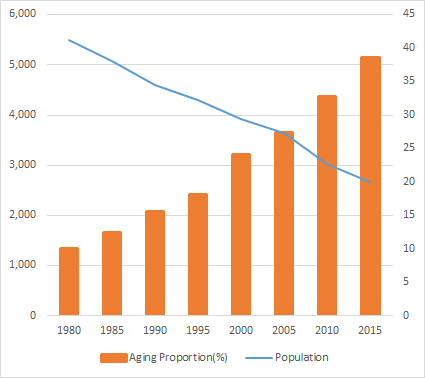
Figure 1 Demographic Changes in Okushiri Town

The 1993 southwest-off Hokkaido earthquake hit Okushiri Island severely. Casualties are 198 (including the missing number)and the economic damage indicator mentioned in the above is 0.03(Day_92). This means human suffering is relatively high however economic damage is not so high to the country. However, aid volume from outside is 14.4 percent, as the indicator, and this is so outrageously huge compared to disasters in Day_92. This can be said in the reflection of the Japanese economic situation during the time.

Okushiri town had faced population decreasing and aging issues before the disaster. After the disaster, Okushiri town had a lot of aids, especially from the inside of Japan. Japan had a very good economy at that time, so the situation enabled them to have such huge aids. Even though the large economic assistance, the town’s demographic tendency before the disaster was facilitated and faces a severe recovery process.

The population was dropped to the 2nd worst in Japanese municipalities between 2005 and 2010 after the disaster. Okushiri’s population was decreasing before and after the disaster, for example, 27.4 percent decreasing from 1990 to 2009. In addition, the population of the island had a declining tendency before the disaster and this was facilitated by the disaster. The decreasing population before the disaster can be confirmed as 5,490 in 1980 and 4,604 in 1990, this means 16 percent decrease.

The aging proportion increased two times from 1990(15.6) to 2010(32.7). The aging proportion (over 65) before the disaster was increased from 10.0 percent in 1980 to 15.6 percent in 1990. The Japanese economy was expanding at the time and a huge amount of aid was coming to the town from outside and installed, however, this Okushiri town’s case supports the recovery theory(Figure 1).

Over 20 years after the disaster, Okushiri town gives us a lot of lessons. The followings are the points that we can learn from the lessons to build a resilient society in demographic challenges.

1. Financial aids allocations: balancing soft and hard countermeasures
2. A Long perspective on the disaster recovery process

Concerning the Financial aids allocations, a huge amount of financial assistance rushed to the town, however, the assistance went to the infrastructures, building houses, purchasing fishermen’s ships, and so on to help the people’s lives in the town after the disaster. This shows more emphasis on the reconstruction than the recovery.

With respect to the recovery process, they tend to miss a long perspective. The people in the town could rebuild their houses and purchase new fishermen’s ships. Infrastructures are also rebuilt after the disaster. However, they have had not so attractive industries which the younger generation would like to work and remain in the town to live their lives. The Okushiri becomes high resistance against the disasters town, however, the population is decreasing and aging is facilitating dramatically. This means not so high resilient town. In addition, the cost of infrastructure maintenance will be a burden for the town in the long run.

To be continued……

# This post will be partly published as a paper.

Day_131 : Italy-Recent earthquake and past earthquake disasters (2)

CNN: (October 30)A powerful 6.6-magnitude earthquake rocked central Italy on Sunday morning, injuring at least 20 people, in the strongest tremor to hit the country in more than three decades. The earthquake follows tremors last week and comes on the heels of a devastating quake in August, which killed nearly 300 people and flattened entire villages.

Asian Disaster Reduction Center (ADRC) still does not list this earthquake situation.This earthquake is severer than this August Earthquake(Day_107). Earthquakes in Italy happened mostly central and southern part of Italy around the

http://disasters.weblike.jp/disasters/archives/3081

Natural disaster trends are usually from human sufferings to economic damage. In Italy, main natural disaster is the earthquake and follow the trends as you can confirm below.
However, recent earthquake disasters in Italy are so severe.  With this August earthquake, the number of casualties would be over 550. The disaster recovery is also the issue. As mentioned in Day_107, “Italy has a poor record of rebuilding after quakes. About 8,300 people who were forced to leave their houses after a deadly earthquake in L’Aquila in 2009 are still living in temporary accommodation(Reuters).”

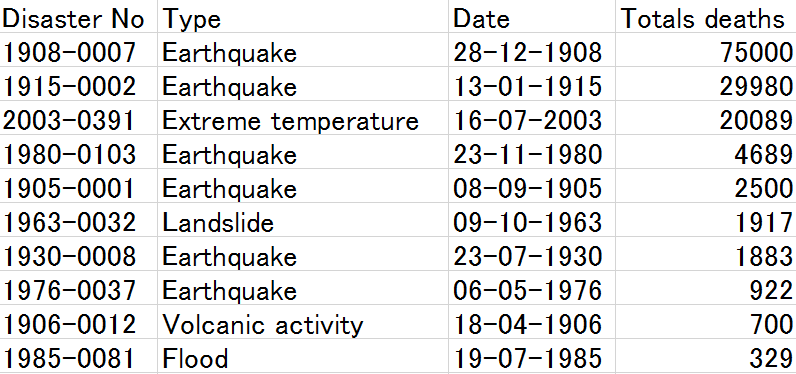
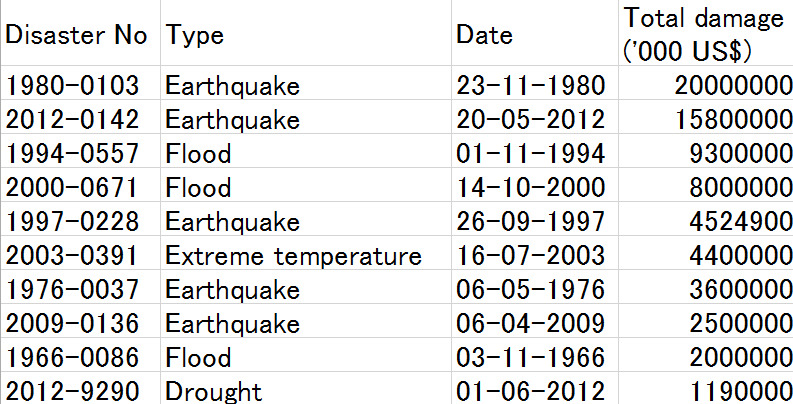
Table 1 and Table 2 show the 1900-2016 top 10 deadliest and costliest disasters in Italy (EM-DAT).

Table 1  Totals deaths
Italy deadliest

Table 2  Total damage
Italy costliest disasters

Day_124 : Chain Reactions of Economic Damage- 2011 Chao Phraya River Flood in Thailand (3) Horizontal and Vertical Damage Exacerbations

Continue to explain the chain reactions of economic damage caused by Chao Phraya river flood. There were horizontal and vertical damage exacerbations types.

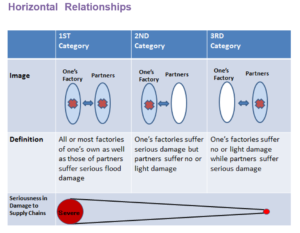
Concerning the horizontal damage exacerbations, we sometimes neglect indirect severe impacts caused by disasters. However, in this global world, economic activities are connected each other and so do the impacts. The following Figure 1 shows the three types of disaster exacerbations for example. The first category is “All or most factories of one’s own as well as those of partners suffer serious flood damage”. This category is the severest. The second category is “One’s factories suffer serious damage, but partners suffer no or light damage”. The third category is “One’s factories suffer no or light damage while partners suffer serious damage”. However, if the one’s factory totally relies on the partners which are affected by the disaster could have a very serious impact.

supply_holizontal
Figure 1  Damage types and severities (Horizontal)

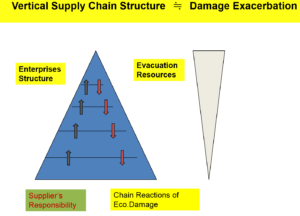
With respect to the vertical damage exacerbation, the key word is the suppliers’ responsibility. For example, a big major car company has the responsibility for customers to supply cars, subcontractors have the responsibility for the car company to supply the parts,  sub-subcontractors have the responsibility for the subcontractors to supply the parts of the parts, sub-sub-subcontractors have the responsibility for the sub-subcontractors to supply the parts of the parts of the parts, and so on. The numbers of the companies become larger along with this vertical pyramidal structure. However, their resources are opposite as mentioned in Figure 2. Industrial estates and parks ordered the evacuation for the companies very slowly at that time of the flood because of some reasons (The reasons will be explained). However, the big companies continued their activities until the time, so sub and sub-sub and sub-sub-sub contractors could not evacuate until the bigger (upstream) companies’ evacuation decision making because of the supplier’s responsibilities. The big companies could evacuate so fast and effectively. They have the resources to do so. However, smaller companies could not evacuate so fast because they needed to wait until the bigger company’s evacuation decision and they tended to have limited resources along with the structure. They, for instance, could not move heavy machines to the upper floors. They did not have enough employees, systems, or plans to do so.

supply_vertical
Figure 2  Damage types and severities (Vertical)

These are the outlines of the disaster damage exacerbation of the supply chains.  These are presented at several meetings in Japan.

Day_105 : Relocations or Rebuildings (2)


http://disasters.weblike.jp/disasters/archives/2950

After the 1896 Meiji sanriku tsunami, many communities considered relocating to higher grounds, however, a few communities could proceed the relocations. The main reasons why they could not relocate to higher grounds are the followings (Nakasu et al., 2011):

1) It was very inconvenient for them to settle the areas which were far from the sea because they were mainly fishermen or living their daily lives by the sea.

2) Most of them were doing small size fishing related businesses, had not enough budgets to relocate.

3) There were difficulties to attain the agreements to do relocations among the community members.

4) They, community members, had conflicts with land owners to select and purchase the relocation lands.

5) There were technical limitations to create a land for living on the slope because Japan did not have enough technological level at that time.

They mainly relocated to higher grounds by their own decisions. However, some groups gave pressures on the people who had planned to move and tried to let them give up to do so because they would like to maintain the communities to recover.

A small number of the communities moved to higher grounds, however, some went back to their original places. In addition, their relatives or other village people started to live there. Some families positively accepted the immigrants from outsides to maintain their ownerships.

Finally, almost all communities had chosen to rebuild at the same places, so the risks were retained and this combined with the fact that they were re-affected by the 1933 Showa sanriku tsunami disaster.

Concerning after the 1933 Showa sanriku tsunami, this will be explained later.

Day_94 : Relocations or Rebuildings (1) (Tentative)

The communities in the Sanriku ria coast have been affected by tsunamis for a long time. After huge tsunami disasters, they have had always faced the difficulty to make a decision, relocations or rebuildings.
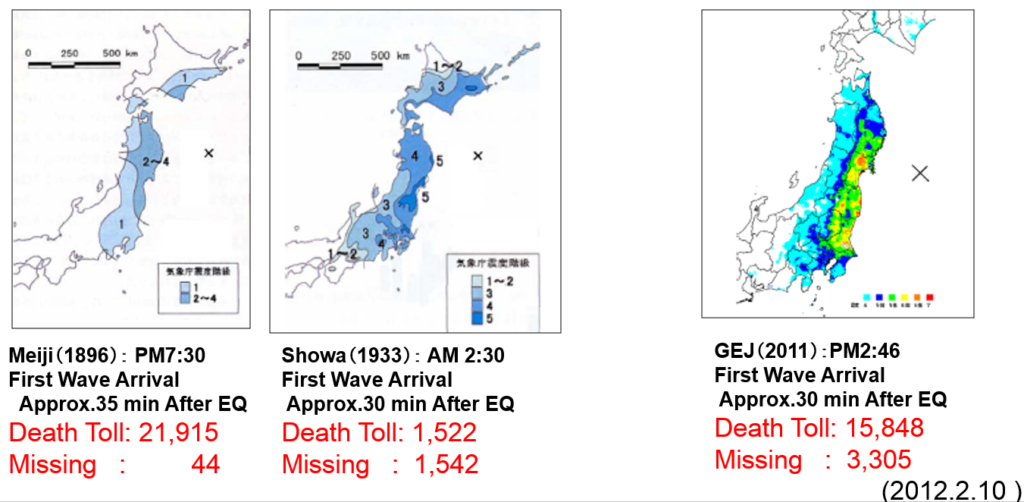
The below Figure 1 is the major tsunamis in the Sanriku ria coast.
sanriku tsunami history
Figure 1 Tsunami disasters in Sanriku ria coast (Cabinet office of Japan)
The Meiji sanriku tsunami in 1896 was the worst tsunami disaster ever in Japanese recorded history. The Showa sanriku tsunami in 1933 occurred in the midnight, however, they evacuated well because of the Meiji’s experience. As mentioned before, they always needed to choose relocations or rebuildings with the consideration of their resources after the tsunami disasters.
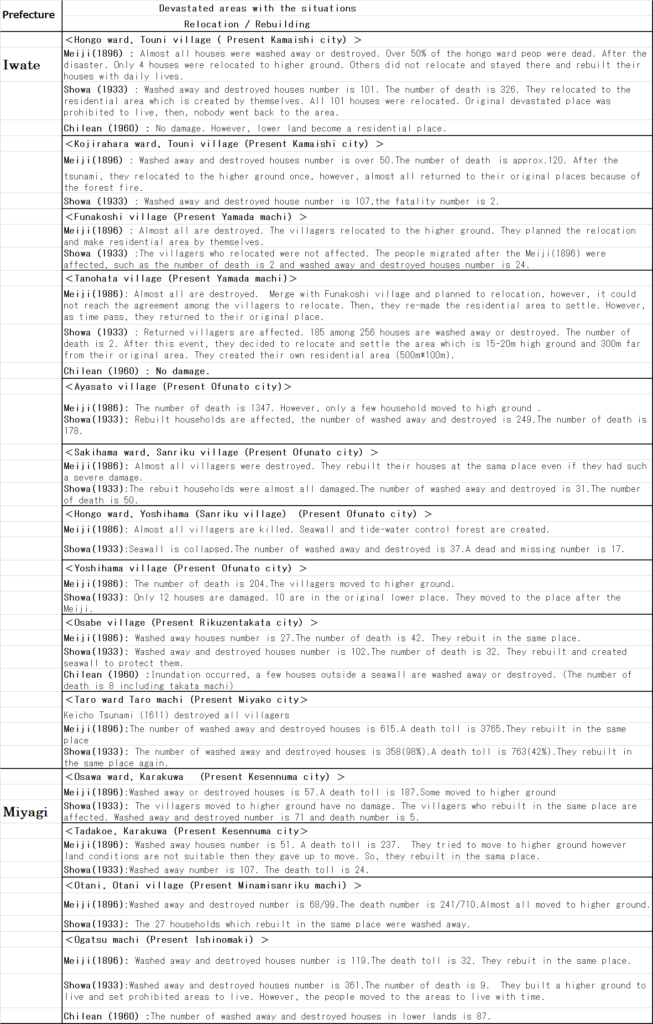
The decisions of each community can be seen in Table 1 (Tentative).
Table 1 Relocations or Rebuilding History of Communities after the Tsunami Disasters(Tentative Table: very rough translation, sorry. Will change soon)
                                                                                                      Ref. ( Nakasu,Tanaka, Miyake, 2011)
relocations2
Some communities relocated to higher grounds after the tsunamis, however, they tended to go back to the original places because of their daily life’s convenience. They are mostly fishermen or making their living by the sea. We can imagine how difficult for them to live in the ground, far from the sea.
To be continued.

Day_92 : Disaster Recovery Theory (2)

The followings are the two disaster recovery theories used for this study.
1) Theoretical framework 1
Disasters contribute to change, they do so primarily by accelerating trends that are already under way prior to impact <Bates et al.(1963);Bates(1982);Bates and Peacock (1993)><Haas et al.(1977)>

2) Theoretical framework 2
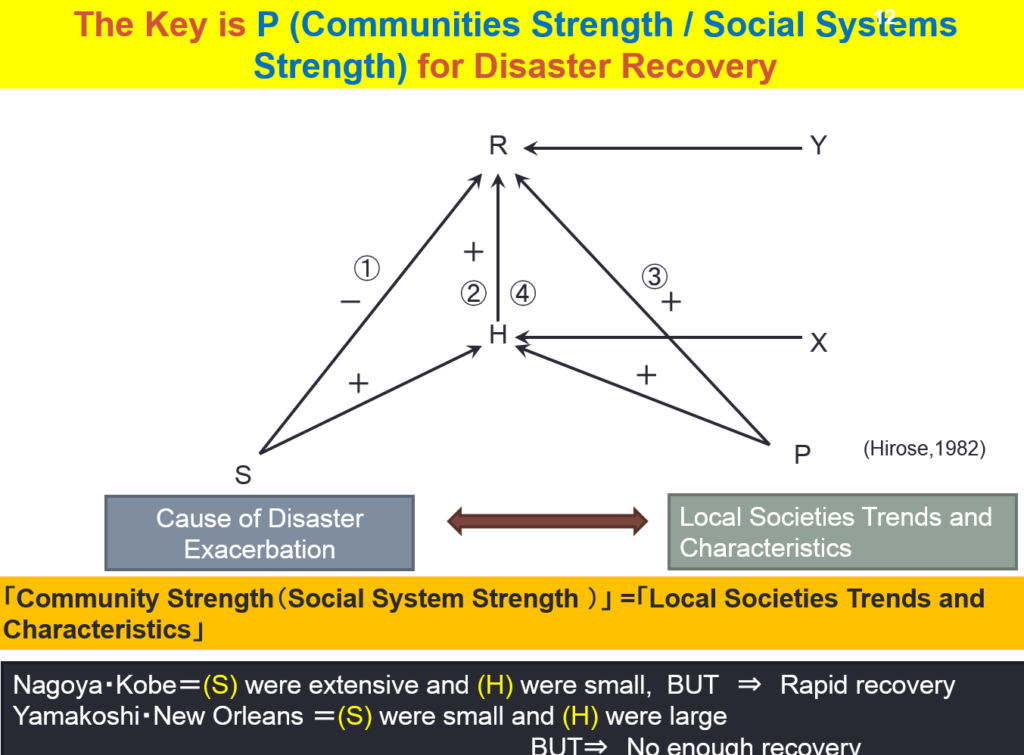
Disaster Recovery Process is influenced by
① Devoted aid volume from outside society
② Disaster scale
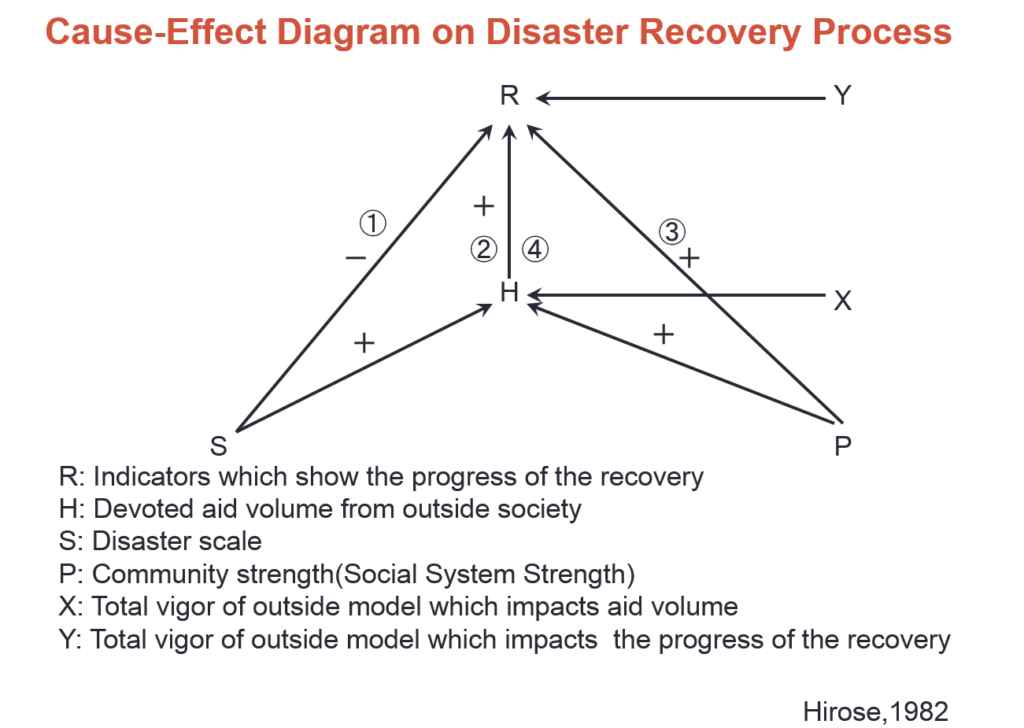
③ Community strength (Social System Strength) <Hirose (1982) >

The first theory was already explained.
Concerning the second theory, the following Figure 4 can be referred.
recovery_hirose
Figure 4  Disaster Recovery

The disaster recovery progress is influenced by the following three indicators: S, Disaster scale, H, devoted an aid volume from outside society, and P, community strength(social system strength). For example, the large scale disaster has a high S which makes the recovery progress slow (Figure 2 indicates ①minus).

Table 1 Four Cases

recovery_theory_fourcases

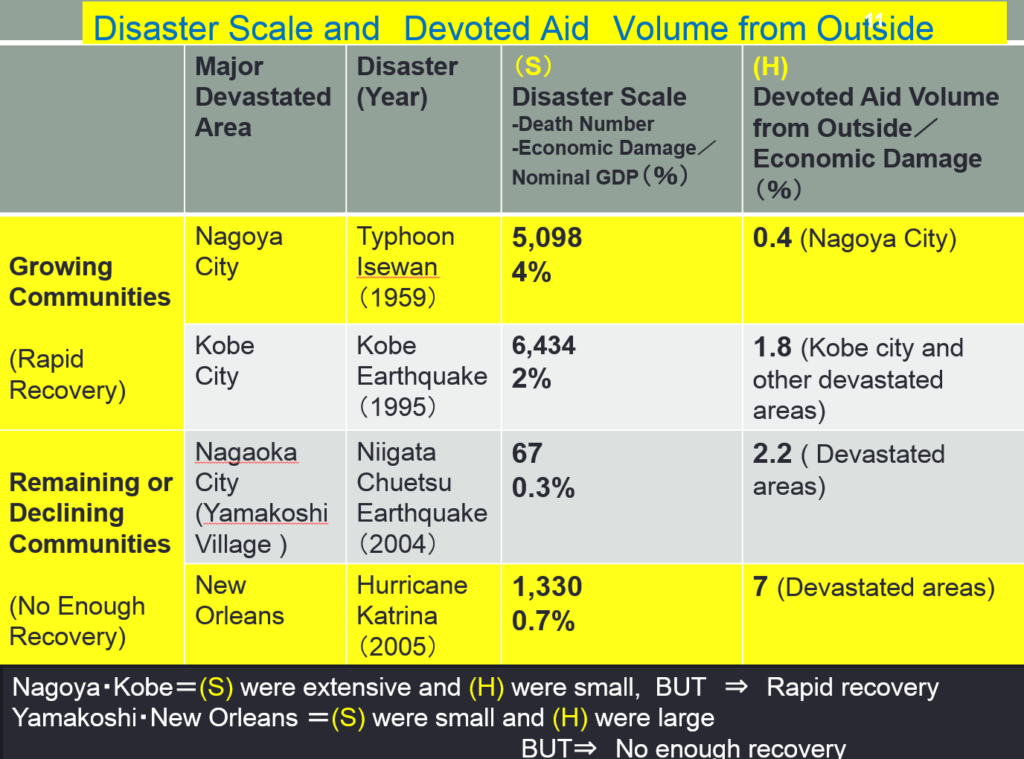
The above Table 1 explains four disaster cases. Two growing communities before the disaster such as Nagoya city destroyed by Typhoon Isewan and Kobe city hit by Kobe earthquake.The other two were declining communities such as Nagaoka city (Yamakoshi village) affected by the Niigata Chuetsu earthquake and New Orleans devastated by Hurricane Katrina.

sponsored link

As you can see the above Table 1, Nagoya and Kobe have recovered rapidly after the disaster even if they had extensive Ss (disaster scales) with small Hs (help, aid from outside).
On the contrary, Yamakoshi and New Orleans have not recovered well after the disaster even if they had small Ss with large Hs.

theory_community
Figure 5  Community Strength (Social System Strength)

Therefore, we can recognize the P(Community Strength) is the key indicator to influence the progress of the disaster recovery as shown in Figure 5.

These are presented at ICFM5 (The 5 th International Conference on Flood Management)