Category Archives: Lessons

Day_198 : Characteristics of Earthquake Disasters

In most cases, when a strong earthquake occurs, many people die as buildings collapse. For example, in the Kobe earthquake, more than 90% of the 5,000 people who died lost their lives within 15 minutes immediately after the quake. For this reason, it is essential to build buildings well to reduce the number of people who die in earthquakes. This will prevent fires, make it less likely that people will lose their homes and become permanent refugees, and reduce the problems of relief and rebuilding.

In developing countries, especially in arid and semi-arid regions, earthquakes cause many deaths. In such areas, sun-dried bricks called “adobe” are common building materials, and buildings made of these bricks often collapse easily in earthquakes, burying many people alive. In developing countries, for economic reasons, standards for building earthquake-resistant buildings are usually low, and construction is often inadequate. Therefore, even earthquakes that are not strong can easily cause severe damage. In addition, in regions with many wooden houses, such as Central America and Southeast Asia, buildings can collapse and catch fire.

Day_76 : 1995 Kobe Earthquake victims

The 1995 Kobe earthquake taught us a lot of lessons. Today I am going to give you the following two questions:.
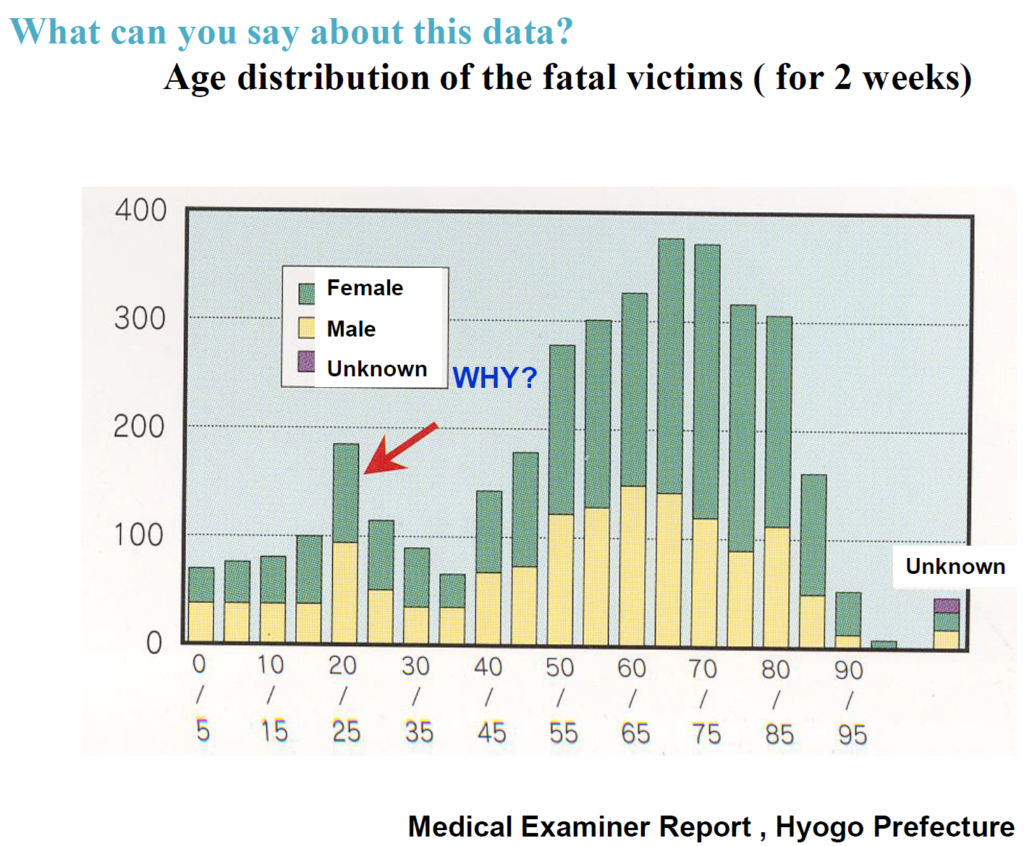
1) Why were there so many early 20s victims?
2) Which floor is more dangerous, 1st or 2nd?

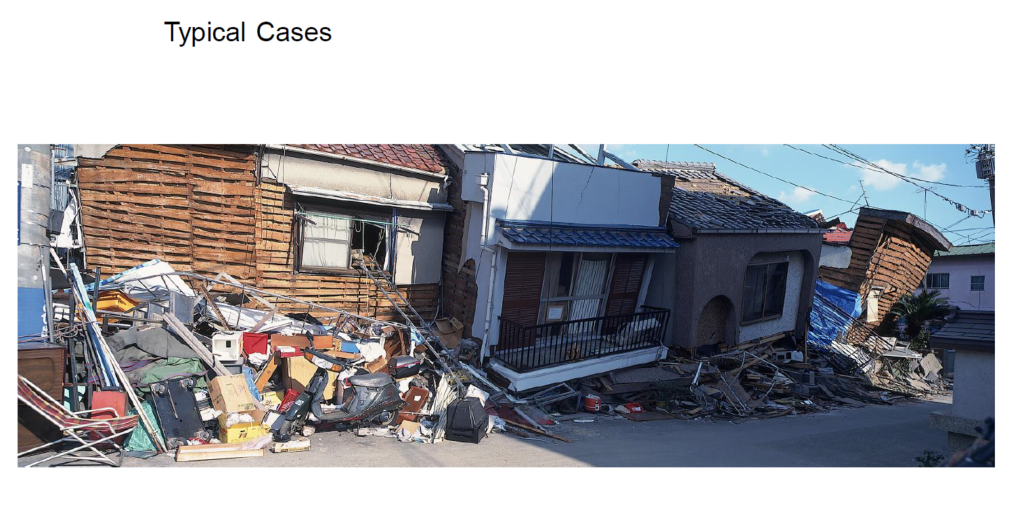
1) Please look at the following picture. You can see the victims’ age distribution. Females and elderlies are more likely to be victimized because of their lack of physical strength. However, why did so many people in their early 20s die? Yes, they were university students. There are many universities in Kobe. Students tended to be less rich. They tended to stay on the 1st floor in cheaper wooden apartments.

kobe victims age distributions

2) You already know the answer. Of course, the first floor is more dangerous, especially in a wooden house. 1981 is the year in which the Japanese government set the building code. So the buildings, apartments, etc. built after the year tended not to be destroyed by the earthquake, including the Kobe earthquake.

1stfloorKobe

Photo: Dr.Takashi Inokuchi

We should learn the lessons from the disaster; this is the best thing we can do for the victims.


Day_112 : The 1923 Great Kanto Earthquake and Disaster Prevention Day(Tentative)

September 1 is Disaster Prevention Day in Japan. This is because of the 1923 Great Kanto Earthquake. This quake caused over 105,000 casualties and had huge impacts on Japanese society. The Great Kanto Earthquake is the worst disaster in Japanese history. Here, some points are picked up. First, the quake directly attacks the capital city, Tokyo. Second, the disaster killed so many people mainly by fire, not objects falling. Third, rumors made the disaster worse. Fourth, Tokyo has recovered first and strongly.
With regard to the devastated areas, Tokyo and Kanagawa (Yokohama) populated areas were severely affected by the quake. The epicenter was located near Oshima Island in Sagami Bay, south of Tokyo. In Yokohama, 90 percent of all homes were damaged or destroyed. 60 percent of the city’s population became homeless (Brown University).
Concerning the fire, the time at which the earthquake hit was 11:58, so the families had prepared for their lunches. Many families’ cooking stoves were overturned by the quake, causing fires. The fire spread out with strong winds.
In respect of the rumors, the rumors, especially about Koreans, such as “Koreans do criminal activities and cause social confusion,” make the disaster more political. The Home Ministry declared martial law and ordered all sectional police chiefs to make maintenance of order and security top priorities. After the disaster, the radio became popular all over Japan. This is because of the disaster’s lessons.
Concerning the recovery, Shinpei Goto, Mayor of Tokyo, created and proceeded with a reconstruction plan for Tokyo to rebuild better. The basic infrastructure of today’s Tokyo was built during that time. 

*Death numbers were revised after the recent research from over 140,000 to 105,000 because there were several double countings.

Day_71: The Tsunami history in Tohoku : 1896 Meiji sanriku tsunami

The Great East Japan Earthquake and Tsunami (GEJET) disaster is the deadliest disaster after the Second World War in Japan. The earthquake happened at 2:46 p.m. on March 11th, 2011. The total casualty number is 19,846 based on the EM-DAT. The maximum . tsunami height is 40m on the Sanriku Ria Coast. The first wave arrives approximately 30 minutes  after the earthquake.

The Sanriku areas have a special geographical condition mentioned as the Sanriku Ria Coast. The coast has mountains close to the sea, so residential areas are limited only in the narrow and lower zones near the sea, and the areas become very vulnerable against the tsunamis. The bays on the coast are small, and the sea inside the bays is very deep. This makes tsunamis faster and higher, which is why the Sanriku Ria Coast has the highest tsunami risk area in the world.

Because of these characteristics, the communities on the Sanriku Ria coast, mainly in Iwate prefecture, have historically been severely affected by tsunami disasters such as the Meiji Sanriku Tsunami (1896), Sowa Sanriku Tsunami (1933), and Chilean Earthquake Tsunami (1960), compared to the flat coast mainly in Miyagi prefecture and other areas in Japan.

I will explain a little bit about the Meiji (1896). This disaster is so-called a surprise attack. The tsunami disaster happened at approximately . 7:30 p.m. on June 15, 1896, mainly on the Sanriku Ria coast. The dead and missing number has been reported at over 22,000. The earthquake is not so strong (the Japanese earthquake scale indicates Shindo 1-2); however, the tsunami is very strong and high (the maximum height is 38.2m in the Ayasato area (present-day Ofunato city)) compared to the earthquake movement scale. This has severe impacts.We call this huge tsunami caused by a weak earthquake Tsunami Earthquake. The first wave arrives approximately 35 meters after the earthquake. The Meiji (1896) has been the worst tsunami disaster ever in Japan.

In 1611, the larger tsunami (Keicho Sanriku Tsunami*) than Meiji hit the Sanriku area. That could also be a “tsunami earthquake.” After that, every 40 years, the people in the area tended to have a big tsunami. Even though they had such experiences, they did not have good tsunami disaster countermeasures, and the tsunami was a “tsunami earthquake.” In addition, they had some ancient traditions, like the idea that a tsunami was a punishment from the gods and Buddha. These are the main causes that made the Meiji worse.

Keicho Sanriku Tsunami
https://en.wikipedia.org/wiki/1611_Sanriku_earthquake

The Kyodo news company has obtained the pictures on the Meiji (1896)


Day_123 : 1995 Kobe Earthquake victims (2)- Golden 72 hours

Day_76 gave you the following two inquiries on the 1995 Kobe earthquake:.
1) Why were so many early 20’s victims victimized?
2) Which floor is more dangerous, 1st or 2nd?

Day_76 : 1995 Kobe Earthquake victims


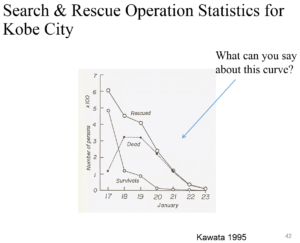
The next question is: what can you say about the following Figure 1?

rescue
Figure 1: Search & Rescue Operation Statistics

You can see the survival rate dramatically dropped after 3 days and 72 hours. The experts say this 72 hours after the disaster, especially earthquake, is golden 72 hours. This is a well-known phrase even before the Kobe earthquake.

Day_107 : Italy-Recent earthquake and past earthquake disasters

Below is the outline of the earthquake disaster in Italy from ADRC.
“A magnitude 6.2 quake hit at 03:36 (01:36 GMT) on April 24, 2016, 100km (65 miles) north-east of Rome, in central Italy. More than 70 people were killed in the earthquake.”

However, Reuters mentioned, “The death toll from a devastating earthquake in central Italy climbed to 250 on Thursday as rescue teams scoured mounds of rubble for a second day in towns and villages flattened by the natural disaster.” on Friday, two days after the quake.

In addition, the source also added, “Almost 200 of the victims died in Amatrice, which is famed for a local pasta dish and was full of holiday makers ahead of its 50th annual food festival, set for this weekend.”

Historically speaking, Italy has had a lot of earthquake disasters that have caused huge numbers casualties. Italy has had 44 earthquakes that have caused over 1,000 deaths since 1600. The interval is approximately . 25 years. They happened mostly in the central and southern part of Italy around the Apennine mountains and caused huge casualties. One of the reasons they had a large number of casualties was the stone-built houses.

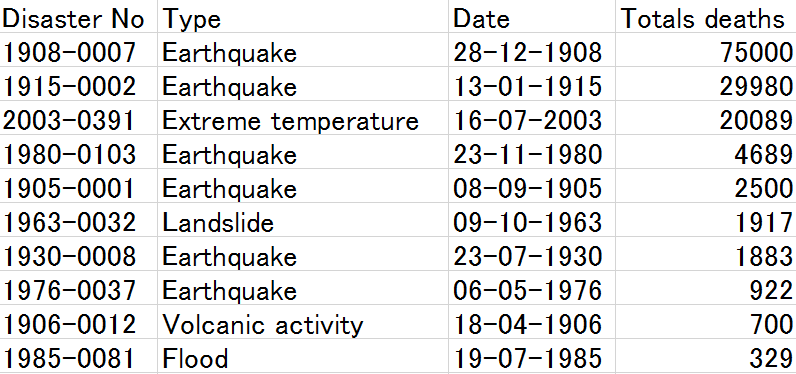
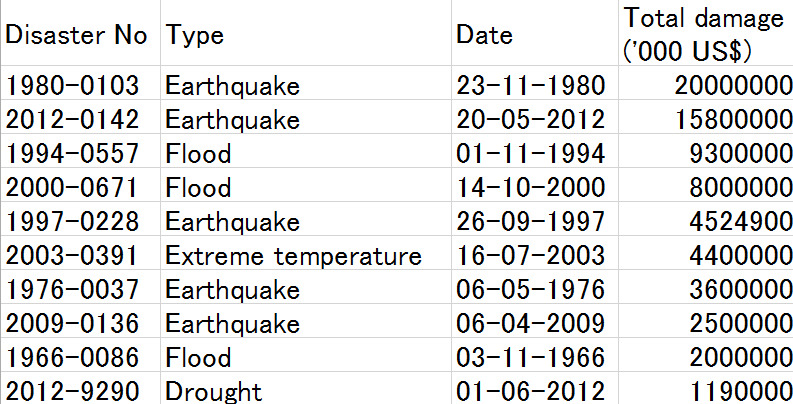
Table 1 and Table 2 show the 1900–2016 top 10 deadliest and costliest disasters in Italy (EM-DAT).

Table 1: Total deaths
Italy deadliest

Table 2: Total damage
Italy costliest disasters

Southern Italy had an earthquake (M6.9) in Campania (1980 Irpinia earthquake), the dead number is approximately . 4700, damage is 20 billion USD. The 2009 L’Aquila earthquake (M6.3) occurred and caused approximately death and 2.5 billion USD damage. This earthquake became controversial because the scientists and government officers were sentenced to six years in prison for their false announcement. The quality of construction also became an issues “Once again, we are faced with a lack of control over the quality of construction.” “In California, an earthquake like this one would not have killed a single person,” Franco Barberi, who heads a committee assessing earthquake risks at Italy’s Civil Protection agency, told reporters in L’Aquila (Reuters AlertNet) after the quake.

1908 Messina earthquake (M7.1) had caused the highest death number (75,000) in Italian history since 1900.

Reuters said still now (26, 2016), “Italy has a poor record of rebuilding after quakes. About 8,300 people who were forced to leave their houses after a deadly earthquake in L’Aquila in 2009 are still living in temporary accommodation.”


Day_177: Earthquake Preparedness and Response: Lessons from Turkey’s Seismic History

Image Source: FreeImages

The recent severe earthquake in Turkey has caused significant suffering throughout the country. This catastrophe serves as a stark reminder that natural disasters are far from ordinary occurrences. It is essential for us to learn and grow from each experience, not only within the affected country but also on a global scale. The article discusses Turkey’s earthquake history and how the nation has implemented lessons learned from past events. This analysis highlights the importance of continuous learning in order to better prepare for and respond to such disasters.

Introduction to Turkey’s seismic history

Turkey, a country bordering Europe and Asia, has suffered earthquakes before. It is incredibly vulnerable to these disasters because of its location on the seismically active Anatolian Plate. Turkey has historically seen some of the most damaging earthquakes in the world. Understanding the nation’s seismic history and drawing from its experiences can teach other countries valuable lessons on preparing for and responding to earthquakes.

A better understanding of how to predict, prepare for, and respond to these catastrophes has been made possible by the terrible impacts of earthquakes on Turkey. The country’s response plans have improved, using new engineering innovations and construction techniques to reduce casualties and property damage. In this post, we will examine Turkey’s seismic past, the significance of Adobe architecture there, and the lessons we can draw from Turkey to improve our readiness for and response to earthquakes.

Understanding earthquakes: Causes and types

Energy is released during the shifting and grinding of tectonic plates, which results in earthquakes. Large plates that make up the Earth’s crust are constantly moving and can collide, divide, or slide past one another, which can cause the ground to shake. Tectonic, volcanic, and induced earthquakes are the three main categories of earthquakes. The movement of the Earth’s plates causes the most frequent earthquakes, known as tectonic earthquakes. While induced earthquakes are brought on by human activity, like the mining of natural resources or the construction of huge reservoirs, volcanic earthquakes are brought on by the flow of magma beneath the Earth’s surface.

The Anatolian Plate, which is being compressed between the Eurasian and Arabian Plates, is Turkey’s leading cause of seismic activity. This tectonic activity has created numerous fault lines nationwide, making it vulnerable to earthquakes. For instance, the North Anatolian Fault, a strike-slip fault with a length of more than 1,000 kilometers, has caused multiple disastrous earthquakes in Turkey’s history.

The Significance of Adobe Structures in Turkey

Turkish architecture has long used adobe constructions built of soil mixed with straw or other organic materials. These constructions, frequently seen in rural locations, have served as fortifications, houses, and public facilities. The key benefits of Adobe structures are their affordability, simplicity, and great thermal qualities, which assist in maintaining a comfortable interior temperature all year round.

However, regarding seismic activity, Adobe constructions also suffer from serious drawbacks. These structures are particularly prone to collapsing during earthquakes because of their weight and low tensile strength. Throughout Turkey’s history, many large earthquakes have painfully illustrated this susceptibility, resulting in the death of countless people and extensive destruction.

Due to this, Turkey’s rising focus is on enhancing the seismic performance of Adobe structures. Researchers and engineers have been working on developing innovative techniques and materials to increase the earthquake resistance of these traditional structures and preserve their cultural relevance while ensuring the safety of their occupants’ safety.

Major earthquakes in Turkey’s history and their impact

Throughout its history, Turkey has been the site of many large earthquakes, some of which have had devastating effects. The Erzincan earthquake in 1939, the Izmit earthquake in 1999, and the Van earthquake in 2011 are three of the most famous. These seismic occurrences resulted in extensive property damage and fatalities and changed the nation’s strategy for earthquake preparedness and response.

Approximately 33,000 people perished in the 7.9-magnitude earthquake that struck Erzincan in 1939, and many more were injured or left homeless. This catastrophe made it clear that better seismic monitoring, prediction, and earthquake-resistant building techniques are required.

With nearly 17,000 fatalities and more than 50,000 injuries, the 1999 Izmit earthquake, which registered a 7.6 on the Richter scale, was among the deadliest and most catastrophic in modern Turkish history. The significant destruction brought on by this incident highlights the significance of strengthening earthquake preparedness and response strategies.

The most recent earthquake, the 7.1 magnitude Van earthquake in 2011, significantly damaged the Adobe structures in the area, killing over 600 people and displacing thousands more. This catastrophe also emphasized the necessity for improvements in construction methods and supplies for Adobe to improve its seismic performance.

Earthquake preparedness: What we can learn from Turkey

Turkey’s earthquake experiences have taught the country important lessons about preparedness. Adopting strict building regulations that account for seismic risks is crucial to earthquake preparedness. Turkey has made tremendous progress in this area; as of present, the country’s building codes demand that buildings be built resistant to earthquakes.

The creation and upkeep of early warning systems is vital to earthquake preparedness. Turkey has made significant investments in seismic monitoring and early warning systems, which can give locals crucial information in the minutes before an earthquake. By giving people enough time to take refuge or flee dangerous structures, this early warning can help save lives and reduce damage.

Finally, vital elements of earthquake preparedness are public awareness and education. Turkey has put a lot of effort into informing its inhabitants about the dangers of earthquakes and the essential safety measures to follow in the case of one. These are examples of regular earthquake exercises in schools, public awareness campaigns, and the distribution of earthquake safety informational materials.

Building earthquake-resistant Adobe structures

Several important regions have been the focus of efforts to increase the seismic performance of Adobe structures in Turkey. To strengthen their tensile strength and earthquake resistance, old Adobe buildings have been reinforced with contemporary materials like steel or concrete. Concrete columns, reinforced Adobe bricks, or the installation of steel reinforcement bars can all be used to achieve this.

Another strategy is the creation of fresh construction methods that more evenly disperse seismic pressures across the building. Using adaptable hardwood frameworks, using seismic-resistant design concepts, or using cutting-edge materials like fiber-reinforced Adobe are a few examples of how to do this.

Turkish scientists and engineers are also looking into the possibility of enhancing the earthquake resistance of Adobe constructions by employing locally derived ecological materials. This includes using natural fibers to increase the tensile strength of Adobe bricks, such as hemp or straw.

Effective earthquake response strategies in Turkey

The tactics used in Turkey to respond to earthquakes have also been informed. The quick deployment of rescue teams to find and aid stranded or injured people is crucial to an effective earthquake response. Specialized search and rescue squads in Turkey have received funding for training and equipment, and they are frequently among the first to arrive in earthquake-affected areas.

The provision of temporary housing and other services to displaced populations is a vital component of the earthquake response. Turkey has established an effective system for disaster response, including pre-stocked emergency supplies and temporary housing that can be quickly distributed to impacted communities after an earthquake.

Finally, effective earthquake response requires coordinated efforts from national and local governments, non-governmental organizations, and international partners. In the wake of significant earthquakes, Turkey has shown the usefulness of such cooperation, with international aid frequently playing an essential part in the nation’s rebuilding efforts.

Public awareness and education on earthquake preparedness

As informed populations are more prepared to respond to devastating disasters, public awareness, and education are essential to earthquake preparedness. The dissemination of educational materials, public awareness campaigns, and integration of earthquake safety education into school curricula are just a few of Turkey’s steps to increase general understanding regarding earthquake preparedness and response.

The “Safe School Program” is one significant part of Turkey’s public awareness campaigns. Schools are assessed for their capacity to withstand earthquakes as part of this program, and any necessary adjustments are made to protect the safety of students and staff in the event of an earthquake. Regular earthquake exercises are another curriculum feature that aids in preparing children and teachers for seismic occurrences.

International Collaboration for earthquake preparedness and Response

Because earthquakes are worldwide in scope, successful earthquake preparedness and response depend on international cooperation. The establishment of uniform building norms, the exchange of seismic monitoring data, and the provision of aid for disaster response are just a few of the ways that Turkey has actively participated in worldwide initiatives to increase earthquake resilience.

The World Housing Encyclopedia, which attempts to offer details on the seismic performance of structures worldwide, is a key endeavor in this area. Turkey has contributed to this effort by offering important information on the seismic performance of its conventional Adobe structures.

Building a resilient future for Turkey and Beyond

Turkey’s earthquake experiences taught us essential lessons about preparedness and response. Turkey has made tremendous progress in lessening the effects of earthquakes on its population by enacting strict construction rules, creating early warning systems, and improving public awareness about earthquake safety.

Researchers and engineers are looking for new methods and materials to increase the seismic performance of conventional Adobe structures in Turkey, which is a continuous effort. These initiatives could significantly impact earthquake-prone areas worldwide where traditional building materials and techniques are still widely used.

Finally, increasing earthquake resilience globally requires global cooperation and knowledge sharing. By cooperating, nations can benefit from one another’s experiences and create plans to lessen the effects of earthquakes on their populations.

To sum up, Turkey’s seismic past warns about the significance of earthquake preparedness and reaction. We can create a more resilient future for ourselves and future generations by implementing the lessons discovered from Turkey’s experiences in our communities.
Day_166: Interview Report: Hurricane Katrina Response (3)

>>>>>>>>>>>>>>>>>>>>>>>>>>>>
Date and time
7 May 2006

Visit
New Orleans Homeland Security and Public Safety Office
(New Orleans City Office of Homeland Security and Public Safety )

Interviewee
Colonel and Director

Subject
Hurricane Katrina Disaster Response
>>>>>>>>>>>>>>>>>>>>>>>>>>>>>>>

https://disasterresearchnotes.site/archives/3002

There are three drainage canals in New Orleans. There is also a pump station for each. Since New Orleans is below sea level, water is constantly pumped from these pump stations and drained into Lake Pontchartrain.

The breakwater was corrupted by the storm surge. The water was flowing into the canal from the lake, and at the same time, the pump station had the maximum pressure with the water. The pumps were broken and became not-functioned.

After the hurricane, there was only one evacuation route that crossed the bridge over Mississippi. However, the route had been blocked. These also affected support activities.

<Measures for breakwater>
At present, the Corps of Engineers will set a lock at the entrance of the canal and close them to prevent water from flowing into the canal since this year.

The challenge from this year is the evacuation of West Bank citizens. Because the levees are weak, hurricanes can easily break them.

The levee can be effective this year, but the problem is that in the next two years, the pump station will have insufficient capacity to pump water.

< Future measures of the city >
The following three goals are set as future measures. First, leave no one in the shelter. Second, the city will assist those who have no access to evacuation. Third, improve the safety of city facilities and property before and after the disaster.

Another important point this year is to let all citizens evacuate two days before Hurricane hit. The challenge is the reality that many people would not try to evacuate. As a background, the levee is to be broken, needs to have a terrible situation imagination.

There is a plan to install floodgates in a wide range of wetlands in eastern New Orleans to prevent storm surges.

Political challenge, New Orleans, including the peripheral has originally 100 million people, was an energy supply base, there is a tremendous national influence, the people here have to work.

As a countermeasure, the city has provided a wireless system. The system had been unavailable after the Hurricane.

A radio station in City Hall as a countermeasure against rumors which had become a social issue during Katrina was set up to keep media members staying and unifying the correct information.

Related information

The NIED team went to New Orleans and Missippi coastal areas to investigate.
Characteristics of the 2005 Hurricane Katrina Disasters

The community data center is the best to investigate to grasp the trend by using stats.

https://disasterresearchnotes.site/archives/2975

Day_164 : Development Environment Disaster Cycle Model

As mentioned before in Day_56, it is clear the model, development-environment-disaster cycle model is an analyzer that can be considered in a wide range of areas. In other words, this analysis perspective raises the sociological position of natural disasters, and the stepping stone of their historical and geographical connections become clearer. We believe that it will even be possible to provide various perspectives to prevent it from being guided.

https://disasterresearchnotes.site/archives/2598

Analytical Viewing Angle by Causal Cycle Model: Case of Isewan Typhoon Disaster and Indian Ocean Tsunami Disaster

In this section, Isewan typhoon disaster and Indian Ocean tsunami disaster are specifically analyzed using the analysis view angle, the causal cycle model of development, environment, and disaster. The first is the Isewan Typhoon that hit Nagoya on September 26, 1959. The disaster was a turning point of disaster management in postwar Japan, but focusing on driftwood damage, which is one of the important aspects of the disaster, the economic recovery of postwar Japan, trade with the United States, and Japan. Forest management, natural disasters such as landslides, the problem of hay fever, which is also called national illness, and the inter-relationship between deforestation and natural disasters in the Philippines, which becomes today, will become clear. Second, regarding the Indian Ocean Tsunami that caused enormous damage on December 26, 2004, mainly in the countries around the Indian Ocean, the damage in Thailand will be analyzed. This analysis reveals the development-environment-disaster in Thailand and its relationship with Japan and Western countries.

The figures are shown as follows:

Figure 1: Interconnections of Typhoon Isewan Disaster

Figure 2: Interconnections of Indian Ocean Tsunami Disasters in Thailand

sponsored link

Day_142 : World Disaster Chronology-1994-1995


Date Place Disaster Type Situations
1994.01.17 US, Southeastern Inland Earthquake 1994 Northridge earthquake *
M6.8, 60(D), one of the costliest natural disasters of US history
1994.02.15 Indonesia, West (Sumatra Island) Inland Earthquake M6.6~7.0, Over 200(DM)
1994.05- Bangladesh Cyclone Over 170 (DM)
1994.05.13 Afghanistan Inland Earthquake M6.0, Over160(DM)
1994.06- India / Pakistan Heat Wave Over 400 (D)
1994.06- Ethiopia Drought Over 5,000(D), Food shortage
1994.06- China, Central eastern Heavy Rain, Flood Over 700(DM), A part of Shanghai was inundated
1994.06.02 Indonesia, South (Java Island) Submarine Earthquake M7.8、死不270以上、津波。
1994.06.06 Colombia, South Inland Earthquake M6.6, 300-800(DM), Debris flow
1994.06.09 Bolivia, Peru Deep-focus Earthquake 1994 Bolivia earthquake M8.2 10(D)
1994.07- Rwanda Heat Wave Over 10,000(D), combined with Civil War
1994.08.18 Algeria, North Inland Earthquake M5.7, Over 150(DM)
1994.10.04 Japan, Kunashiri Island Submarine Earthquake The 1994 Hokkaido Toho Oki Earthquake M8.2-8.3, 15(DM), Tsunami
1994.11- India South Cyclone 190(DM)
1994.11.14 The Philippines Inland Earthquake M7.1 Over70(DM) Tsunami
1994.11- Italy Heavy Rain, Flood Over 60(DM)
1994.11- Egypt Lightning 560(DM) Lightning damage to Oil facilities
1994.11- Haiti, Cuba Hurricane, Flood Over 700(DM)
1995.01.17 Japan Inland Earthquake The 1995 Great Hanshin Awaji Earthquake * M6.9~7.3 5,500~6,400(DM)
1995.03- Afghanistan Heavy Rain, Flood, Landslide Over 360(DM)
1995.04- Bangladesh Strong Wind 700(DM)
1995.05.27 Sakhalin, North Inland Earthquake The 1995 Neftegorsk earthquake,M7.1~7.5, Over 1,989(DM) Neftegorsk city was destroyed and vanished from the map after the disaster
1995.05- Brazil Heavy rain, Flood. Landslide Over 80(DM)
1995.05- China Heavy rain, Flood Over 1,100(DM), Yangtze river flood
1995.06- India, Pakistan Heat Wave Over 800(D)
1995.06- Japan Heavy rain, Flood 9(DM), Destroyed Approx.200, Inundated over15,000
1995.07- US Heat Wave Over 800(D)
1995.07- D.P.R.Korea Heavy rain, Flood Over 60(DM)
1995.07- Thailand Heavy rain, Flood Over 200(DM)
1995.08- Morocco Heavy rain, Flood Over 150(DM)
1995.9- The Philippines Heavy rain, Flood Over 540(DM)
1995.11- The Philippines Typhoon, Flood Over 780(DM)
1995.12-  Kazakhstan Cold Wave Over 100(DM) Snowstorm

D: The number of Death M: Missing number DM: The dead and missing number

https://disasterresearchnotes.site/archives/2831

Related articles across the web