Category Archives: Lessons

Day_77 : Historical trends of the damages caused by natural disasters

The damages caused by natural disasters are from human to economy with the development. This is one of the universal and historical trends in the world and within the countries. Mortality numbers of natural disasters tend to be decreasing with national development, but economic losses are the opposite. This is because of urbanization, science and technology advancement, asset values, and so on. This is the same as developing and developed countries’ relationships. Developing countries tend to have high mortality numbers, on the other hand, developed countries are inclined to have high economic losses.

The following tables (little bit old, sorry) which I used to research on Hurricane Katrina in 2005. What you can say about these?
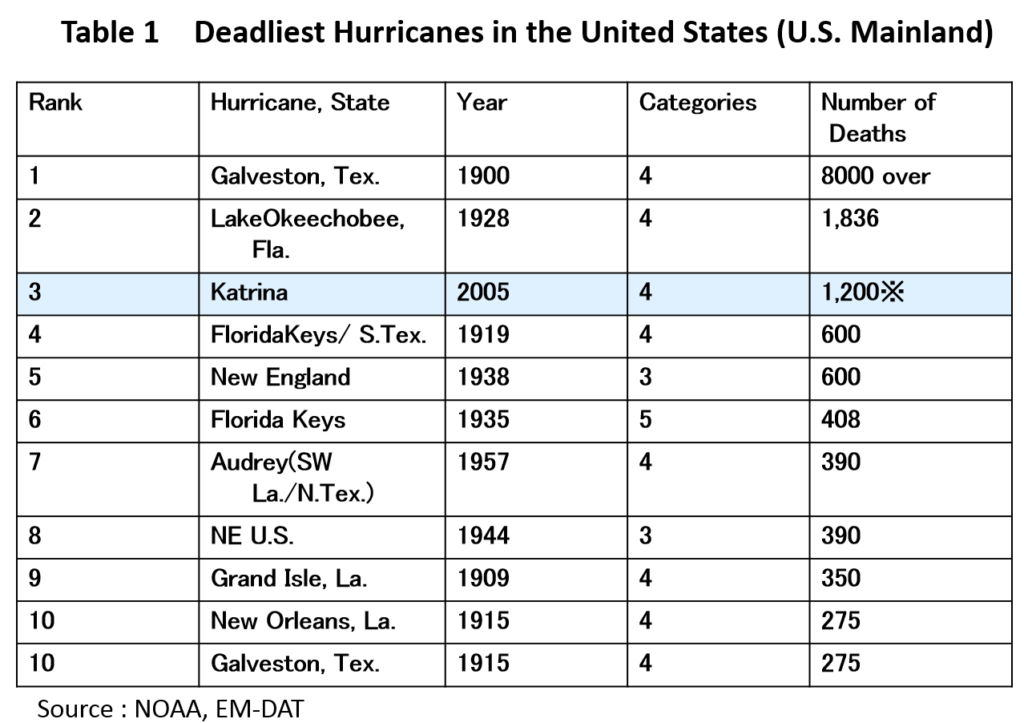
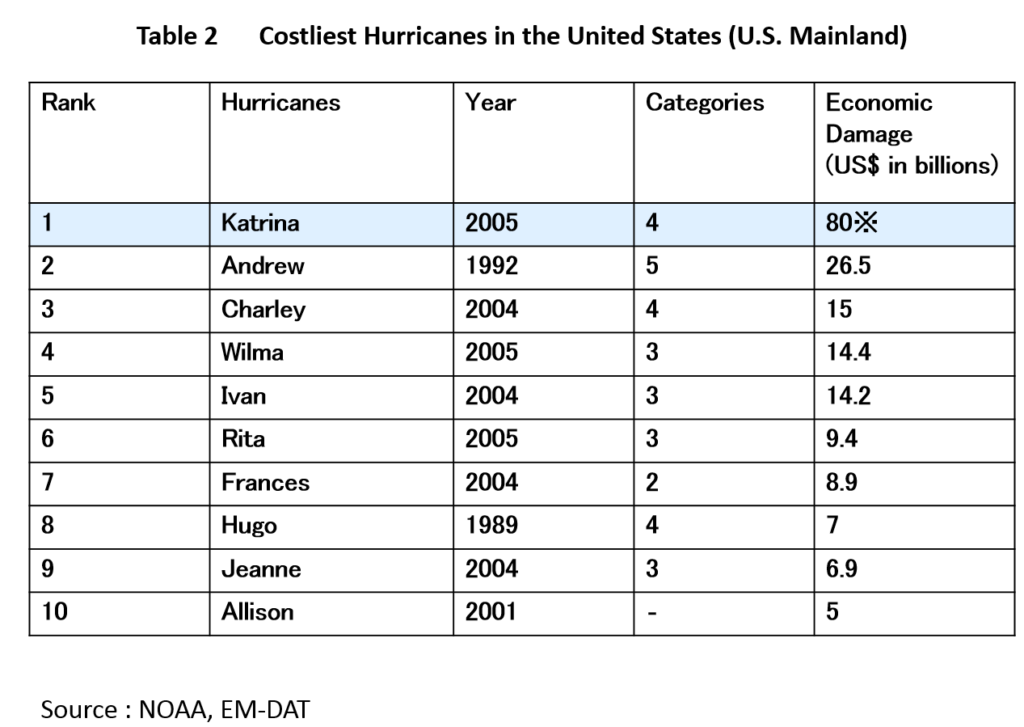
table1

table2

Yes, table 1 indicates almost all high mortality numbers hurricane disasters in the United States are before 1960. On the contrary, table 2 shows almost all high-cost hurricane disasters are after 2000.

sponsored link
Day_73 : Altruistic Behaviors

Many disaster cases in Japan indicate some people were victimized to help others.  For example, the following testimony was found in a case of the 1959 Typhoon Isewan disaster (did interviews in 2009):

My father tried to help the neighbor who was drowning and he(my father) was washed away by the water. I and my mother were left”

We also have a traditional legend “Tsunami Tendenko” *in Tohoku, however, it was difficult for local people to follow this during the 2011 Great East Japan Earthquake and Tsunami disaster.

*A traditional legend ”Tsunami Tendenko”
“The ancient “Tsunami Tendenko” tradition means that everybody should run away immediately, without consideration for their families, relatives, or neighbors”

How do you think?

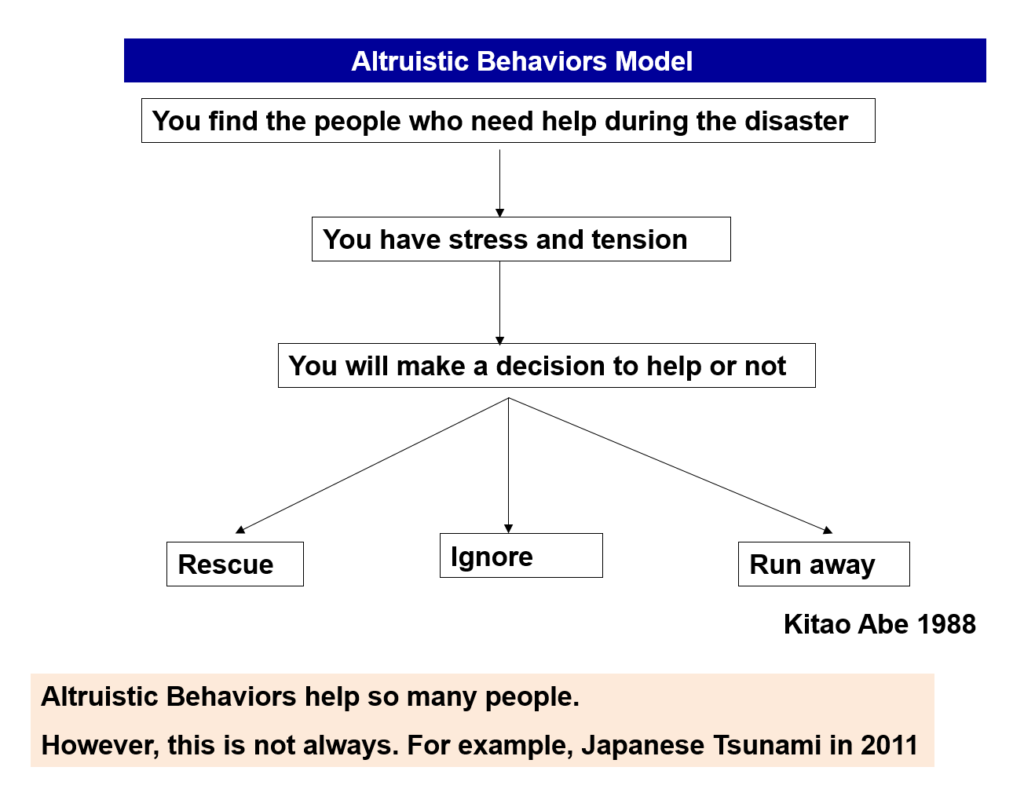
The following is the altruistic behavior model which we can consider.

altruistic behaviors

To know the altruistic behaviors, the below book can be checked.

Altruistic Behavior: A factorial analysis of determinant variables: Altruistic Behavior: is it a function of environmental factors?

Day_62 : liquefaction

After the 2011 Great East Japan Earthquake and Tsunami disaster, Chiba prefecture (including Disney Land and Disney Sea) faced liquefaction Problems. The liquefaction means a phenomenon whereby a saturated or partially saturated soil substantially loses strength and stiffness in response to an applied stress, usually earthquake shaking or other sudden change in stress condition, causing it to behave like a liquid *. There were many houses in Chiba prefecture inclined caused by the liquefaction. The people living in the houses lost their health such as dizzy and nauseous symptoms. They also faced financial challenges to fix their houses. Niigata earthquake in 1964 is very famous for the liquefaction as you can see the below Wikipedia site.

NIED(National Research Institute for Earth Science and Disaster Prevention) developed “Ekky” to explain liquefaction for mainly school children.
http://www.bosai.go.jp/activity_general/ekky/ekky.pdf

*Wikipedia
https://en.wikipedia.org/wiki/Soil_liquefaction

Day_59 : Lessons from a Japanese environmental movement

The UN emphasis the importance of building a bridge between science and policy*. The Mishima Numazu and Shimizu (MNS) environmental movement in 1963-1964 is really really turning point in Japan. After the movement, the Japanese environmental movement was spreading out all over Japan. Establishing the Japanese Environmental Impact Assessment (EIA) Law was delayed because of this movement. The core story related to science and policy is the conflict between the governmental EIA research group and the local EIA group. The government group used high-tech machines and money, but the local research group used high school students, local people, and local knowledge. For example, the government group did research by using a helicopter to check the wind direction, on the other hand, the local group used a carp-shaped streamer for examining the direction around the 5th of May in 1963. Japanese people usually raise carp-shaped streamers in front of the house to celebrate their children’s prosperity. Finally, local people, including farmers and fishermen studied hard to recognize the environmental impacts of their living areas and chose the local research group results.

*https://sustainabledevelopment.un.org/?page=view&nr=1101&type=230&menu=2059

Day_56 : A cyclic model of development-environment-disaster

I once proposed a model for analyzing relationships between natural disasters and society, a cyclic model of development-environment-disaster. This provides a long-term perspective and an overhead view for examining natural disasters. This analytical framework could expand on previous research from the viewpoints of the nexus between development and environment and also development and disasters. This also makes it possible to consider the relationships between development, environment, and disasters and the process from the disaster to the victims and from the disaster back to development.

160731_cyclic model

Not only that, but this circular thinking method also provides viewpoints of circulation, opposite direction, cycle speed, time, development stage, and so on. Moreover, this framework provides foresight into considering relationships, not only for development, environment, and disasters in terms of domestic views but also for two or more countries. This is effective for grasping the meaning of natural disasters in the social context. In other words, this framework makes it possible to stimulate sociological imagination and to visualize the issues.

I actually analyzed the Typhoon Iwean disaster in 1959, the Indian Ocean Tsunami disaster in 2004, and the Great East Japan Earthquake and Tsunami disaster in 2011 with this framework. However, these works are only in Japanese.

To be continued.

Abstract of the Japanese paper
http://ci.nii.ac.jp/naid/110008664615/en

Day_51 : Matsushiro Earthquake and Underground Imperial Headquarter

The Matsushiro Earthquake Research Center is located in Nagano Prefecture. It was established in 1967 by the Matsushiro Earthquake Observatory, Japan Meteorological Agency. The center’s background was based on the world’s rare earthquake swarm in the area. From 1965 to 1969, 6,780 earthquakes were observed, and they became social issues.

There are two famous stories about the establishment. The first story is that the mayor, Mr. Nakamura, declared, “We want to have science and research rather than equipment and money” after the earthquake swarm. This attracted the center. The second is that the location was the place where the planned underground imperial headquarters was just before the end of the Second World War. This explains the location, which is deep underground and has a strong structure. So this means the best location to place a seismometer.

Day_48 : 1995 Kobe Earthquake(2) : Disaster-related death

So many people, especially the elderly, die after the events because of stress, sickness, suicide, and others. We call this a disaster-related death. The Kobe earthquake became the trigger to notice this. Over 1,126 people were reported as dead, not by direct effects of the earthquake. They were old and easy to get sick, which became worse with the circumstances around them, such as cold weather, insanitary situations, and private matters after the disaster. They had stressful conditions. They worried about their future, which they could not see. 3,472 people (2016.3.31)* were reported as dead, disaster-related deaths, after the Great East Japan Earthquake and Tsunami disaster in 2011.

* The disaster-related death number from the 2011 tsunami is still increasing.

http://www.reconstruction.go.jp/topics/main-cat2/sub-cat2-6/20160630_kanrenshi.pdf

Day_46 : 松代群発地震(Matsushiro Earthquake)[Japanese]

熊本地震は、松代群発地震を想起させます。以下かつて書いたコラムを転載致します。

ーーーーーーーーーーー
長野県の松代に松代地震センターという組織があります。松代地震センターは、1967年2月に、長野県松代町(現在長野市)の気象庁地震観測所内に設立されました。この設立の背景は、1965年8月3日の無感地震から1966年4月17日までに、震度5と4を各3回、有感、無感を含む合計6780回の群発地震が観測されるなど激しい地震活動が大きな社会問題となったことによります。

当時の中村町長が「物・金より学問・研究がほしい」といってセンターを設立のきっかけを作ったことでも有名であり、また、その立地がもと大本営のあった場所であることも知る人ぞ知るといった感じです。またこの地震の観測によって得られた経験は、今日の地震予知と災害対策の進展に大きく影響を与えたことでも知られています。

筆者は、自然災害情報室として気象庁精密地震観測室(松代地震観測所)のご協力のもとで、当時の談話会の記録を整理をしていますが、松代地震後の生まれの筆者にとっても、とても興味深い記録ばかりで驚いています。松代が街全体で地震を契機としてして災害に強いまちづくりにしていこうと力をあわせていることが生き生きと伝わってきます。例えば、地震そのものの研究に限らず近くの学校の生徒を対象とした群発地震による健康状態の調査などありました。これは、松代の保健所及び病院の協力によるもので地震が生徒の精神的、身体的にどのような影響があるかという報告でした。それに留まりません。地震を原因とした地すべり調査や地震時の水道施設に及ぼす影響など、当時の様々な分野の第一線で活躍するメンバーが様々な視点から報告しています。
ーーーーーーーーーー
転載元参考URLです。
http://researchmap.jp/read0139271/%E7%A0%94%E7%A9%B6%E3%83%96%E3%83%AD%E3%82%B0/

Day_35 : Technological Disasters

Concerning the technological disasters in Japan, we had a lot of pollution issues after the Second World War. We had been seeking economic development first and tended to neglect the side effects. There are four major issues, Minamata disease, Niigata Minamata disease, Yokkaichi asthma, and Itai-itai disease. The issues had been uncovered, especially from the late 1950s to 1960s.

The followings are the youtube videos from TVE we can see the situations.