Category Archives: Earthquake

Day_131 : Italy-Recent earthquake and past earthquake disasters (2)

CNN: (October 30)A powerful 6.6-magnitude earthquake rocked central Italy on Sunday morning, injuring at least 20 people, in the strongest tremor to hit the country in more than three decades. The earthquake follows tremors last week and comes on the heels of a devastating quake in August, which killed nearly 300 people and flattened entire villages.

Asian Disaster Reduction Center (ADRC) still does not list this earthquake situation.This earthquake is severer than this August Earthquake(Day_107). Earthquakes in Italy happened mostly central and southern part of Italy around the

http://disasters.weblike.jp/disasters/archives/3081

Natural disaster trends are usually from human sufferings to economic damage. In Italy, main natural disaster is the earthquake and follow the trends as you can confirm below.
However, recent earthquake disasters in Italy are so severe.  With this August earthquake, the number of casualties would be over 550. The disaster recovery is also the issue. As mentioned in Day_107, “Italy has a poor record of rebuilding after quakes. About 8,300 people who were forced to leave their houses after a deadly earthquake in L’Aquila in 2009 are still living in temporary accommodation(Reuters).”

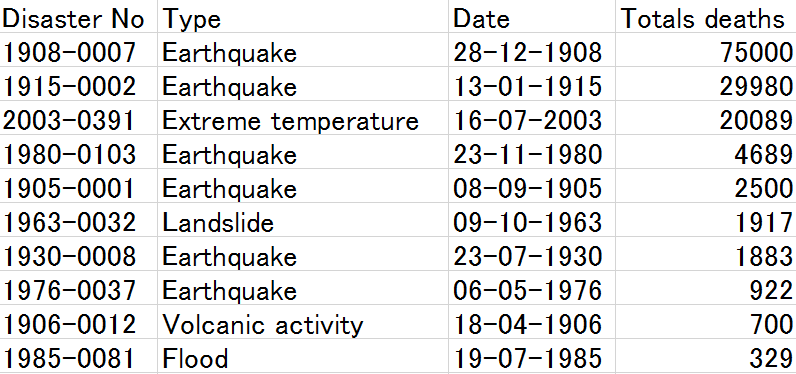
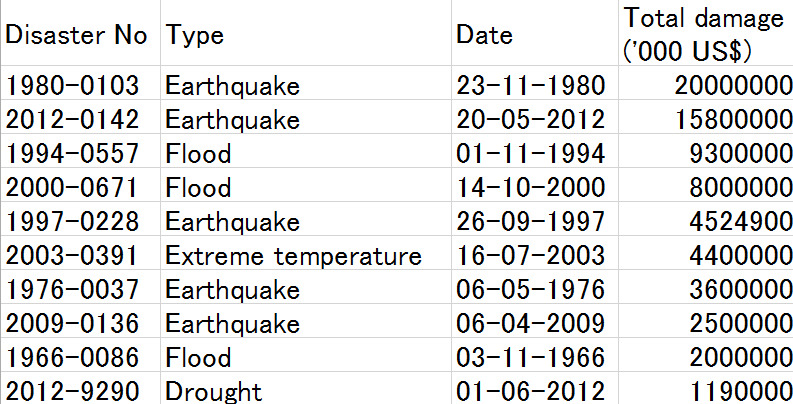
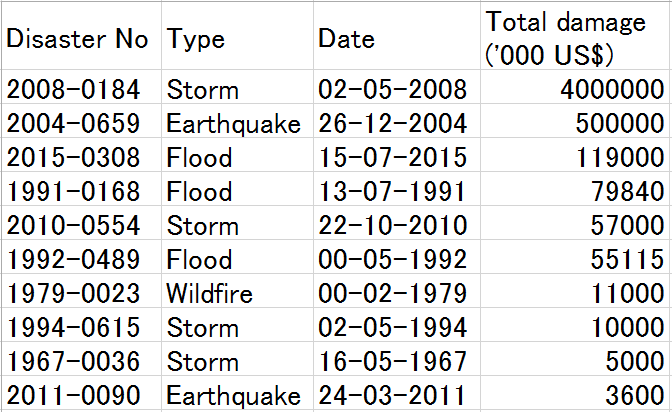
Table 1 and Table 2 show the 1900-2016 top 10 deadliest and costliest disasters in Italy (EM-DAT).

Table 1  Totals deaths
Italy deadliest

Table 2  Total damage
Italy costliest disasters

Day_130 : Natural Disasters in China (2) – Two Earthquake Disasters


Two Earthquakes
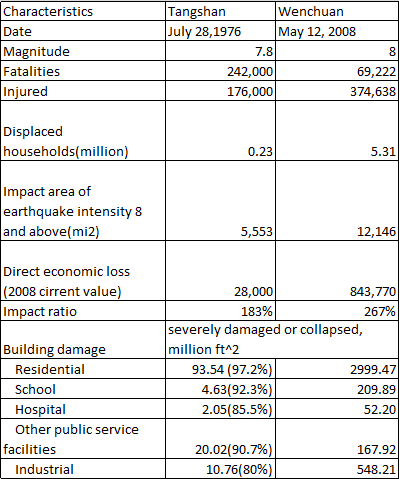
Yang Zhang William Drake, et al. (2016)* indicates interesting views on two earthquakes disaster recoveries, the 1976 Tangshan earthquake and the 2008 Wenchuan earthquake. The point is, why the 2008 Wenchuan earthquake recovery was so rapid compared to the 1976’s earthquake.
However, the paper could add more about the total background changes of China such as society, economy, and politics. The china has changed dramatically after the 1976 from historical viewpoints.

The Tangshan earthquake is one of the deadliest disasters in the world and the Wenchuan earthquake is one of the top ten costliest disasters in the world also. Munich Re ranked the Wenchuan as the top four costliest disaster after the Japanese Tsunami (2011), the Hurricane Katrina (2005). and the Kobe Earthquake (1995). The number of deaths caused by the Tangshan is still controversial because of the Chinese government’s political climates at the time.

A Comparison of the two earthquakes

tanchanwenchan
Yang Zhang William Drake, et al. (2016)

The Rapid Disaster Recovery after the 2008 Wenchuan earthquake
Yang Zhang William Drake, et al. (2016) describes the following points, historical and socio-economic contexts, why the 2008 Wenchuan earthquake recovery was so rapid compared to the 1976’s earthquake.

[Historical context]

  1. The Chinese government drew lessons from its handling of the Tangshan earthquake recovery. The government emphasized the importance of planning for coordinated reconstruction.
  2. China had established a strong planning institution to support its rapid growth agenda since the economic reform began in the late 1970s. The contrast of recovery planning between the two earthquakes highlights the notion that a pre-existing planning institution and pre-existing policy documents that describe development visions for a disaster area.

[Socio-economic context]

  1. China’s ability to promptly fund the earthquake recovery was far superior in the 2000s. China’s annual GDP in the year prior to the Wenchuan earthquake was 3.494 trillion USD 2007, which was 22 times its GDP in 1975.
  2. The earthquake happened less than three months before the Beijing Olympic Games. It was in the government’s best interest to move swiftly with the response and recovery to ensure social stability for the Olympic Games.
  3. The global economic downturn of 2008 might have also played a role in speeding up the earthquake recovery. To stimulate the economy, heavy investment in the earthquake recovery became a convenient policy option.

However, many things can be added about the above points such as the acceptance of international aids (Day_95).

http://disasters.weblike.jp/disasters/archives/2971


This rapid recovery from Wenchuan reminds us the Japanese historical trends  from 1945 to 1959, especially after the Typhoon Isewan in 1959. The Haiti’s cases, 2010 Earthquake and 2016 Hurricane Matthew also can be found as the same analogy (The below related articles across the web).

The Meanings of the Lessons
We cannot experience the disasters so often, of course, we do not want to have disasters. This is why we should learn from the past disasters and this is what we can do all the time.

*Yang Zhang William Drake, et al. (2016) Disaster Recovery Planning after Two Catastrophes: The 1976 Tangshan Earthquake and the 2008 Wenchuan Earthquake, International Journal of Mass Emergencies and Disasters, 34(2):174-203

[ad#ads1]


Day_126 : World Disaster Chronology-1989

The accuracy will be improved with citing some data sources.

Date Place Disaster Type Situations
1989.01 USSR, Central (Tajikistan Inland Earthquake M5.3, Over 270(DM)
1989.04.20 China Hail Damage Over 150(DM)
1989.04.26 Bangladesh Tornado The Daulatpur–Saturia Bangladesh tornado*.1300(D)The deadliest tornado disaster in history. 
1989.05- Viet Nam Tropical Storm, Flood Over 740(DM), Tropical Storm Cecil
1989.05- Bangladesh Cyclone, Flood Over 200(DM)
1989.06- China Sichuan Torrential Rains, Flood Over 1,300(DM)
1989.06- Sri Lanka Torrential Rains, Flood 300-500(DM) 
1989.07- India Cyclone, Flood Over 2,700(DM)
1989.07- China Torrential Rains, Flood Over 1,500(DM)
1989.07- Bangladesh Torrential Rains, Flood Over 200(DM)
1989.07- Viet Nam Typhoon, Flood Over 200(DM)
1989.08.01 Iran, West Inland Earthquake M5.8, 120(DM)
1989.09- China Typhoon, Flood Over 520(DM)
1989.10.17 US, West (Calfornia) Inland Earthquake Loma Prieta earthquake **(M7.1) 62(DM), Damage cost 7bill.US

DM: The number of dead and missing.

*The Daulatpur–Saturia, Bangladesh tornado occurred in the Manikganj District, Bangladesh on April 26, 1989. There is great uncertainty about the death toll, but estimates indicate that it killed around 1,300 people, which would make it the deadliest tornado in history. The disasters in Bangladesh indicate natural disaster is not natural.                        Can refer Day_117.

http://disasters.weblike.jp/disasters/archives/3224

**The 1989 Loma Prieta earthquake occurred in Northern California on October 17 at 5:04 p.m. local time. This earthquake happened in the northeast of Santa Cruz on a section of the San Andreas Fault.The death toll was relatively not high compared to the economic damage. This can be explained with developed countries, especially US disasters characteristics.  Can refer to The Day_119.

http://disasters.weblike.jp/disasters/archives/3248


Day_114 : World Disaster Chronology-1980


Date Place Disaster Type Situations
1980.01- US, East Cold Wave 100 (DM)
1980.01- India, North Cold Wave 80 (DM) Bihar 
1980.04- Peru Heavy Rain, Flood 90 (DM)
1980.05- US, Northwestern Volcano  Mount St.Helens Volcanic Eruption*  80 (DM), A summit was disappeared by landslide and huge volcanic eruptions.
1980.06- India Heavy Rain, Flood Over 600 (DM)
1980 India Disease Over 550 (D)
1980.07- Japan Cool weather damage Damage cost was over 6,900 mil, yen
1980.07.28 Nepal Inland Earthquake (not confirmed), 90(DM)
1980.08- Japan Heavy Rain, Flood 26 (DM),Injured 50, Destroyed 400, Inundation over 39,000
1980.08- US, East Heat Wave 1,000-1,300 (DM)
1980.08- India, East Heavy Rain, Flood Over 1,500 (DM)
1980.08- Haiti Storm, Flood 270 (DM)
1980.08- China Heavy Rain, Flood Unknown (DM)
1980 Bangladesh Heavy Rain, Flood Over 650 (DM)
1980.09- India, Southeastern Heavy Rain, Flood 200 (DM), Orrisa
1980.10.10 Algeria, Northwestern Inland Earthquake  M7.1-7.5, El Asnam Earthquake 2,600-5,000(DM)
1980.10- India Infectious disease Over 400 (D)
1980.10.24 Mexico, Central Inland Earthquake (unknown), 65 (DM)
1980.11.23 Italy, South Inland Earthquake 1980 Irpinia earthquake** M6.9   2,500-4,700 (DM)
1980.12- Japan Heavy Snow 103 (DM)Injured over 1,300, Destroyed over 5,800, Inundation over5,500

D: Dead number DM: The dead and missing number

*St.Herens volcanic eruption

https://disasterresearchnotes.site/archives/2860

**1980 Irpinia earthquake


Day_111 : Earthquake Information (1)

Introduce you two earthquake information websites. 1) The Earthquake Track 2) J-RISQ

1) The Earthquake Track

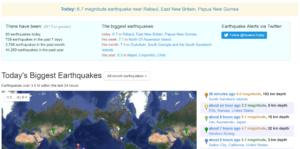
The Earthquake Track is useful to overview the earthquake occurrence situation in the world (Figure 1). As you can see in the below figure, every day’s earthquake occurrence situation such as how many times the earthquake occurred, what is the biggest earthquake of the day, and the earthquake locations on the map can be seen. Also, we can access to the detailed information of the quakes.

160831_earthquakepic1
Figure 1  The Earthquake Track

2) J-RISQ

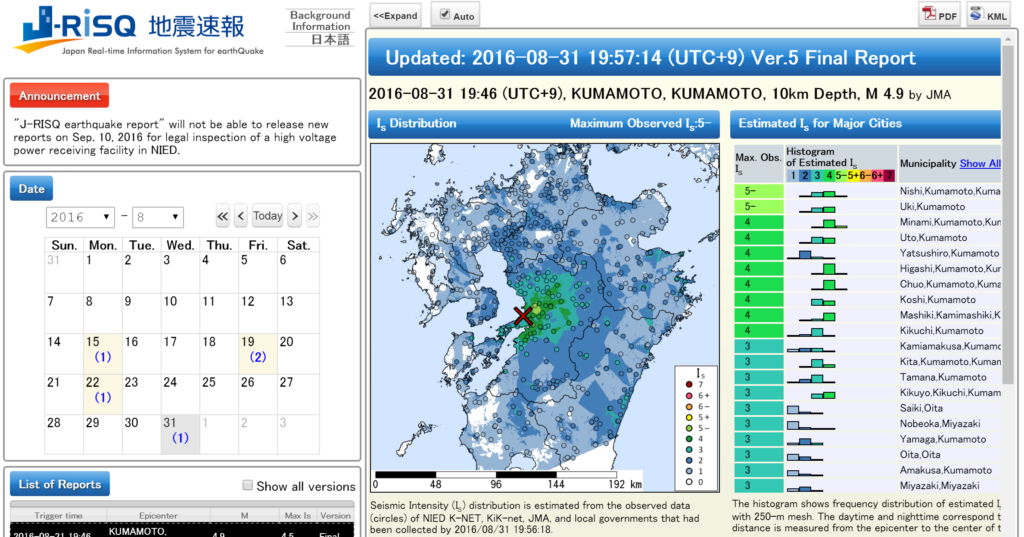
Figure 2 shows J-RISQ provided by the National Research Institute for Earth Science and Disaster Prevention (NIED).

160831_JRISQ1
Figure 2  J-RISQ website

As you can see the Figure 2, this site does not only provide earthquake (hazard) information but also affected population estimation (exposure). In addition, the site gives us historical information of the affected area. You can also refer prediction data on the map such as earthquake distribution of 2% probability of exceedance in 50 years and distribution of return period of 50,000-year.

Day_109 : Earthquake disasters in Thailand

The earthquake disaster is not so common in Thailand, therefore, that is why Thai people should consider the risk. They have a lack of experience.

The Earthquake Track is one of the useful websites to check the earthquakes in Thailand including neighboring countries. The recent earthquake can be confirmed
Recent Earthquakes Near Thailand” site.

The below is a guide book for earthquake disaster reduction in Thai (especially for Thai people).
A Guide Book for Earthquake Disaster Reduction (Thai language)

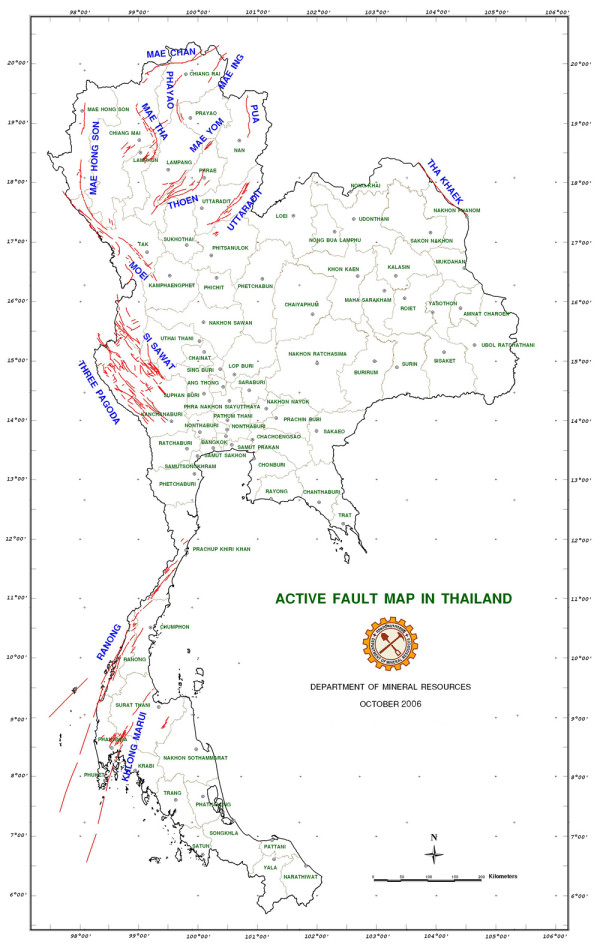
There are some active faults in Thailand (Figure 1).

thai faultline
Figure 1 Active Fault Map in Thailand

We should know the BKK is one of the earthquake vulnerable areas because the
ground is not so firm.
A short essay about natural disaster risk mapping in Thailand was written as follows:

https://disasterresearchnotes.site/archives/2935

Day_108 : World Disaster Chronology-1978

The chronology will be improved little by little. This is the first draft version. The information source will be shown later. In addition, other some events will be explained.

Date Place Disaster Type Situations
1978.01- US, East Cold wave The dead and missing number is 160
1978.02- US Disease Influenza, the dead number is over 6,000
1978.04.16 India Tornado The dead and missing number is over 600
1978.06.12 Japan, Northeast Submarine Earthquake 1978 Miyagi ken Oki earthquake M7.4, The dead number is 28
1978.07- Bangladesh Heavy rain, Flood The dead and missing number is over 120
1978 Pakistan Heavy rain, Flood The dead and missing number is over100
1978.08- India Heavy rain, Flood The dead and missing number is 900-1,300
1978.09- Africa, East Disease The dead number is over 350
1978.09.16 Iran, Central Inland Earthquake 1978 Tabas earthquake*  M7.2-7.8, The dead and missing number is 18,000-25,000
1978.10- India Disease The dead number is over 480
1978.11- Sri Lanka, and others Typhoon, Flood The dead and missing is 1,500

*1978 Tabas Earthquake

The one of the most earthquake vulnerable countries in Asia is Iran. Iran had 16 times earthquakes in the 1800s  and 18 times earthquakes in the 1900s which caused over 1000 deaths. In particular, the one of the main causes of deaths is a building structure, called adobe.

Adobe is a kind of clay used as a building material, typically in the form of sun-dried bricks (Oxford dictionaries).

In dry climates, adobe structures are extremely durable, and account for some of the oldest existing buildings in the world. Adobe buildings offer significant advantages due to their greater thermal mass, but they are known to be particularly susceptible to earthquake damage if they are not somehow reinforced. Adobe are common throughout the world such as Middle East, West Asia, North Africa, West Africa, South America, southwestern North America, Spain, and Eastern Europe (Wikipedia).

“Adobe and earthquakes are a perverse and tragic combination”
“The people on the street are killed by the walls that fall out, the people inside are killed by the roof that falls in”  says Mr Marcia Blondet (A Peruvian engineer). (BBC).

Day_106 : Myanmar-This week’s earthquake and the past trends

Myanmar had a huge earthquake (M6.8) on 24Aug2016.
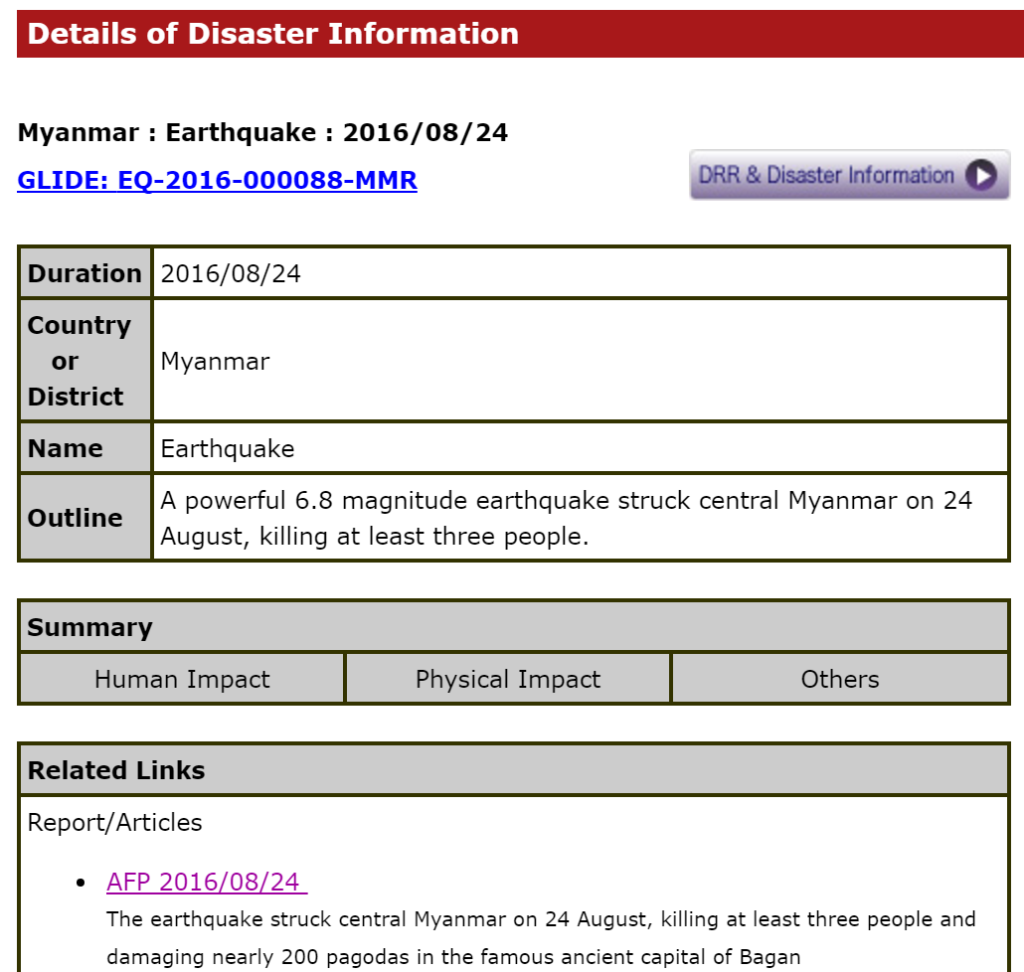
The outline of the information can be checked by the ADRC website (Figure 1).

Myanmar Earthquake
Figure 1  Myammar Earthquake 24Aug2016 (ADRC)

“A powerful 6.8 magnitude earthquake struck central Myanmar, killing at least three people and damaging nearly 200 pagodas in the famous ancient capital of Bagan. The quake was also felt across neighboring Thailand, India and Bangladesh, sending panicked residents rushing onto the streets (AFP).”

Let’s check the disaster data.
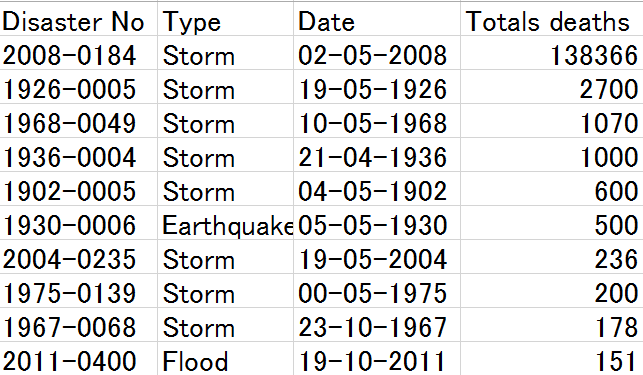
The Figure 2 Figure 3 are the 1900-2016 top 10 deadliest and costliest disasters  in Myanmar (EM-DAT).

Myanmar death toll 2
Figure 2 Totals Deaths (Top 10 deadliest natural disasters in Myanmar)

Myanmar economic damage 2
Figure 3 Total damage (Top 10 costliest natural disasters in Myanmar)

We can confirm how the 2008 Cyclone Nargis was influential.
Many natural disasters which have high total deaths numbers occurred before 2000 (7/10).  On the contrary, many high economic damage natural disasters hit after 1990 (8/10).  These facts support the following “disaster is from human suffering to economic damage with development process”.

The notes on the recent major events (ADRC) are as follows:

1) Cyclone Nargis (May 2008)
Cyclone Nargis hit Myanmar in May 2008 which killed 84,537, with the missing 53,836, injured    19,359. 450,000 houses were destroyed, with another 350,000 damaged. Total affected people     were 2.4 million. The total economic loss was US$ 4.1 billion (according to Post-Nargis Joint         Assessment- PONJA).

2) Indian Ocean Tsunami (December 2004)
Indian Ocean Tsunami occurred off the Sumatra Island on 26 December 2006 killed 61,                 injured 42, affected 2,592 and destroyed 601 houses in Myanmar.

*The numbers of deaths are not the same with different sources. This is the one of the most important challenges of disaster research.

We can especially consider the political conditions for understanding the 2008 Cyclone Nargis disaster exacerbations. During the disaster, the county had refused international aids.

[ad#ads1]

Day_98 : The Major Tsunami disasters in Sanriku Ria Coast in Japan

The following slide indicates the Great East Japan Earthquake and Tsunami(GEJET)disaster’s data by each municipality (IRDR conference).You can see the fact that Sanriku ria coast has more severe damage compared to the population of the municipalities.We also need to notice the Sanriku ria coast has a long history of tsunami disasters.But why did they have a sever damage again?

sanriku tsunami history death
Figure 1 Tsunami Disaster Impact in the Sanriku Ria coast (IRDR)

The Sanriku areas have a special geographical condition mentioned as Sanriku ria coast. The coast has mountains close to the sea, so residential areas are limited only in the distributed, narrow and lower zones near to the sea and the areas become very vulnerable against the tsunamis. The bays in the coast are small and the sea inside the bays are very deep. This makes tsunami faster and higher, this is why the Sanriku ria coast makes the one of the highest tsunami risk areas in the world.

Because of these characteristics, the communities in Sanriku ria coast, mainly in Iwate prefecture historically has been severely affected by tsunami disasters such as Meiji Sanriku earthquake tsunami (Meiji (1896)), Sowa Sanriku earthquake tsunami (Sowa (1933)), and Chilean earthquake tsunami (Chilean (1960)) disasters compared to the flat coast mainly in Miyagi prefecture and other areas in Japan.

See the below “Relocation or Rebuilding (1)”

http://disasters.weblike.jp/disasters/archives/2950

The following is the brief explanations of each tsunami disaster. The Figure 2 (Figure 1 of the Day_94 post) does not include the Chilean Tsunami.

sanriku tsunami history
Figure 2
 The Tsunami Disasters in Tohoku (Cabinet office of Japan)

1) Meiji sanriku tsunami disaster(1896), this disaster is so called a surprise attack tsunami disaster happened at approx. 7:30 pm, 15th of June in 1896 mainly in Sanriku ria coast. The dead and missing number has reported over 22,000. The earthquake is not so strong (Japanese earthquake scale indicates Shindo 1-2), however, tsunami is very strong and high (max. height is 38.2m at Ayasato area (present Ofunato city) compared to the earthquake movement scale. The first wave arrival is approx.35m after the earthquake. The Meiji sanriku tsunami disaster (1896) is the worst tsunami disaster ever in Japan.

2) Showa sanriku tsunami disaster(1933), this tsunami disaster can be examined the lessons learned from Meiji (1933) mitigate the impacts. This tsunami attacked mainly the Sanriku ria coast at approx. 2:30 am, 3rd of March in 1933. Even if the midnight, the residents evacuated so quickly because of their memories of the Meiji (1896) with strong earthquake (Japanese scale is Shindo 5.5). The max. tsunami height is 23m at the same place, Ayasato area, with Meiji (1896). The first wave arrival is approx.30 min. after the earthquake.

3) Chilean tsunami disaster(1960), this is caused by the tsunami generated offshore in the long distance. This is coming from Chile in South America. The earthquake occurred in Chile was magnitude 9.5 and this huge earthquake generates tsunami and reach to Japan after 22 hrs and a half. The tsunami come approx. at 3 am, 23rd of March in 1960. The death number is 139 all over the Japan and Sanriku ria coast is the worst such as 63 in Ofunato, 37 in Shizugawa (present Minamisanriku), and 8 in Rikuzentakata.

4) Great East Japan Earthquake and Tsunami(GEJET) disaster(2011), this disaster is the deadliest disaster after the Second World War in Japan. The earthquake happened at 2:46 pm, 11st of March in 2011. The total casualty number is 19,846 based on the EM-DAT.The max.tsunami height is 40m at the Sanriku ria coast. The first wave arrival is approx. 30 min. after the earthquake.

Day_97 : World Disaster Chronology 1976 (2)


Date Place Disaster Type Situations
1976.08.17 The Phillipines, South
Mindanao
Submarine earthquake 1976 Moro Gulf earthquake and tsunami*: M7.8-8.1,A dead and missing number is 4,000-8,000
1976.09- Japan Typhoon 1976 Typhoon No.17 Flood (Nagara river flood
A dead and missing number is 169, Injured 400
1976.10.28- Japan, North-eastern Strong wind Sakata conflagration: A death and missing 2, Injured over 900
1976.10.29 Indonesia, East Irian Jaya Inland earthquake M7.2, A death and missing number is 100-6,000not confirmed),landslide
976.11.24 Turkey and Iran border Inland earthquake  1976 Çaldıran–Muradiye earthquake**: M7.2-7.6, A death and missing number is 3,600-10,000
1976.12- Japan Snow  A death and missing number is 84, Injured over300, damage loss 40 billion yen

1976 Moro Gulf earthquake and tsunami*
The worst tsunami disaster in the Philippines.1) It happened while most people were sleeping.
2) No warning after the earthquake.

1976 Çaldıran–Muradiye earthquake**
The almost all houses were destroyed because of the structure constructed of thick walls made from rubble masonry cemented with mud mortar.

[ad#ads1]