Category Archives: Asia

Day_68 : Aging Asia to Natural Disasters -Thailand-

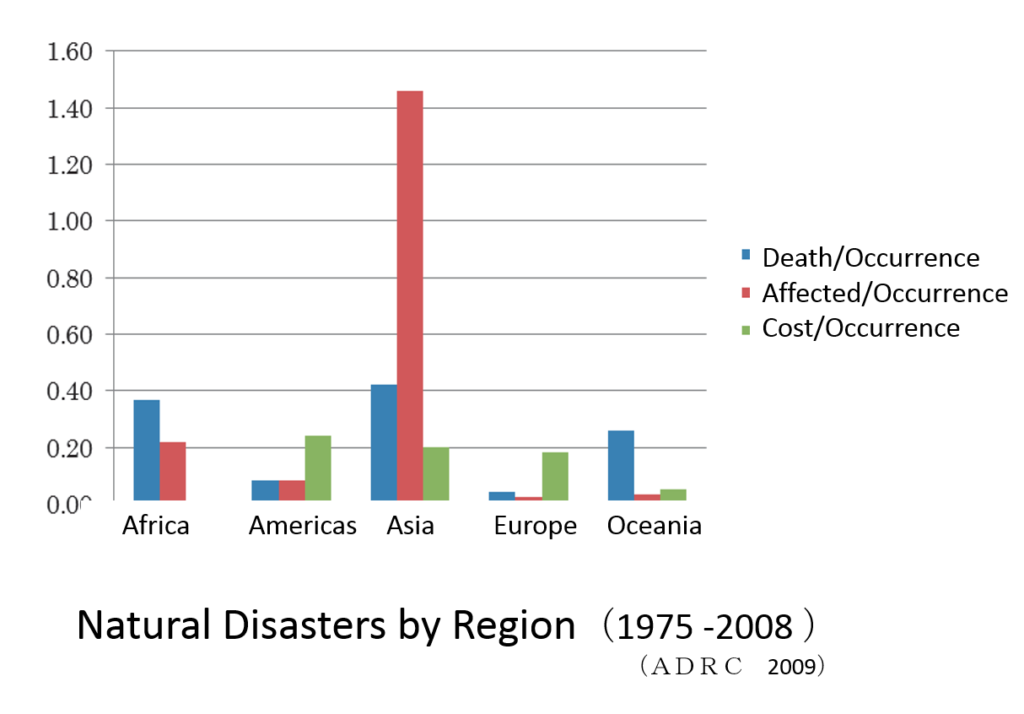
Many Asian countries are facing an aging society. For instance, the Thai population in 2012 was 64,460,000 and the proportion of those over 65 is 8.6 percent compared to 3.1 percent in 1970. This shows that Thailand is facing an aging society and the World Population Prospects* predicts this trend will accelerate. This situation is not exclusively in Thailand, but can likewise be viewed in almost all Asian nations. In addition, Asia is the most vulnerable in terms of natural disasters such as 7 of 10 of the deadliest natural disasters (1980-2014) took place in this region.


World bank notice**:
The Thai population is aging rapidly. The declining share of the working age population will affect economic growth.
– As of 2016, 11% of the Thai population (about 7.5 million people) are 65 years or older, compared to 5% in 1995.
-By 2040, it is projected that 17 million Thais will be 65 years or older – more than a quarter of the population.
-Together with China, Thailand has the highest share of elderly people of any developing country in East Asia and the Pacific.
-The primary driver of aging has been the steep decline in fertility rates, which fell from 6.1 in 1965 to 1.5 in 2015, as a result of rising incomes and education levels and the successful National Family Planning Program launched in 1970.
-The working age population is expected to shrink by around 11% as a share of the total population between now and 2040 – from 49 million people to around 40.5 million people.
-This decline in the working-age population is higher in Thailand than in all other developing East Asia and Pacific countries, including China.

* World Population Prospects
https://esa.un.org/unpd/wpp/

** World Bank, 2016
Thailand Economic Monitor – June 2016: Aging Society and Economy

Disaster data and statistics can be referred by the following link:
http://www.preventionweb.net/english/professional/statistics/

Day_42: 人口と災害【3】:人口研究とアジア[Japanese]

災害に関する人口研究の重要性

William Donner and Havidan Rodriguez(2008)は、気候変動より、人口変動による将来の自然災害によるリスクの重要性を指摘している。現実問題として、将来の気候変動による災害に対する影響などは、IPCCなどの主導による研究に代表されるように多くの研究成果が主に自然科学者などにより実施されているが、人口の変動による将来の災害に対する影響の研究は、指標研究を含めてほとんど語られていないのが現状であり、課題となっている。

アジア地域の脆弱性

Munich Re(ミュンヘン再保険会社)によるデータによれば、1980年から2014年における、アジア、アフリカ、北・中央アメリカ、南アメリカ、オーストラリア/オセアニアに分類した世界全体の地域別自然災害のうち、アジアの占める割り合いは、死者数で、69%、経済損失で40%に及び、最も脆弱な地域であることを示している。また同時にアジアは、沿岸部への人口の集中とともに、高齢化が特に進んでいる地域でもある(大泉 2007)。これらは、アジアにおける自然災害に対する脆弱性は今後ますます高まると言っても過言ではない。将来気候変動が叫ばれるなか、さらに日本では、南海トラフや首都直下地震、さらには、2016年の熊本地震で示されるように、いつどこで起こってもおかしくない地震をはじめ、ハザードの側面、及び、進む少子高齢化など社会的脆弱性の側面、両面からリスクは増加する傾向にあるといってよい。それらのリスクへの対応としては、ハザードすなわち自然現象に対するアプローチは主に工学や自然科学分野で多くなされているが、社会的脆弱性という意味での少子・高齢化などによるリスクへの影響に関する研究は、今後の災害対策を考えるうえでも益々重要な位置づけとなるだろう。

Day_37: 伊勢湾台風災害, 流木被害, そしてフィリピン [Japanese]

伊勢湾台風とフィリピン、つながらないようで、実はつながっています。もともと、フィリピンに着目したのは、災対法及び防災科研が設立するきっかけとなった伊勢湾台風災害の流木被害(多くの犠牲者を生んだ)に興味をも ち、その関係を調べていると、その木材の90%はフィリピンからのラワン材 で、名古屋で加 工して、朝鮮戦争後の住宅ブームのアメリカに輸出するという構図に着目してからです。南区の犠牲者の多くがこの流木によって、家屋が破壊されたことによるものだったからです。これは朝鮮戦争からの流れ、アメリカの影響による木材の自由化などとつなが り、また、フィリピンの森林破壊(当 時輸出の8割強が日本)と日本の森林の 衰退とつながり、これが現在まで続くフィリピンの洪水、土砂災害日本の地震や 豪雨による地 すべりや、少し強引には花粉症問題がでているというのが見えてきました。

[ad#ads1]

Day_33 : Japanese Disaster History after the Second World War

Japanese disaster history has three turning points. The first was Typhoon Isewan (Vera) in 1959. The second is the Kobe earthquake disaster in 1995, and the third is the Great East Japan Earthquake and Tsunami (GEJET) disaster in 2011. After Typhoon Isewan, the Disaster Countermeasures Basic Act was enacted in 1961. The act combined many disaster-related laws into one. This act is always updated after disasters. The Kobe earthquake facilitated volunteer activities. Many social scientists started to investigate disasters. Before the disaster, natural scientists and engineers were the main players in disaster-related research, along with Japanese infrastructure-centered policies. We have noticed we cannot prevent disasters, but we can mitigate disasters after Kobe. The GEJET disaster became the worst ever disaster in Japan after the Second World War. Japan had confidence before the disaster because we had two major disaster experiences and polished hard and soft countermeasures.
The GEJET broke confidence and made us reconsider our strategies.
…………………………………..to be continued

*Disaster countermeasures basic act:
http://www.preventionweb.net/english/policies/v.php?id=30940&cid=87


Day_32: Disaster Chronology and Typhoon Isewan (Typhoon Vera)

A disaster chronology will be shown in this blog. The chronology can be said basic research for social science.  The environmental sociology in Japan was polished by the chronology. Our research laboratory was very famous in this field. The NIED (National Research Institute for Earth Science and Disaster Prevention) has created a short disaster chronology and conducted some memorial events. The Typhoon Isewan (1959) related event was held in 2009. The following site is the information about the event. Sorry, this is only in Japanese, however, so many precious pictures and movies are uploaded, so you can easily check the contents. A Japanese disaster history after the Second World War including the Typhoon Isewan disaster is explained below:

http://disasters.weblike.jp/disasters/archives/3283

Typhoon Isewan <Typhoon Vera> (Wikipedia)
https://en.wikipedia.org/wiki/Typhoon_Vera

The event site:
http://dil.bosai.go.jp/disaster/1959isewan/

sponsored link

Day_18 : Natural disasters in Thailand

“More must be done to fight climate change” (Bangkok Post)
http://www.bangkokpost.com/opinion/opinion/1034545/more-must-be-done-to-fight-climate-change

The above article was found on the Bangkok Post. The risk assessment mapping in Thailand* indicates the flood is the first priority to prepare. Disaster data infrastructure is challenging in Thailand to analyze. The culture to establish an excellent disaster management system in Thailand could be facilitated by the research based on the data infrastructure.

* Risk assessment mapping in Thailand (Tentative)

http://disasters.weblike.jp/disasters/archives/2935

The above was already published in JAEE report.