Category Archives: Demography

Day_43 : Okushiri Island

The 1993 southwest-off Hokkaido earthquake hit okushiri island severely. The number of casualties was 165. Okushiri town had faced population decreasing and aging issues before the disaster. After the disaster, okushiri town had a lot of aids, especially from inside of Japan. The Japan had a very good economy at that time, so the situations enabled them to have such huge aids. Even though the large economic assistance, the town’s demographic tendency before the disaster was facilitated.Total population is from 4,604(1990) to 2,662(2015), an aging proportion, over 65, is from 15.6%(1990) to 38.6%(2015).

[ad#ads1]

Day_42: 人口と災害【3】:人口研究とアジア[Japanese]

災害に関する人口研究の重要性

William Donner and Havidan Rodriguez(2008)は、気候変動より、人口変動による将来の自然災害によるリスクの重要性を指摘している。現実問題として、将来の気候変動による災害に対する影響などは、IPCCなどの主導による研究に代表されるように多くの研究成果が主に自然科学者などにより実施されているが、人口の変動による将来の災害に対する影響の研究は、指標研究を含めてほとんど語られていないのが現状であり、課題となっている。

アジア地域の脆弱性

Munich Re(ミュンヘン再保険会社)によるデータによれば、1980年から2014年における、アジア、アフリカ、北・中央アメリカ、南アメリカ、オーストラリア/オセアニアに分類した世界全体の地域別自然災害のうち、アジアの占める割り合いは、死者数で、69%、経済損失で40%に及び、最も脆弱な地域であることを示している。また同時にアジアは、沿岸部への人口の集中とともに、高齢化が特に進んでいる地域でもある(大泉 2007)。これらは、アジアにおける自然災害に対する脆弱性は今後ますます高まると言っても過言ではない。将来気候変動が叫ばれるなか、さらに日本では、南海トラフや首都直下地震、さらには、2016年の熊本地震で示されるように、いつどこで起こってもおかしくない地震をはじめ、ハザードの側面、及び、進む少子高齢化など社会的脆弱性の側面、両面からリスクは増加する傾向にあるといってよい。それらのリスクへの対応としては、ハザードすなわち自然現象に対するアプローチは主に工学や自然科学分野で多くなされているが、社会的脆弱性という意味での少子・高齢化などによるリスクへの影響に関する研究は、今後の災害対策を考えるうえでも益々重要な位置づけとなるだろう。

Day_40 : EM-DAT_disaster trends

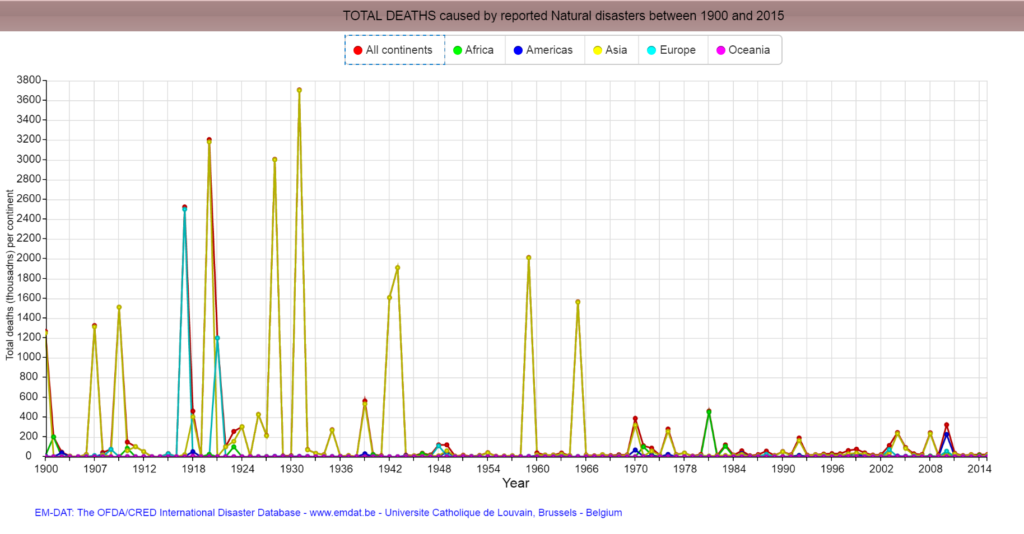
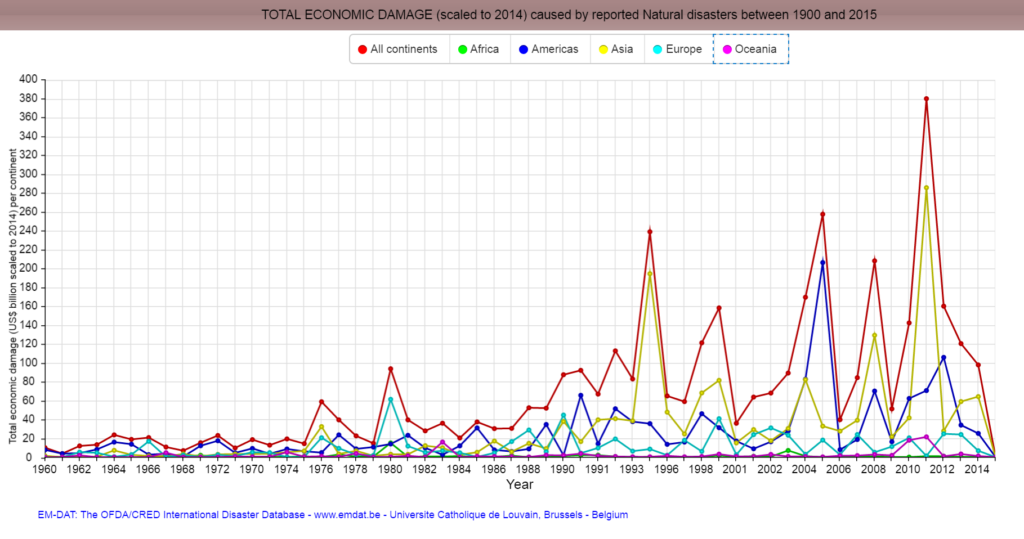
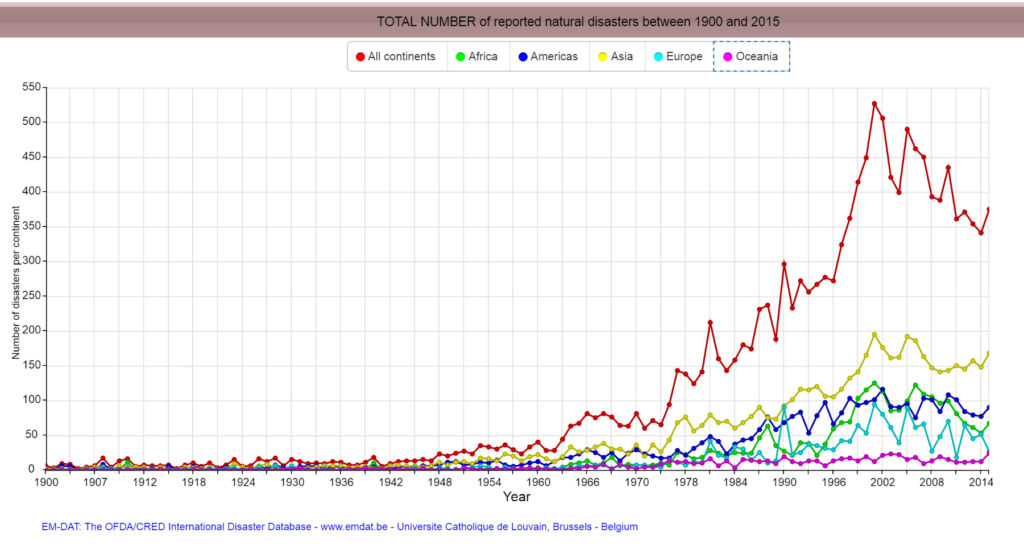
I ve just used EM-DAT* to check the disaster trends by continents.

The number of disasters

trend_numbers

The number of death

death_numbers

The cost

cost_numbers

*D. Guha-Sapir, R. Below, Ph. Hoyois, EM-DAT: The CRED/OFDA International Disaster Database, www.emdat.be, Université Catholique de Louvain, Brussels, Belgium.

You can see the general trends. This clearly shows Asia is the most vulnerable continent.
As mentioned before, there are no disasters if there are no people. Also, we can notice that
disasters change from human sufferings to economic damages with the development process
of the countries.


Day_31 : 人口と災害【2】[Japanese]

人口と災害について、指標研究では、社会脆弱性指標、リジリエンス指標が中心課題となっている。社会脆弱性指標については、サウスカロライナ大学のカッター*などが先駆的で大きな貢献をなしてきた。その社会脆弱性指標の延長として近年数多くの成果が出されてきているのがリジリエンス指標研究である。どちらの指標研究も基本は、Wisnerら(2004)のPressure and Release(PAR)モデルが理論的な下敷きになっており、リスクを、Risk(リスク)=H(ハザード)× V(バルナラビリティ)で考え、リスクは、ハザードとバルナラビリティの重なった部分ととらえる。ハザードには自然現象(例えば降雨量)が、バルナラビリティには社会的な条件が当てはまり、このバルナラビリティに関しては、地域の暴露人口、高齢化率、男女比、識字率、さらには所得などの統計データを用いることによって指標化が可能となる。リジリエンス指標については、教育レベルや収入等より長期的な視点を含めた変数を加えたものである。GISなどの技術の進歩とともにこれらの結果が地図上に落とし込まれ地域毎の社会的脆弱性、リジリエンス、及びリスクが可視化されるようなり、指標研究が進んだ。 これらの指標研究は、実用的な研究としても多くの防災・災害研究者が取り組んでいる。ただ、国や地域により、災害や各種統計データに格差があることや、実際の災害による妥当性の検証などの問題を常に抱えていることも確かである。これらの問題の対応として、ターゲッ地域へのフィールド調査による質的な情報を組み合わせる指標への試みもなされてきている。

*スーザン・カッター サウスカロライナ大学(米国) ハザードと脆弱性研究所教授・. 所長

[ad#ads1]

Day_29 : Human Vulnerability Index

I am developing the Human Vulnerability Index.

If you have some ideas about this issue, please let me know.

The HVI was originally developed when I was doing research on the Great East Japan Earthquake and Tsunami (GEJET) disaster in 2011. I needed to compare the disaster impact by municipality for not only the 2011 tsunami but also the 1896, 1933, and 1960 tsunamis. However, it was difficult to compare because geographical and population sizes are different by municipality. So the HVI was developed. A member of JAEE thankfully recognized this for the applications.

The following are just some parts; I will disclose the details in the paper and post the link here in the near future.

1. The HVI can be applied to compare the municipalities not only for the GEJET disaster but also with the historical tsunami events and clarify the historical trends.

2. The recurrent HVI was calculated by a ridge regression analysis using the evacuation-related factors, which this paper estimated based on some theories, such as the PAR model.

3. The HVI was also applied to two international cases: the 2004 Indian Ocean Tsunami and the 2005 Hurricane Katrina.

The HVI-related paper was published with Dr.Yozo Goto.
https://www.researchgate.net/publication/329961277_HUMAN_VULNERABILITY_INDEX_FOR_EVALUATING_TSUNAMI_EVACUATION_CAPABILITY_OF_COMMUNITIES_Eng_Version
Day_26 : A text mining : Trends of disaster research on aging

Have just conducted a text mining as follows:

Overviews of the Literatures concerning elderly and disasters by text mining for the initial stage.
1.Search the keywords at Web of Science (Core Collection)
2.Selected Information (Authors, Titles, and Abstracts) was gathered into one text file.
3.1st contents analysis has been carried out and omitted the unnecessary words for the next analysis.
Cleaning process
4.2nd contents analysis has been carried out. >>This process was repeated
5.Research findings are examined.
6.Check the extracted words and phrases by reaching to the original abstracts and original papers.

*5 and 6 are not finished yet.
**To do the textmining, RH corder was used.

The folloing attached file is the results which I can share
Elderly_disasters_initial_litreview_outline

Day_25 : 人口と災害 【1】 [Japanese]

人口と災害についてこれまでどのような研究がなされてきたか。まず基本的に災害とは人がいなければ災害にならないという前提を押さえておかなかえればならない。ユネスコの自然災害の定義では、natural hazard とnatural disasterと分けている。すなわち、自然現象と自然災害として分けて説明しているが、例えば、地震が起こってもそこに人がいなければ災害とはならないことからも自明のことであろう。以上を踏まえたうえで、これまでの人口と災害に関する研究について俯瞰すると、大きく社会変動及び指標研究が研究上重要な役割をはたしてきたといえる。
社会変動に関する研究としては、古典的には、災害のコミュニティに与える影響を比較的長期的な視点で研究するもので、人口の変化の検討が大きな役割を果たす。Bates等*は、災害は災害前のコミュニティの状態を加速するものであることを指摘しており、具体的な事例として、アメリカのハリケーンによって黒人地域が消滅していく過程を考察している。また、秋元**も、北海道洞爺湖の温泉街の復興について、火山災害がトリガーとなって、人口が急速に減少した状況について紹介している。
また、2005年のハリケーンカトリーナ災害後は、特に気候変動との関係で語られることが多くなった。 *Bates  **R.Akimoto 適宜追加します。