The following is the revised version of my past short essay for the institution’s mail magazine:
There is an index called the World Risk Index. According to the World Risk Report, Bangladesh ranked among the highest-risk countries in the world in 2019. Indonesia and Haiti also came to mind readily, their names long associated with devastating earthquakes in recent memory.
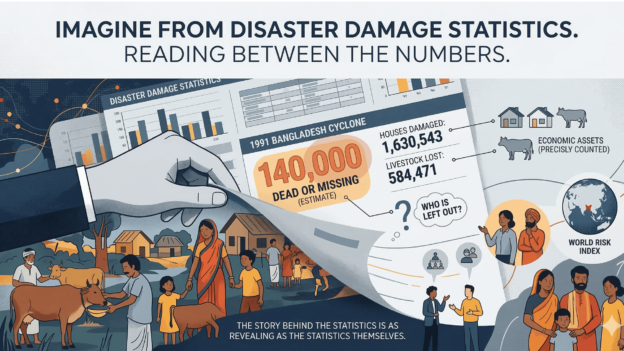
During a study session at my institution, I had the opportunity to examine Bangladesh’s disaster history from a land environment perspective — particularly the catastrophic cyclones of 1970 and 1991. The reported death tolls were staggering: approximately 500,000 and 140,000 lives lost, respectively. The sheer scale of these figures was striking, but what caught my attention was something subtler — why were these numbers so rounded?
When I looked more closely at the damage breakdown table, something immediately stood out. For the 1991 cyclone, the data recorded 1,630,543 houses damaged, 140,000 people dead or missing, and 584,471 livestock lost. House damage and livestock figures were precise to the single digit. Human casualties, by contrast, were a rough estimate.
That contrast is telling. It reflects not a statistical coincidence, but something deeper about how societies count — and what they choose, or are able, to count. Understanding Bangladesh’s social fabric — its caste structures, religious communities, and the central role of livestock in rural livelihoods — helps explain why certain losses were carefully documented while others remained approximate. Livestock, after all, represent measurable economic assets. Human lives in crisis, particularly among the most marginalized, are far harder to account for.
This gap becomes even more apparent when we look at 1970: no reliable death toll exists. Estimates from various sources range from 200,000 to 550,000 — a spread of 350,000 lives.
When a disaster strikes, damage figures circulate quickly. But I have come to believe that one of the most important analytical habits we can develop is to ask: Where do these numbers come from? What do they capture — and what do they leave out? The story behind the statistics is often as revealing as the statistics themselves.
By the way, the website is
https://reliefweb.int/sites/reliefweb.int/files/resources/WorldRiskReport-2019_Online_english.pdf
Issued July 5, 2010 No. 6
Source:
1. NIED-DIL mail magazine: 6
Imagine from disaster damage statistics
Contribution day and time: 2013/08/19
2. Day_167: Imagine from Disaster Damage Statistics, Disaster Research Notes