Category Archives: Warning

Day_171 : Past Interview Records – PTWC (Pacific Tsunami Warning Center) in Hawaii (2)

Interview Records at PTWC No. 2
2008.2.26 (Tue.) at 1000 am
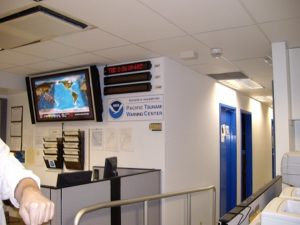
The records from the interview survey are shown below.

■ Science and technology
Many models of the tsunami have been developed. However, it is difficult to adopt because it is crucial whether it is practical or not.

■ Staff training
Only internal training is available.

■ A system where Civil Defense gives warnings to citizens.
There is a hotline to the provincial government and another one to the federal government.

■ Work shift
One person is always at the center for 24 hours.
8hr-4hr-4hr 4hr 16hrs are in shift
When there is a problem, three staff gather at the center.

■ Backup
The center’s backup is at the Alaska center and if Hawaii doesn’t work,. Alaska center can cover.

■ Relationship with media
Concerning the media, media is, in a sense, a partner.
Civil Defense needs 3 hours before the event to evacuate. for that reason, there are too many time constraints. The media is fast. However, there are various restrictions. To decide to proceed with the warning or not, the media has no such authority. Also, in the United States, the media is a business and not state-owned, so it could mislead. You must always pay attention to the points.

■ Resources
Before the tsunami damage of 2004, the conditions were very limited in terms of resources. A lot of money has been invested in this field since the beginning of the year. The function of the center has been improved because of that. The staff has increased. The 2004 event was a severe tsunami disaster, letting the world know the reality.

Related information . and Books
The following tsunami warning center provides the world situations on the map and list
U.S. Tsunami Warning Centers
Day_168 : Past Interview Records – PTWC (Pacific Tsunami Warning Center) in Hawaii (1)

Continue to the past New Orleans Interview Records, I would like to open the memo about the interview to PTWC. It was a great time and I learned a lot from the interviews.  So I would like to share this fact to let you know their efforts to tackle the tsunami disasters in the world.

PTWC is the core center for tsunami warning and is well known to the world.

2008.2.26 (Tue.) at 1000 am
15 staff: director, deputy director
Information Technician, including nine scientists
16-hour shift on 8-4-4; homes are next to the center

The records from the interview survey are shown below.

■ Evacuation
There is no international standard in terminology. Terminology varies by country/region. The words sometimes make me confused. Also, in the past, it was either an evacuation or no evacuation.

■ Warning Error
It is challenging to give a warning. There are errors in the original earthquake and the tide data. There is an error in the gauge also.
To judge them is too hard. So, it can be said that 99.99% is an error.

In Hawaii, only a quarter of evacuation were actually damaged in the past. It is not unusual that, although there were evacuations, there were no damages at all.

■ Past data and warning judgment
Only use a few. Because how to put out the past data, equipment, etc. is hard to do. The numerical model used to determine if the earthquake becomes a tsunami is complicated. There are more things to do.

■ Relationship with other countries
The countries that are most focused on warning about tsunami in the Pacific are Japan, America, Australia, Chile, Canada, and Russia. Also, it is not possible to evaluate the inspection records of other countries. This should be noted.

■ At the time of the 2004 tsunami
Most of the records before the Indian Ocean Tsunami were reported hourly, so judge the event was tough. Every 15 minutes, now every 6 minutes, is normal and very good.

■ Conditions for cancellation
Make a comprehensive decision. The problem of reflections adds to the complexity. Not only direct waves but also indirect waves should be considered.