Category Archives: Evacuation

Day_73 : Altruistic Behaviors

Many disaster cases in Japan indicate some people were victimized to help others.  For example, the following testimony was found in a case of the 1959 Typhoon Isewan disaster (did interviews in 2009):

My father tried to help the neighbor who was drowning and he(my father) was washed away by the water. I and my mother were left”

We also have a traditional legend “Tsunami Tendenko” *in Tohoku, however, it was difficult for local people to follow this during the 2011 Great East Japan Earthquake and Tsunami disaster.

*A traditional legend ”Tsunami Tendenko”
“The ancient “Tsunami Tendenko” tradition means that everybody should run away immediately, without consideration for their families, relatives, or neighbors”

How do you think?

The following is the altruistic behavior model which we can consider.
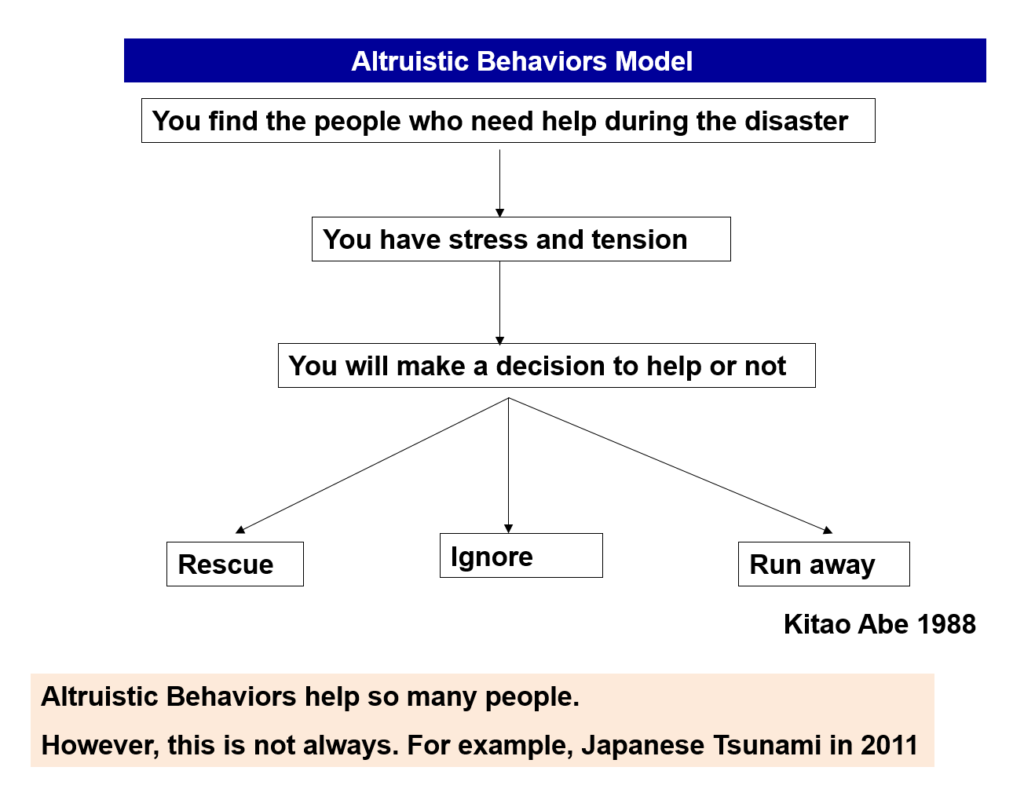
altruistic behaviors

To know the altruistic behaviors, the below book can be checked.

Altruistic Behavior: A factorial analysis of determinant variables: Altruistic Behavior: is it a function of environmental factors?

Day_57 : Normalcy Bias

We tend not to admit unusual situation. This is the crucial point for disaster risk reduction. In Japan, there are so many true stories about the bias as follows:

So many victims told me “I thought I was ok, that thing (Fooding) would never happen to me, ” even if their neighbors were already affected.                                         – Researchers Note-

The very insightful information was found from the following site:
https://geroldblog.com/2013/04/26/beware-your-dangerous-normalcy-bias/

The followings are from the above Gerold Blog:
C) When Mount St. Helens volcano began rumbling in Washington State in 1980, Park Rangers issued warnings for resident to leave and blocked access to keep people out. Some residents ignored evacuation warnings and other campers and sightseers walked or drove around the barricades to get into the park. They’d always camped there and since there had never been a disaster before; their normalcy bias prevented them from understanding the possibility of one happening. Then the volcano violently erupted and 57 people were killed.

D) Before Hurricane Katrina hit New Orleans in 2005, inadequate preparation by both governments and citizens as well as constant denials that the levees could fail are an example of normalcy bias as were the thousands of people who refused to evacuate. After the hurricane, many of the Louisiana Super dome refugees were unable to cope with the disaster. Many people couldn’t understand that a hurricane could devastate their city and, unable to help themselves, they waited in vain for government help that never came as murders and rapes escalated, sewers backed up, and food and water ran out. Normalcy bias left them unable to deal with the disaster.”